


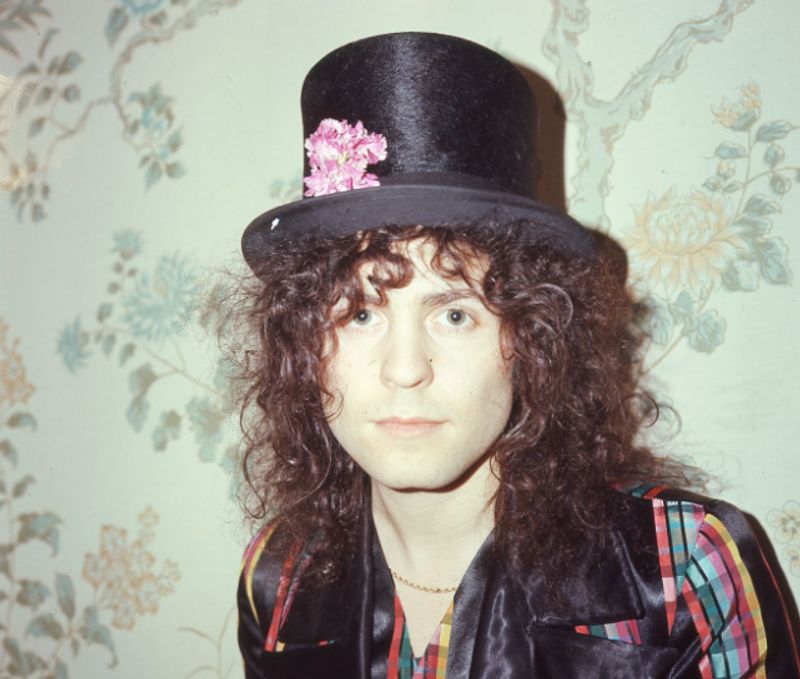
Investigating the claim that Marc Bolan invented rap

“People say that’s the first rap record,” Tony Visconti says while clutching T-Rex’s 1971s album Electric Warrior—an album he produced no less. “I don’t say that, but people say it,” he importantly adds. It isn’t the first rap record, in short, not to stop the car before it got started, but there is a slew of precursors and other contributing factors that led to rap before you get to Marc Bolan’s spitfire verse on the track ‘Rip Off’. However, it’s highly notable that many esteemed folks within the industry claim that it is, and we’re investigating why.
Firstly, ‘Rip Off’ is a frantic affair. The same year it was released, Gil-Scott Heron rattled off the proto hip hop masterpiece Pieces of a Man which included the resplendent rap-like epic ‘The Revolution Will Not Be Televised’. However, some folks find this rather leisurely to be considered rap. The argument is that if it was just about singing fast then you could opine that Bob Dylan was a rapper and all the quick-talking blues before him. However, ‘Rip Off’ has the vital air of revolution in its ferocious wake.
The problem with that is that initial iterations of rap in earnest weren’t as pointedly punk as it soon became. It was on August 11th, 1973, that all the elements of Hip Hop coalesced into the earliest form of the genre. On this date, at 1520 Sedgwick Avenue DJ Kool Herc threw a back-to-school party with his sister Cindy Campbell in the ground floor recreation room and a cultural movement was seeded from the humble beginnings of two turntables in full flow, a sanguine hum in the atmosphere and a space awash with breakdancing, graffiti artists, DJs and MCs.
That auspicious evening Herc took to spinning the same record on two different turntables to create a longer breakbeat so that dancers could all get a share of the stage. At one point, Coke La Rock grabbed hold of a microphone and yelled out the names of his friends to the rhythm of the music. In the process, he unwittingly became perhaps the first-ever rap MC and pioneered a tradition that continues to this day.
Thus, while the feel might have been more celebratory than Bolan’s belting anger, he did inadvertently capture some of the structure that has remained a mainstay to this day. Generally speaking, a lot of rap choruses are a mere 8-16 bars and frequently repeat the refrain twice to break up the flow of rapid verses. This is, in a way, what Bolan employs on ‘Rip Off’. He furious rattles off a long verse then bookends it simply by shouting, “It’s a rip off, it’s a rip off.” Unlikely most rock singles, the emphasis here is on the verse rather than the brief refrain.
Moreover, the topline melody of his repeating verse tone has a stringent meter. In rap, this is known as the flow. He keeps the flow very disciplined on the track—hitting the bars with each new line. This repetition is key, not least because it drove home the point of what Bolan was doing.
Lastly, there is also a sample backbeat feel to the track. Guitar strums are very deliberate and repeat just a few notes in each sequence. All the while, brass adds a flourish that plays over the top of the track, almost in isolation of the constituent parts. However, despite this, it still sounds very much like a rock song in a derivation sense. Far from the clean, distortion-free sounds that early rap used almost exclusively.
Thus, there might be many structural similarities between ‘Rip Off’ and rap, but in many ways, it’s apples and oranges. The fury of Bolan’s delivery is more of a take-home than the structure itself, and that is likely to have inspired more punk than it did rap, albeit they are both parts of the same coin, so the beat goes on in the cycle of music.
