


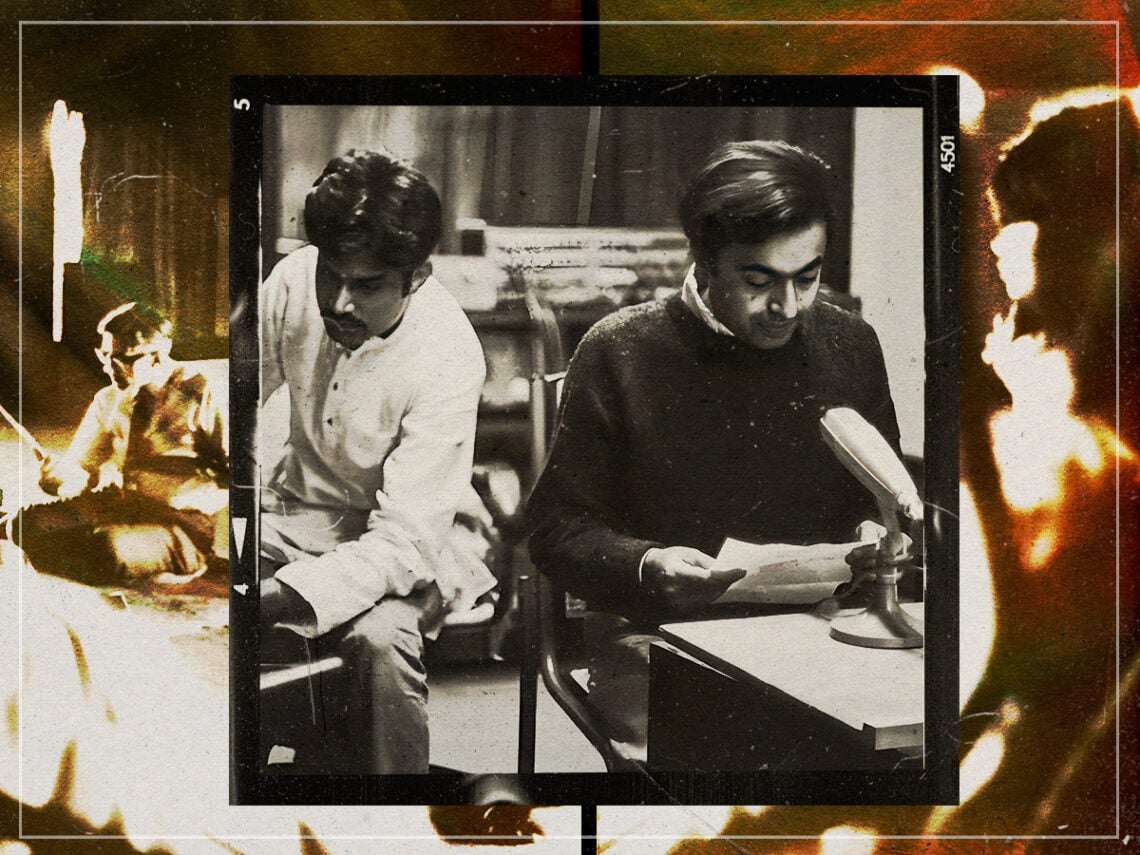
NID Tapes: The Indian musicians who pioneered electronica in the 1960s

In the years immediately following the independence revolution in India, the country’s culture began to fundamentally change. Western influence became more pronounced as the country’s art, cinema, and music began to shift rapidly. When the 1960s rolled around, the synthesiser revolution was primed to affect India in a major way. Around the country, various composers and experimental minds began to adopt the still-primitive synth as their instrument of choice for what would eventually become electronica.
At the National Institute of Design in Ahmedabad, New York-based composer David Tudor arrived with a Moog modular system. Tudor had been an experimental music pioneer in the United States, most famously working with John Cage to stage some of his most famous works. The first Moog synth had only been built less than half a decade prior when Tudor sought to establish one of the first foreign music studios at the NID.
Across roughly three years between 1969 and 1972, Indian composers like Gita Sarabhai, I.S. Mathur, Atul Desai, S.C. Shama and Jinraj Joshipura made their way to the NID for their chance to experiment with the Moog. Sarabhai, a master of the pakhavaj drum, had previously traded musical lessons with Cage in New York.
“She studied contemporary music and counterpoint with me. She said, ‘How much do you charge?’ I said, ‘It’ll be free if you’ll also teach me about Indian music.’ We were almost every day together,” Cage later recounted, as quoted in the book Indeterminacy. “At the end of six months, just before she flew away, she gave me The Gospel of Sri Ramakrishna. It took me a year to finish reading it.”
With the freedom that the academic programme provided them, the composers were given chances to pioneer new forms of music. Most of the artists who used the synthesiser started by simply attempting to understand the intricacies of the complex instrument. Numerous weeks were spent understanding the input process and various modules that made up the Moog. Once the initial stages of familiarity were complete, the composers began to create full pieces and experimental movements with the synthesiser.
While almost all of the composers used similar modes to traditional Indian music, a strong majority of them incorporated rhythms and progressions that were favoured by Western musicians. This blend lent itself to early versions of what would later be described as electronica and dance music. The programme came to an end in 1972, just as foreign rock music was gaining new traction among Indians.
The tapes of the various experiments with the Moog synth were held in the archives of the NID for years. Upon repeat visits to Ahmedabad to learn about India’s electronic history, however, British musician Paul Purgas discovered the tapes. He started a laborious process of restoring, digitising and mastering the collection into what eventually became The NID Tapes: Electronic Music from India 1969–1972, a compilation album featuring work collected from the brief time when India was a leader in the development of electronic music.
Check out The NID Tapes: Electronic Music from India 1969–1972 down below.
