


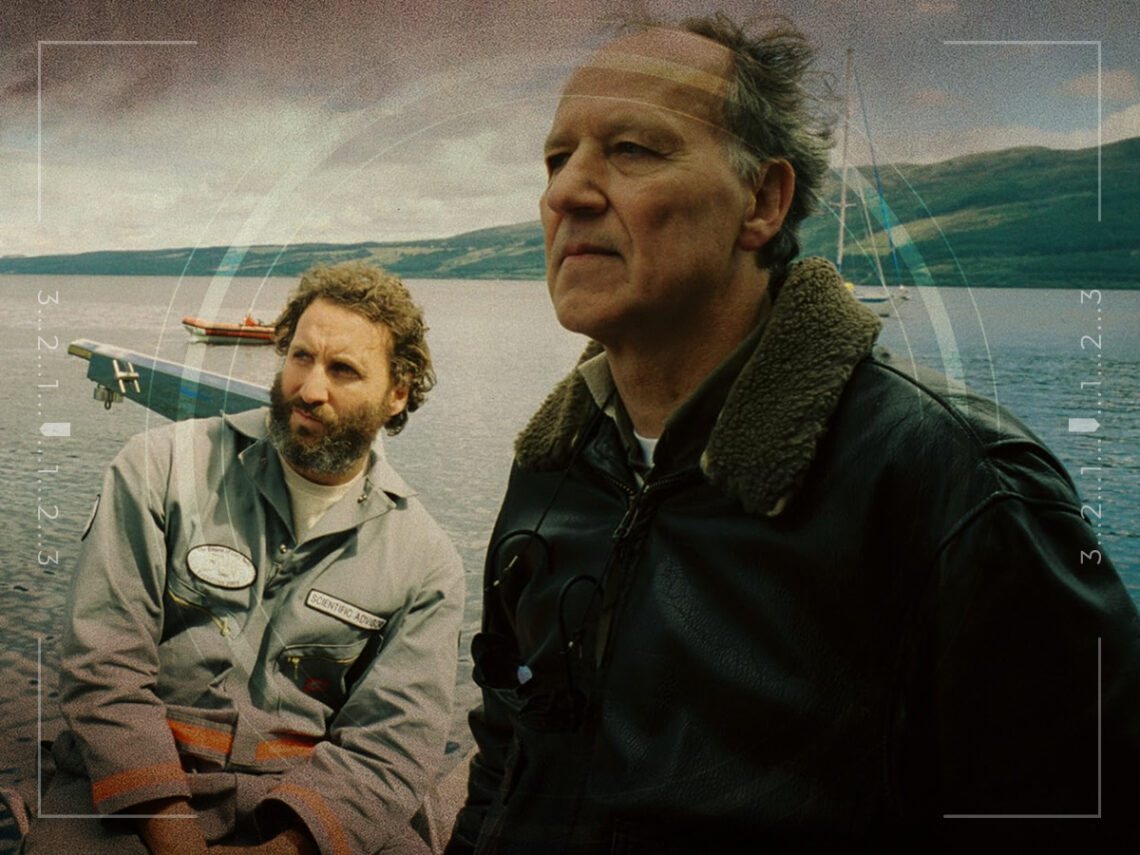
‘Incident at Loch Ness’: the moment Werner Herzog proved he was in on the joke

Most documentary filmmakers try to stay out of the spotlight, but Werner Herzog often places himself front and centre. He doesn’t even have to appear on the screen to be the main character. With his thick German accent and tendency to veer off onto existential tangents, his presence is unmistakable and a key draw for most of his films.
Over the years, the legend of Herzog has grown into cult-like proportions for arthouse types, but he has also drawn his fair share of controversy over allegations that he exploits his cast and crew on various productions, blurring the lines between fact and fiction. To that latter criticism, he has posited his own terminology, saying that cinema has the ability to create “ecstatic truth”. According to him, “truth does not necessarily have to agree with facts”, but can exist as a poetic moment of understanding between a film and its audience.
All of this can be pretty eye-roll-inducing for anyone who doesn’t worship at the altar of Herzog, but in the 2004 mockumentary Incident at Loch Ness, the filmmaker revealed that he does not, in fact, take himself as seriously as some of his fans do. Directed by Zak Penn, it’s a film within a film within a film. Penn plays himself, a screenwriter who is producing a (fictitious) Herzog documentary called Herzog in Wonderland, in which the legendary filmmaker intends to explore the enigma of the Loch Ness Monster.
The production of the film is captured by a crew of (fictitious) documentarians who follow the breakdown of the project as Herzog realises that the producer is tampering with the facts. For starters, Penn hires a fashion model to pretend to be a sonar specialist. In one scene, she strips down to an American flag bikini, pours a bottle of water over herself, and leaps into the loch for vague scientific reasons. Penn has also created an animatronic version of Nessie in the hopes that Herzog will believe it to be the real deal. During one expedition into the loch, however, something lurks beneath the water, and everything goes haywire.
Penn wrote the premise of the film but allowed the actors to improvise the bulk of the dialogue, adding to the sense of authenticity. Herzog proves to be a master at playing himself, refusing to suffer fools gladly, never resorting to the kinds of tantrums that would instantly invalidate his performance. Even when he’s improvising, he sounds exactly like one of his own voice-overs.
Adding to the confusion about whether the film is a documentary or a mockumentary is the fact that the crew is made up of recognisable real-life figures. Cinematographer Gabriel Beristain plays himself, as does two-time Oscar-winning sound mixer Russell Williams II. Even Kitana Baker, who plays the supermodel sonar specialist is playing a version of herself.
Not surprisingly, the press fell for the ruse even before the movie started filming, announcing that Herzog was headed into production of a documentary about the Loch Ness monster. Perhaps its subtlety is to blame for the fact that it hasn’t garnered nearly as much attention as it deserves. Brilliantly paced and performed, it is one of the greatest and least hammy mockumentaries of the past few decades, moving from low-key showbiz satire to disaster movie with surprising ease.
Its greatest coup of all, however, is Herzog. The director has acted before, most notably when he played the baddie in Jack Reacher, but never has he deserved an Oscar more than for Incident at Loch Ness. Perhaps, as some of his critics have said, Werner Herzog has always just been a performance.
Either way, however, it’s clear that he’s in on the joke. Towards the end of the movie, he voices his regret that he ever sought to make Herzog in Wonderland. He hadn’t started the project expecting to find the monster, he explains, so the outcome was strangely unfulfilling. “The truth was not ecstatic,” he laments, “It was vulgar and pointless”. As far as Incident at Loch Ness goes, nothing could be further from the truth.
