


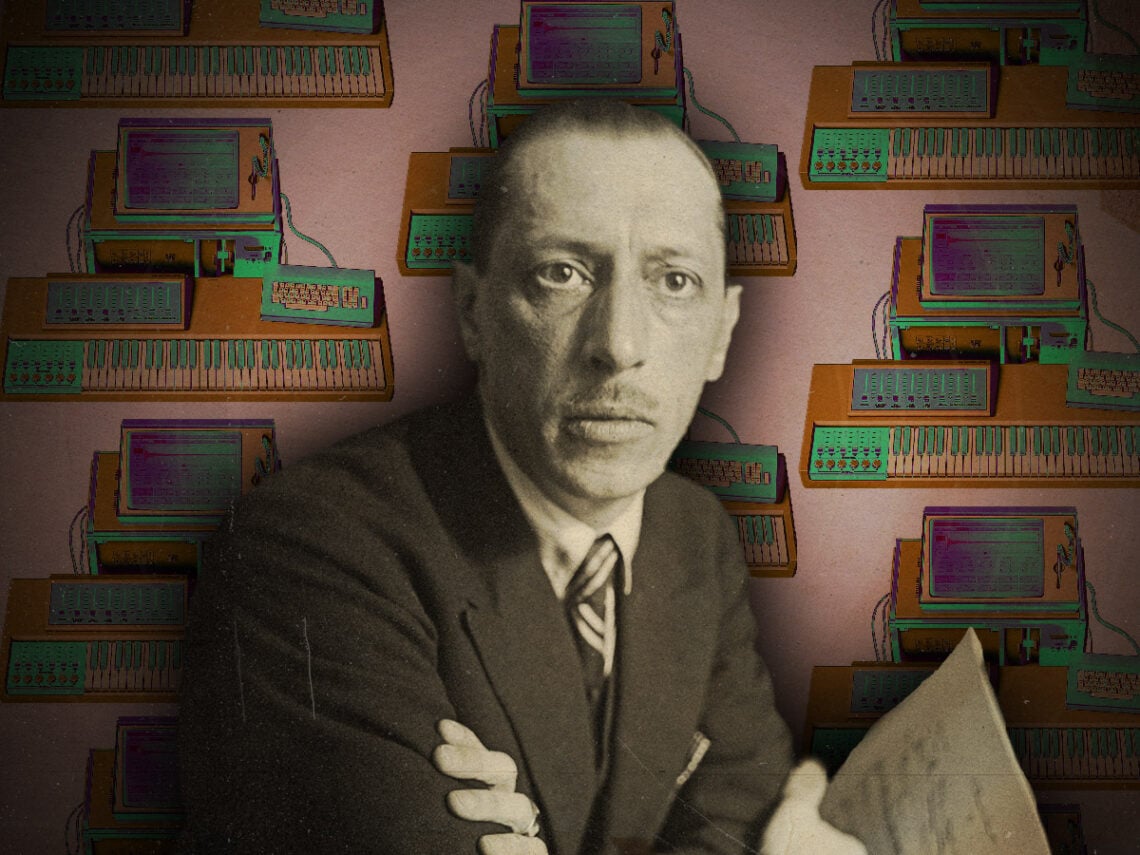
How Igor Stravinsky became the father of 1980s pop

What does Britney Spears have in common with an orchestral composer from Tsarist Russia making music 90 years before she did? The most diffused musical sample on the first sampling machine to ever be invented might have some stake in answering that.
It all started when Igor Stravinsky was commissioned to compose ‘The Firebird’ for the Russian ballet. The suite tells the folk tale of the eponymous firebird, a mythical bird that appears in a number of Russian fairytales. Although Stravinsky was initially unhappy with his first full-length ballet, the composer went on to have overnight success following the ballet’s debut at the Paris Opera in 1910, turning the St Petersburg native into a pivotal influence on 20th-century classical music.
A record of his earliest success happened to be resting on a shelf in Sydney 65 years later, when electronic music aficionados Kim Ryrie and Peter Vogel set to work on manufacturing the world’s greatest synthesiser.
The Australian duo started ‘Fairlight’, a business which quickly turned on its heels in realising that the sound of real instruments is quite challenging to replicate. By mapping a single piano note on a keyboard into different pitches, they pivoted instead to inventing sampling, for which they coined the name we still use for the process today.
The duo created the Fairlight CMI machine, for ‘computer musical instrument’, to mechanise the operation. The machine was fairly bulky and had limited storage, but it allowed a sample to be reproduced into different pitches and versions in real time. Although Vogel referred to it as “a lazy shortcut”, it blew many minds, from Peter Gabriel’s to Herbie Hancock and Stevie Wonder, who all eagerly awaited its first version. From Kate Bush to Duran Duran, the Fairlight CMI was used by musicians for decades to come.
But before the machine was ready to be packaged and sent off to make a £130,000 dent in the wallets of music’s finest (in today’s money), Ryrie and Vogel realised they needed to fill it with some stock samples: “We started sampling whatever we could lay our hands on, see how it would sound when you played it back at different pitches.”
Taking heed of what was nearest at hand, Vogel told the Sydney Morning Herald: “I happened to have this record on the shelf, I recorded the first half a second of one of the tracks, it was the whole orchestra playing a big chord” – that being the opening of the ‘Firebird Suite: Infernal Dance of Kastchei’.
That ‘Firebird’ sample, referred to as ‘Orch2’ on the machine and forever again since then, became a staple of music production for decades. As time went on, it was refined with technological improvements and became featured on iconic songs like Madonna’s ‘Vogue’, ‘Ridin’ by Chamillionaire and Krayzie Bone, ‘Lucky’ by Britney Spears, and Prince’s ‘It’. Robert Fink from UCLA told Vox: “[‘Firebird’s opening second] is basically a gesture for the orchestra, it shocks the hell out of you.”
Stravinsky’s small fraction of a sonata paved the way for the 1980s, ’90s, and even naughties classics not to sound as artificial as synthesisers would have done, while making us dance until the present day.
