


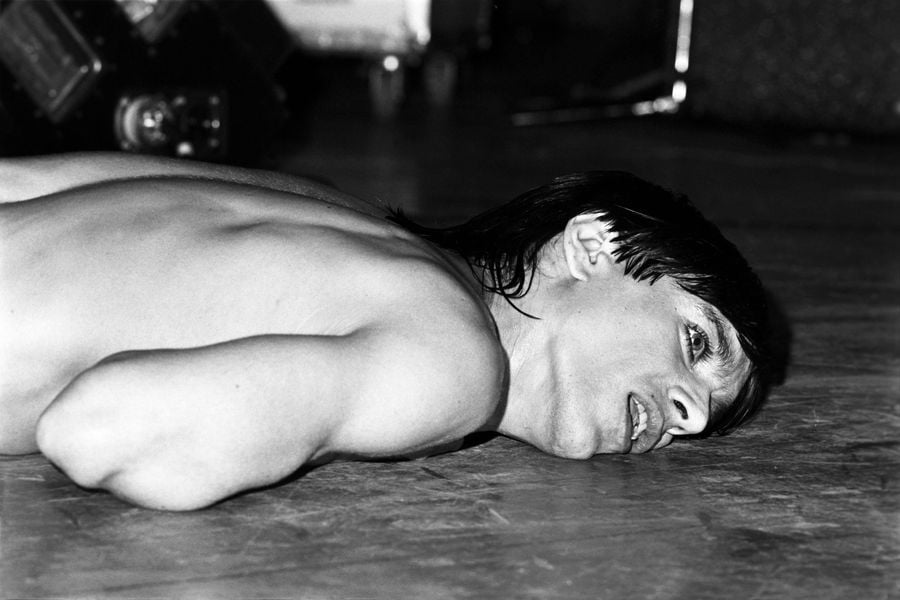
Iggy Pop names the band that “nobody could exceed”

While Iggy Pop made fame and fortune as a provocative proto-punk vocalist, he began his musical journey as a drummer in his middle-school marching band in Michigan. Iggy’s supportive parents, James Osterberg and Louella Christensen, kindly cleared their master bedroom to create a practice area for their son. His first band at school was Megaton Two, which offered classic R&B vibrations with hints of surf-rock.
In 1965, Iggy and his bandmate Jim McLaughlin teamed up with a more aspirational group of musicians, The Iguanas. The group of high school students earned $55 a night supporting gigs for popular groups, including The Four Tops, The Guess Who, and the Shangri-Las.
While The Iguanas weren’t prolific in the studio, they recorded a few covers, including Bo Diddley’s 1957 single ‘Mona’ and The Kingsmen’s ‘Louie Louie’, which heard Iggy on vocals for the first time. They also laid down an original single written by Iggy called ‘Again and Again’.
By the end of 1965, Iggy began to wear his hair long, dying it platinum blonde. The shift in appearance coincided with increased flirtations with the wrong side of the law, leading to his banishment from Club Ponytail, The Iguanas’ gigging haunt. Iggy soon left The Iguanas to join Prime Movers. It was at this point that James Osterberg Jr became Iggy Pop, named after his previous band.
As Iggy progressed, briefly with The Prime Movers and most notably as the frontman of The Stooges between 1967 and ’74, he departed from his roots in surf-rock and traditional R&B music. The coarse, provocative sounds thrown up by The Stooges joined forces with those of The Velvet Underground and New York Dolls to form the foundation of punk.
Despite this vital sonic transgression, Iggy and the Stooges remained loyal to their childhood influences, and in some of their tracks, the strains of surf rock DNA can still be heard. These similarities, of course, mainly reside in the rhythm section; I don’t profess that Iggy’s vocal style could be compared with The Beach Boys’ twee harmonies.
Over the 20th century, Iggy explored the realms of art rock with David Bowie and brought heavy rock to the masses with Stooges reunions, but his deepest affections still appear tethered to his youth.
On Brian Wilson’s website, Iggy is quoted as saying, “The Beach Boys were probably underrated in many ways because their rock forays were on the light side. But when it comes to melody and touching your heart with a ballad, nobody could exceed them.”
Here, the Godfather of Punk highlights the importance of such formative soft rock groups in the genesis of heavier styles. Naturally, Iggy wasn’t alone in his sentiments. Lou Reed, another architect of the punk rock movement, who rarely endorsed his peers, also lauded the influence of the surf-rock legends.
“Will none of the powers that be realise what Brian Wilson did with the chords,” Reed said. “Deftly taking from all sources, old rock, Four Freshman, he got in his records a beautiful hybrid sound – ‘Let Him Run Wild’, ‘Don’t Worry Baby’, ‘I Get Around’, ‘Fun, Fun, Fun’ – and she had fun, fun, fun ’till her daddy took her T-bird away.”
In 1969, The Stooges released their classic eponymous debut album, best known for ‘I Wanna Be Your Dog’. Elsewhere on the album is the lively hit ‘No Fun’. Reflecting on the track in a past interview with David Fricke at SXSW, Iggy noted its links to songs by The Rolling Stones and The Beach Boys.
“When Ron started jamming the chords in ‘No Fun,’ I knew instantly that we would be in the book,” Iggy recalled. “As for the lyrics of that track, I always thought that ‘no’ is a great word. One of my favourite parts of the Rolling Stones’ ‘Satisfaction’ is when Mick goes ‘No no no’. And then, on the other hand, you had the Beach Boys, another great band, who had this song where they kept repeating ‘Fun, fun, fun’, so I thought to myself, ‘Well, there you go.'”
