


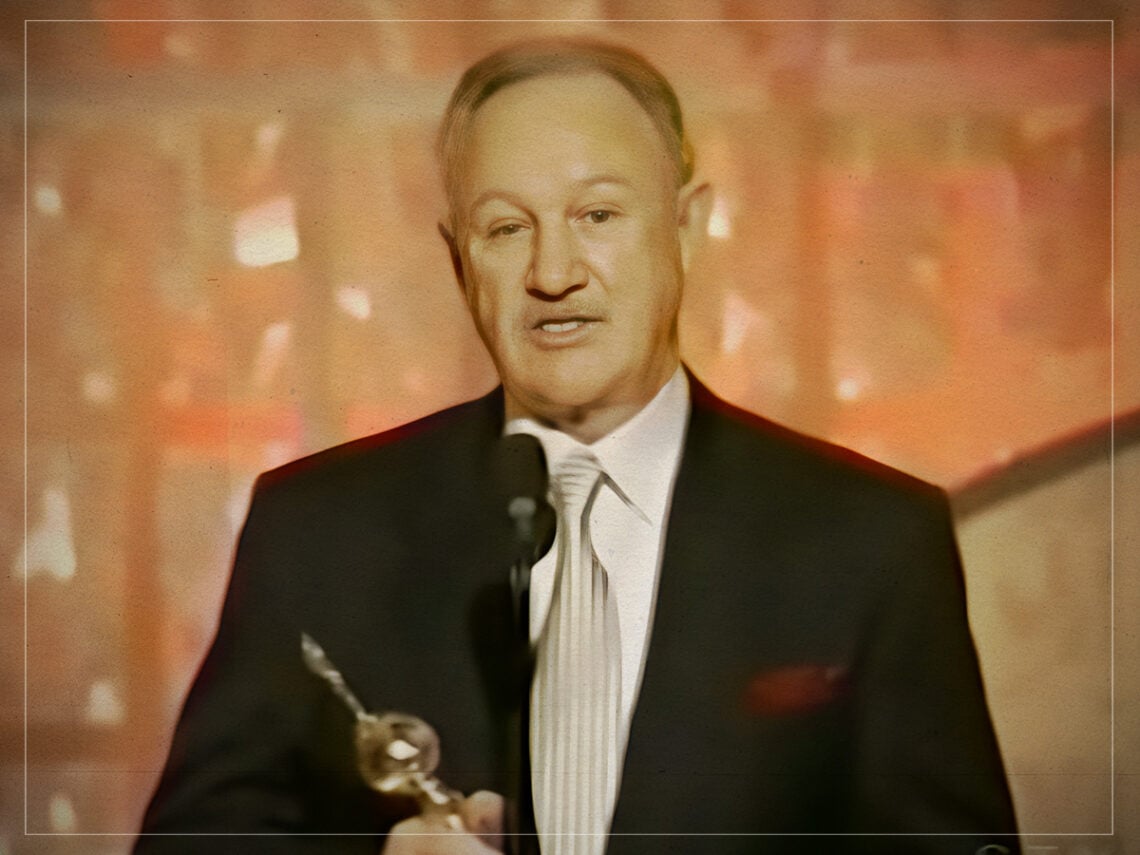
The icon who made Gene Hackman want to be an actor: “I saw some kind of kinsmanship”

Gene Hackman had an incredible run during the 1970s, appearing in movies like The Conversation, Young Frankenstein, Night Moves, and The French Connection, with the latter winning him an Oscar. The actor had earned his first nomination in 1967 for the era-defining Bonnie and Clyde, in which he played Buck Barrow, marking a true turning point in Hackman’s career.
Until then, he had starred in a few small parts across television, film, and theatre, hoping to make his way into Hollywood, but he was initially told he was never going to make it. It’s a tale as old as time – a star who has since gone on to win plenty of awards was told when they were younger that they’d have no chance – and Hackman certainly proved his classmates wrong.
The actor knew he had it in him to make it as a star, and he credits a certain acting icon as his main source of inspiration. Talking to Film Comment, Hackman revealed, “I really started in the business because of [Marlon] Brando, I suppose. I saw in Brando some kind of kinsmanship, not because of the way he looked, but something inside him that let me say: ‘I can do that.’ I’m sure that’s why he has such a following.”
He added, “People see in him some kind of strength, some kind of strength that could be an everyday attitude. Although he’s not a common man at all. He’s not your ordinary off-the-street guy. I mean, there’s a lot more to him than that.”
Brando rose to prominence in the early 1950s with his role as Stanley in A Streetcar Named Desire, a character he originated on Broadway before reprising the part for Elia Kazan’s film. He earned an Oscar nomination for his performance, shooting his way to stardom by quickly following it with further acclaimed roles in films such as The Wild One and On the Waterfront.
It’s no surprise that Hackman has cited Brando as one of his ultimate inspirations; the actor is routinely labelled as one of the most influential stars of all time, emerging as a star with considerably more realism and grittiness to him compared to many of the icons who had come before him. He wasn’t interested in shiny classic Hollywood roles, often playing rebels and villains with a truthful sensibility. Popularising method acting and fully immersing himself in many of his characters, Brando was a key figure during the 1950s, although his popularity began to wane in the late 1960s and early 1970s.
Yet, following a career-defining role as Vito Corleone in The Godfather, the actor got back on the horse, and Francis Ford Coppola even offered him a role in his next film, The Conversation. Brando turned it down, however, leading Hackman to the part.
Eventually, the pair got to work together in 1978’s Superman, with Brando playing the father of the titular character, Jor-El, while Hackman played the antagonist Lex Luthor. Hackman was surely delighted to be able to appear in the same movie as one of his acting icons – he might not have got there without him.
