


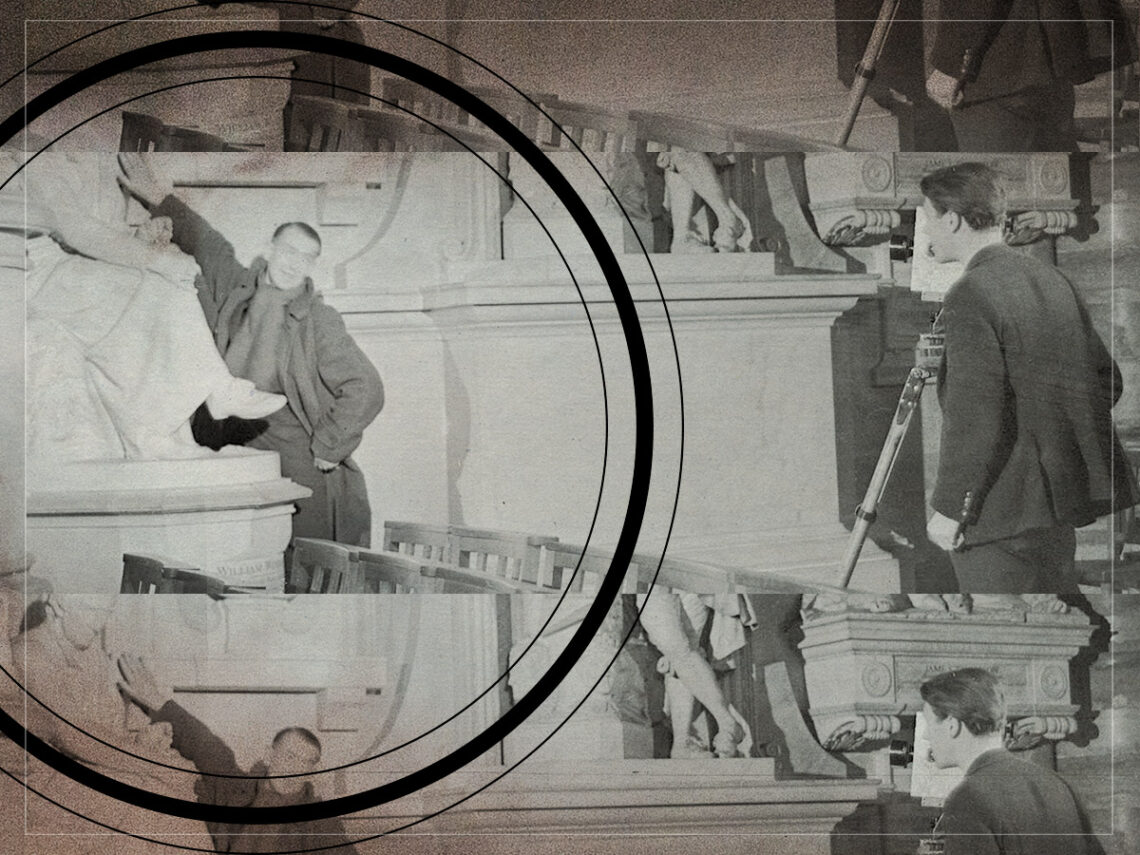
Humphrey Jennings and his “legacy of feeling”

Widely considered to be British cinema’s war poet, Humphrey Jennings was a documentary filmmaker who also made significant contributions to photography, modern art theory, and painting. Despite an untimely death at the age of 43 while scouting film locations, Jennings is credited with making a significant contribution to both British cinema and the broader intellectual landscape of the 20th century.
Born to Guild Socialists, Jennings’ was educated at Cambridge and was en route to a successful academic career when he dropped his post-graduate studies to pursue a career in the GPO film unit. The film unit of the UK General Post Office mainly produced sponsored documentary films related to the GPO. Apparently only joining to support his family and often disregarded as a dilettante, he was criticised by his fellow documentary filmmakers as too experimental.
However, what was considered by many then as too experimental and surreal has now become central in modern and contemporary filmmaking. Using his pioneering technique of associative montage, his documentaries had such a distinctive, almost mystical portrayal of real life that he is credited as being one of the innovators of the poetic documentary. Associative montage is the technique of juxtaposing seemingly unrelated visuals and sounds to create a deeper symbolic meaning, it has become such an integral part of filmmaking today that it is almost ubiquitous. It became a hallmark of his style and was exemplified in his most famous short film, Listen to Britain.
As with Listen to Britain, Jennings used these experimental film techniques to explore the complexities and diversity of English identity and life in Britain. He connected disparate elements such as industry and art to capture the social realities of his time and place, often portraying everyday life in surreal ways. In fact, he was so involved in the surrealist movement in Britain that he helped to organise the 1936 International Surrealist Exhibition in London.
He saw surrealism as having replaced “apparations” with “coincidences”, which he viewed as having “the infinite freedom of appearing anywhere, anytime, to anyone: in broad daylight to those whom we most despise in places we have most loathed: not even to us at all: probably least to petty seekers after mystery and poetry on deserted sea-shores and in misty junk-shops.”
Using his surrealist approach, he made Spare Time, a short film documenting the working-class leisure pursuits of the British working class, which was shot with minimal commentary and much of his early montage work. But, for Humphrey, the biggest Surreal pursuit was in documenting wartime Britain, which served as a major source of his “coincidences” given the fact that the landscape was constantly being changed and remade. His 1941 documentary Words For Battle imaginatively overlaid a soundtrack of passages from John Milton, Rudyard Kipling and William Blake with images from wartime Britain. His work often utilised literary works, with his last major work even being narrated by the writer EM Forster.
Jennings’ films often avoided conventional narrative techniques, opting instead for a ruminative, questioning style where commentary and visuals entered into a dialogue. This approach allowed Jennings to capture the emotional and cultural landscape of Britain, creating what he called the “legacy of feeling” that reflected national identity.
This ‘legacy of feeling’ is one that can still be felt today, with much of what was experimental in his work being utilised in mainstream filmmaking of the 21st century. While Jennings is relatively unknown to those who aren’t filmmakers, he is continually celebrated by scholars and academic institutions, such as the British Film Institute. The writer Frank Cotrell Boyce even cited him as an influence on the 2012 London Olympics Opening Ceremony, demonstrating the long-lasting legacy of the short-lived legend.
