


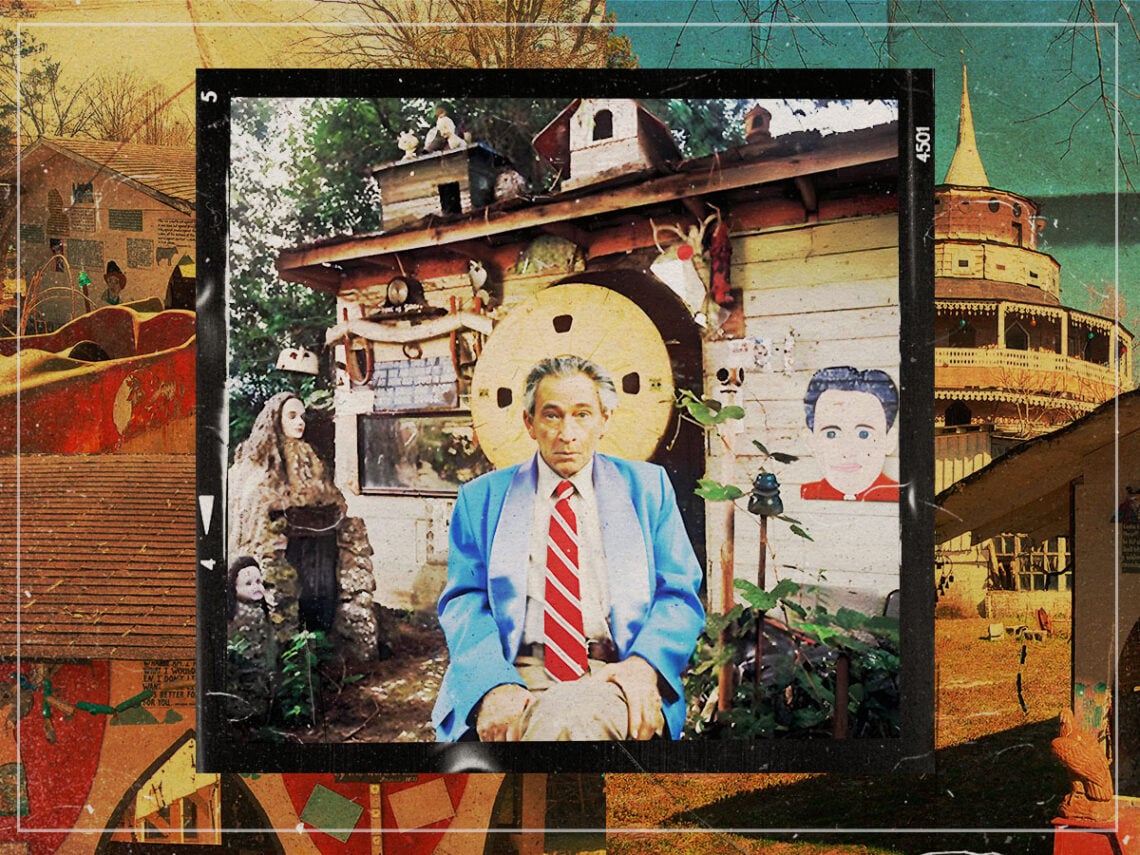
Exploring Howard Finster’s Paradise Garden

In 1976, Howard Finster found himself staring at the tip of his finger and communicating with God. He was patching up an old rusty bike, rubbing a patch of white, when he saw a tiny face appear in the paint. A warm, almost familiar feeling overtook him. “Paint sacred art,” the face instructed. Finster, who was 59 at this point, was a veteran of these visions. But the face in the paint instilled a sense of urgency, and the retired Baptist preacher dedicated the rest of his life to the Paradise Garden.
He was no stranger to spreading the word of God in various gardens. Before the Paradise Garden was the late ’40s park in Georgia, which displayed all of mankind’s greatest inventions, and then the Plant Farm Museum, designed like the Garden of Eden. Key features included the Bible House, the Bicycle Tower, and the Folk Art Chapel.
It was on the second property Finster realised putting up signs with Bible verses written on them “stuck in people’s heads better”, a consistent theme in his artwork and garden décor.
As well as the signs, all his paintings were numbered. God had asked him to do 5,000 paintings, all spreading the gospel. Finster dutifully painted his way to the 5,000 mark a few days before Christmas in 1985 and then resolved to simply carry on. A few years later, he was in the tens of thousands. By his death in 2001 – not including any unnumbered artworks – he’d produced 46,991. It’s been said he didn’t sleep much.
And that’s not to say he was creating these with quantity over quality in mind, either. The art lining the Paradise Garden is detailed, often featuring handwritten Bible verses, as well as more unlikely appearances from pop cultural staples like Elvis and aliens. In a 1987 event at the garden, he explained it as simply as it was relayed to him via white paint.
“God called me here. I’m interested in every human being in this world,” he said. “I didn’t come here to put nothin’ on nobody, push nothin’ on nobody. I didn’t come here to take nothin’ away from nobody – I didn’t come here to start some new kind of religion. I come here for one thing, and that is, I have visions of other worlds. I have visions that’s unimaginable. I have visions that I can’t even tell people. And I try, the best I can, to draw my visions,” he concluded.
In the years following his death, the Paradise Garden experienced a resurgence in popularity. Although the property was ramshackle and overrun with artwork, to the point art has been literally dug up – its shabby charm saw a steady stream of visitors increasing year on year. The garden is a quaint, kitschy walk-through of Finster’s thoughts, just as he’d been told to paint them.
