


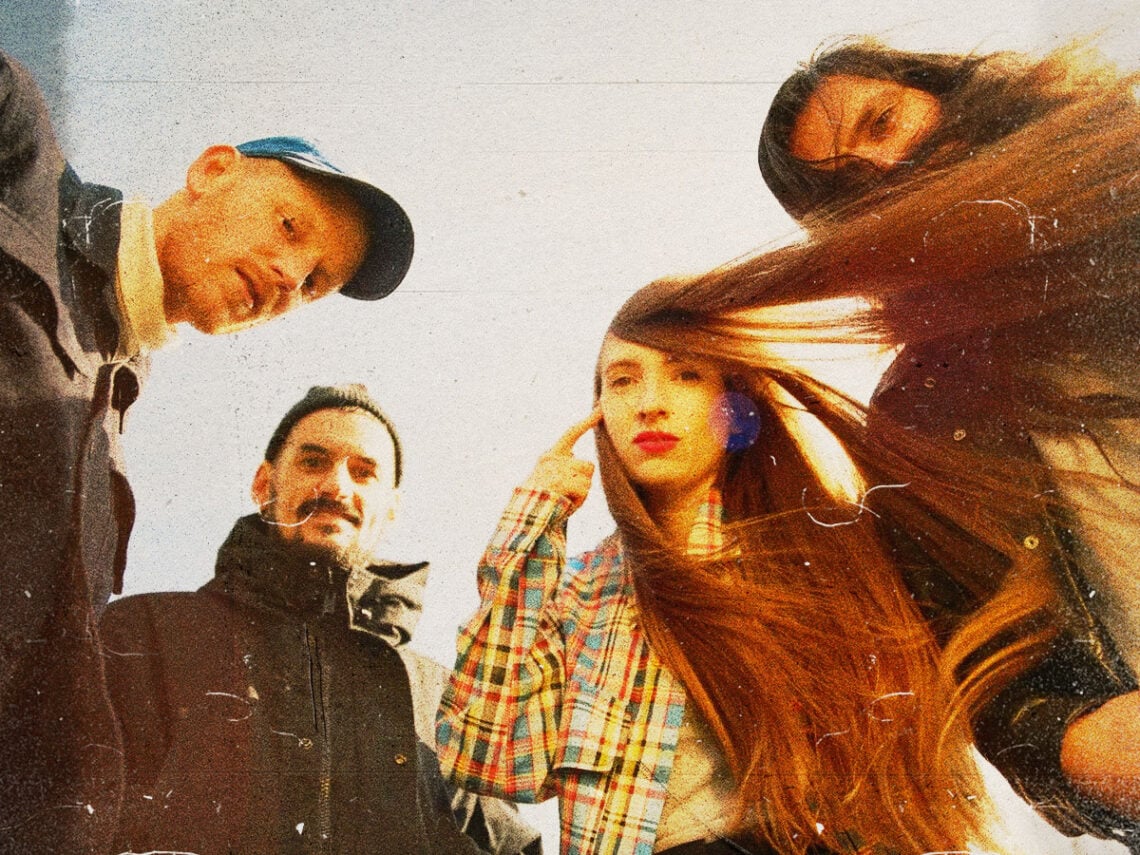
How to play guitar like Dry Cleaning’s Tom Dowse

Standing out in the crowded world of post-punk is not an easy task. Alternative music’s favourite modern genre seems pretty easy to make on paper: angular guitar riffs, spoken word vocals, crashing drums, and rubbery bass lines. Sounds simple, right? The astonishing thing about Dry Cleaning is that they check all those boxes without sounding anything like their peers. Much of that comes down to guitarist Tom Dowse… if you could even call him a guitarist.
“I don’t really think of myself as a guitarist,” Dowse told Total Guitar in 2022. “I play all day, and I love it. It’s a big part of my life, but I just can’t think of myself as one because I’ve never been interested in being technically any good! I’ve just tried to find my own language. I’ve always gravitated towards guitarists that sound a bit more abstract. I quite like not knowing too much about the guitar, so it’s always exciting.”
Across two albums of dense experimentation, Dowse has created walls of noise, scratchy riffs, heavenly soundscapes, and squeals that sound more like animals than instruments. All the while, bits of melody have crept into his work to counteract the monotone recitations of vocalist Florence Shaw. But no one in Dry Cleaning seems all that interested in traditional hooks, least of all Dowse, who seems to be fighting his axe as much as he is playing it.
With his trusty Gibson SG in hand, Dowse can frequently be seen hunched over his amp, forcing feedback and overtones out in any way he can. That usually means manipulating the neck of the guitar as well, pushing the craftsmanship of the SG to its very limits to see if it will reach a breaking point.
“That’s something I do with the SG a lot. I like to bend the neck,” Dowse explains. “I treat it quite badly, to be honest. I switched from a Silvertone 1478 back to my SG again, and it was so much more indistinct, almost like an ocean. There’s more space for the texture and weirdness I was going for.”
For the band’s debut, New Long Leg, Dowse came out swinging with plenty of distortion and overdrive at his disposal. But on tracks like ‘Scratchcard Landyard’, ‘Leafy’ and ‘Her Hippo’, Dowse also employed distinct layers of delay and chorus to give his sound more depth and dynamics. As the band approached their sophomore LP Stumpwork, Dowse leaned even harder into these textures, going for an atmospheric sound on songs like ‘Anna Calls From The Arctic’ and ‘Hot Penny Day’.
The latter track features some insane ringing tones, with discordant notes ricocheting off mountains of effects to create a jarring sonic effect. And if you think you’re crazy for hearing a twelve-string guitar across Stumpwork, you’re not.
“I’ve got a Burns Double Six which I really like playing. I’m a bit addicted to 12-string guitars,” Dowse told Told Guitar. “If I had the money, I’d start collecting 12-strings. I have a Roland JC-30 amp with built-in chorus, and sometimes I have a chorus pedal as well as the chorus on the amp, so it’s really crazy. That’s one of the reasons I like 12-strings – it’s like natural chorus.”
Apart from the Roland, Dowse’s other main amp is a Fender DeVille. While Dowse swears by the tones and sonics that he can get out of the amp, most players who use the DeVille have it on hand for louder live gigs as opposed to studio work. When Dowse brought the DeVille into Rockfield Studios to record New Long Leg, he sent producer John Parish into a state of disbelief.
“I’ve got a Fender [Hot Rod] DeVille 4×10. Most sophisticated sound people are horrified when they see that,” Dowse claimed. “As soon as John Parish saw it, he just shook his head, like, ‘Oh no, not that again!’ I really like them. I play live with the DeVille and an [Vox] AC30, with a different chorus pedal on each.”
Those chorus pedals form the main textures that Doswe achieved on Dry Cleaning’s two studio albums. “One is a Boss CE-5, the one people don’t like,” he said. “The good thing about the CE-5 is you can set the lower and higher frequencies separately. When I’m doing something lower down and more rhythmic, you don’t get a lot of chorus, then if I want to go higher up, it’s much more apparent.”
Ultimately, Dowse’s sound doesn’t have much in common with the rest of the post-punk world. Disliked amps and pedals, twelve-string guitars, and atmospheric approaches to guitar with little time for major distortion or boost puts Dowse in a league of his own, one that can be just as aggressive as any other post-punk guitarist with half the gear. The spontaneity, creativity, and skill mostly come from how Dowse uses his equipment, not how well the equipment can shape him.
