


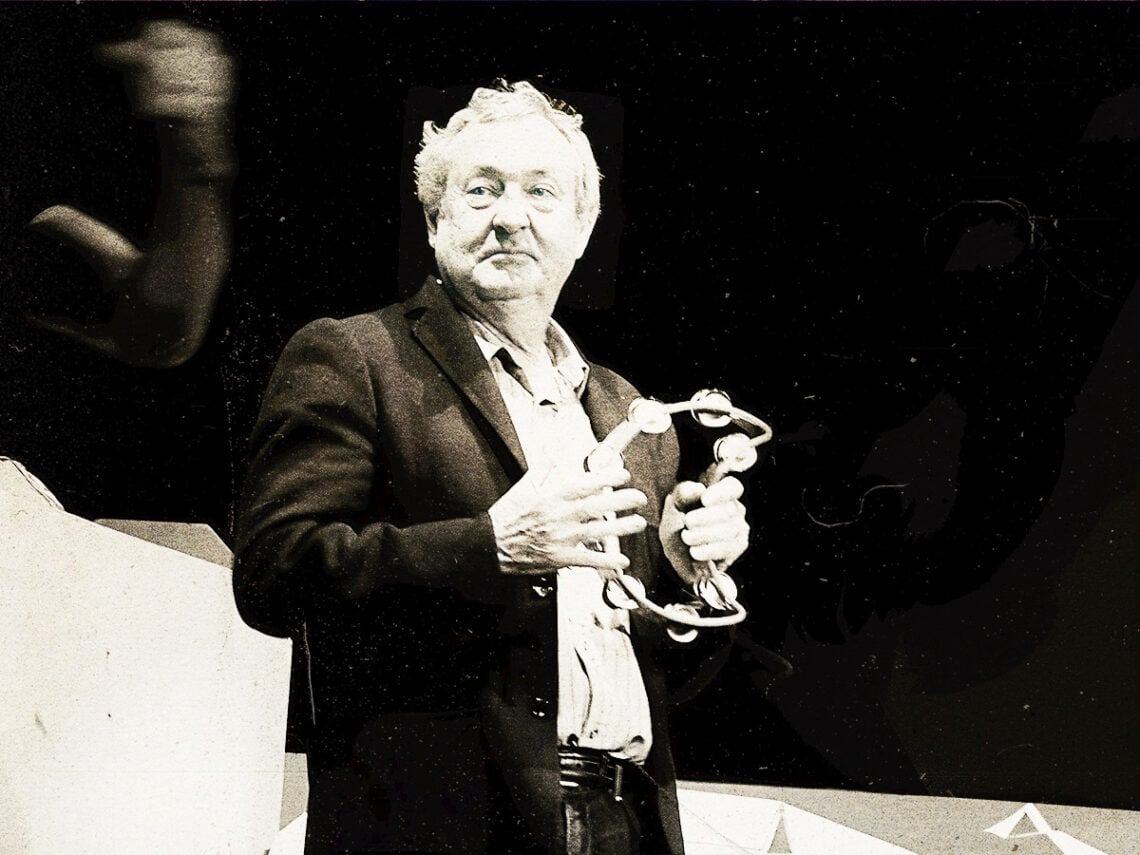
How to play the drums like Pink Floyd’s Nick Mason

When losing oneself in the gateway masterpiece The Dark Side of the Moon or the kaleidoscopic obscurity of The Piper at the Gates of Dawn, one can easily overlook the masterful work of Nick Mason. As the rhythmic backbone of Pink Floyd, undoubtedly one of the 20th century’s finest rock bands, the affable beat-keeper always knew just how much to add and when to add it, an oft-overlooked attribute.
Furthermore, as the longest-standing member of Pink Floyd, his role has mimicked that of Ringo Starr in The Beatles as a mediator in times of internal tension. Unfortunately, in the story of Pink Floyd, there has been no shortage of that. But a closer look at Mason’s style will unlock the secret to his talent.
Firstly, it is important to note that Mason is not a virtuoso on the level of Ginger Baker or Mitch Mitchell by his own admission. “I still feel that. I’m still learning to live with it,” he told The Drummer’s Journal in 2015 when asked if he really felt insufficient as a drummer. “It’s hard to know now, but if I’d had lessons, there’s an argument to say that I wouldn’t have played the way I did.”
Mason continued to note how a lack of technical knowledge can open new doors to a departure from convention. “The upside is I’m grateful to have developed my own style,” he pointed out. Like so many drummers before and after him, Mason discovered that there’s much more to creative drumming than virtuosity.
To understand Mason’s approach to drumming, a good place to start is his pool of influence. Like his favourite drummer, Mitch Mitchell of The Jimi Hendrix Experience, Mason was a jazz enthusiast who, awed by the virtuosity of genre icons like Buddy Rich, endeavoured to blend the intricate style into blues rock.
Speaking to Music Radar in 2010, Mason revealed his love for Mitchell and his jazz sensibilities. “In terms of style and rock drummers I like, it was Mitch Mitchell,” he said. “Whether it’s behind the beat or not, it’s so lazy, but it worked perfectly under Jimi and that slightly jazzy thing. There’s no one else like him.”
As a rock drummer with a jazz persuasion, Mason opts for a kit typically comprising both single and double-headed acoustic drums, tuned percussion, electronic drums and Rototoms. This extensive setup offers Mason a galaxy of intricate tones to adorn Pink Floyd’s often cinematic and ethereal compositions.
During Pink Floyd’s early chapters, Mason was heavy on the snares, often emphasising the second and fourth beats. This heavier approach can be heard prominently on 1969’s Ummagumma; the album’s first side was recorded during live shows, giving a snapshot of Mason’s live presence, which was generally a little heavier and more involved than in the studio.
When Pink Floyd released Meddle in 1971, its side two epic ‘Echoes’ lit the path for a more concerted future, namely the success of The Dark Side of the Moon two years later. This 23-minute offering was an all-around triumph, but too little has been said of Richard Wright’s keyboard composition and Mason’s newfound drumming command in the song over the years.
With his delicate studio approach maturing in the early ’70s, Mason abandoned the heavy snares in favour of a flatter, more subtle timbre. It is this approach by which Mason is recognised as an inspiration of his era. While his contemporaries lashed seven bells out of their skins, Mason observed a less-is-more mantra like his bandmate, lead guitarist David Gilmour.
With Mason’s gently swelling jazz-inspired approach under the belt, you might want to use the same brands as he has over the years. While he set out with Premier drums in the 1960s, he traded them for Ludigs in 1970, through Pink Floyd’s most celebrated spell until 1992. Today, he opts for Drum Workshop toms, pedals and hardware. Throughout his whole career, Mason has used Paiste cymbals.
Watch Mason discuss his modern setup, as used with his band Nick Mason’s Saucerful of Secrets, below.
