


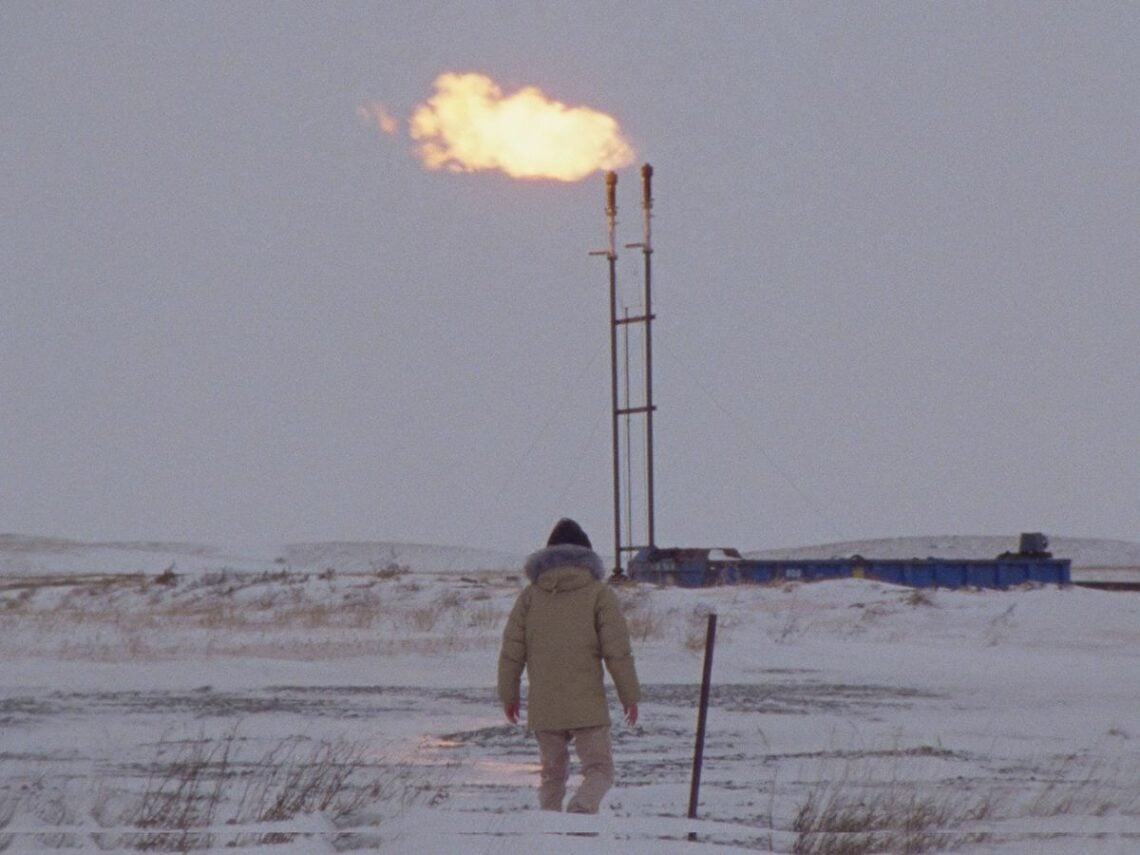
‘How to Blow Up a Pipeline’ movie review: A rarely thrilling eco disaster

Following his 2018 debut film, Cam, Daniel Goldhaber has returned with his second feature, How to Blow Up a Pipeline, loosely based on the non-fiction book of the same name by Andreas Malm. The book advocates for the validity of property destruction to achieve environmental justice; thus, Goldhaber’s fictional characters come together to do as the movie’s title suggests.
The eight characters are each given their own motivations for gathering in west Texas to destroy a pipeline, with their stories told through brief flashbacks. We learn that Sasha Lane’s Theo has been diagnosed with a rare form of leukaemia caused by living near an oil refinery, and Forrest Goodluck’s Michael, a young Native American, is angered by oil workers occupying his land. Whereas some characters have valid reasons for their destructive acts, others, like Rowan (Kristine Froseth) and Logan (Lukas Gage), seem to spend more time having sex and observing than actually rallying for the cause.
The trouble with How to Blow Up a Pipeline is that none of the characters are particularly likeable, and there is a distinctive amount of emotional distance between them and the audience. Perhaps the most likeable is Theo, who powers through her terminal illness to the best of her abilities to seek revenge, defiantly arguing against those who believe her efforts futile. However, each character is generally forgettable, perhaps due to the shortness and often ambiguous nature of the flashbacks.
Due to the weakly fleshed-out characters, it often feels difficult to root for any of them. Similarly, although their efforts are admirable, the characters fail to bring enough charge and complexity to their performances, making it hard to connect to their ambitions. Despite being dubbed a thriller, How to Blow Up a Pipeline is rarely thrilling. Instead, it teeters along with prolonged shots of the characters making and placing their bombs, set to a cliched techno-inspired score that gives the false impression of tension.
Every flashback scene was like a sigh of relief, acting as an escape from monotonous scenes of Goodluck dramatically frowning and concocting bombs or uber-American Dwayne (Jake Weary) perfecting a moody stare. Yet, these retrospective moments never seem to fully satisfy.
However, there are flashes of brilliance in Goldhaber’s film, such as an ambiguous twist that pulls it out of complete complacency. The movie captures a particularly relevant moment of environmental consciousness, and precise attention to detail is paid to bring this to life with realism. The over-saturation of internet users declaring the end of the world, shouting into the void without taking any action and creating widespread panic is captured well. Similarly, the cinematography is meticulous, moving between careful frames and shaky, tense close-ups, attempting to draw the audience closer to the action.
Unfortunately, Goldhaber could have done much more with the source material. Rather, How to Blow Up a Pipeline fails to pack the punch it needs to deliver its message, which is a real shame.
