


How The Cure influenced Tim Burton: “Really saved me”

With his captivating blend of the gothic and whimsical, Tim Burton has carved a niche for outcasts to see themselves in his peculiar worlds.
Across his filmography, attempting to choose a favourite is like choosing a favourite child. Who can resist the comedic horrors of 1998’s Beetlejuice, the macabre melodies of 2007’s Sweeney Todd: The Demon Barber of Fleet Street, or the tragic love story behind the animated 2005’s Corpse Bride, among the many, many other films that continue to craft the “Burtonesque” that fans know and love.
Burton’s penchant for the Gothic has permeated each of his films from the very beginning, seen in his 1982 short film Vincent, an ode to one of his heroes, the horror icon Vincent Price. But Burton’s work took a starkly personal turn when he began to conceptualise Edward Scissorhands.
“It first started out of those very simple, teenage impulses of the feeling of wanting to touch and wanting to communicate, but not being able to,” Burton reflected on the film’s beginnings, and the auteur’s suburban hometown in Burbank, California, exacerbated his feelings of alienation, and he found solace in the Gothic: literature, film and art, beginning to draw sketches inspired by the stories he absorbed, one being of a sullen boy with scissors for hands.
Having established his career as a filmmaker with the releases of 1985’s Pee-wee’s Big Adventure, 1988’s Beetlejuice and 1999’s Batman, Burton’s next project would see him personify the boy in his drawings. In 1986, he met writer Caroline Thompson and the two shared an affinity for gothic horror. Seeing Burton’s high school drawing, Thompson was immediately intrigued and thus came the story of Edward Scissorhands.

The film’s plot is centred in a town that emulates Burton’s own upbringing, a small, candy-coloured suburb where, on top of a hill, sits a decrepit Gothic mansion. An Avon saleswoman, Peg, enters the home to find Edward, a character not too dissimilar to Frankenstein in his own origin story. His inventor (played by Vincent Price, in one of his last film roles) died of a heart attack before being able to give Edward human hands, leaving him “unfinished” with large scissor blades for hands. Peg takes Edward home and adopts him into her family, and as he begins to fall in love with her teenage daughter, Kim, Edward is introduced to the strange outside world he had otherwise been secluded from, subject to both fascination and danger.
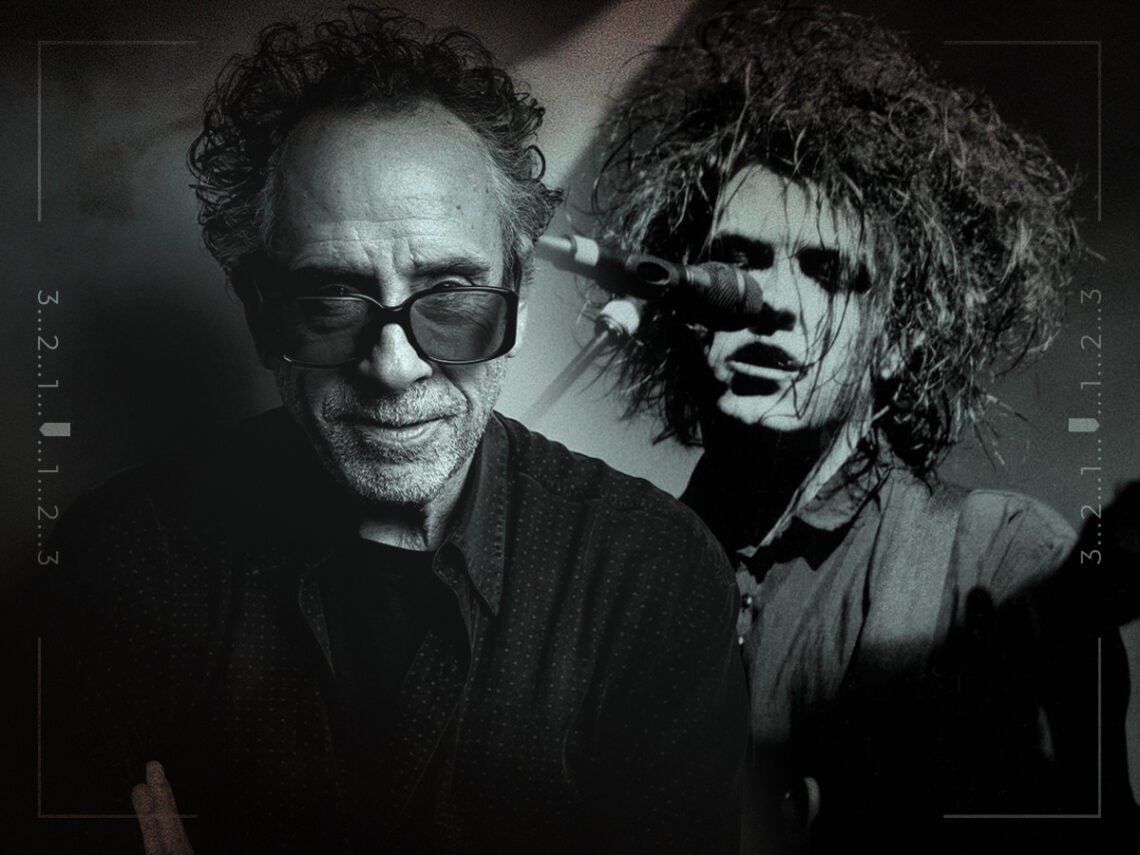
In the late 1980s, Burton approached one of his favourite bands to provide a soundtrack to Edward Scissorhands: The Cure. At the time, the band were recording their 1989 album Disintegration and were therefore too consumed to contribute, but their influence is evident in the eventual honing of the “Burtonesque” that would define the director’s distinct style. Even more apparent are the parallels between The Cure frontman Robert Smith’s signature look and the character of Edward Scissorhands, with unkempt black hair and all-black outfits making them two icons of the Gothic, in their own respects.
Burton would continue his attempts to get The Cure’s music featured in his films, approaching them to score his 1999 film Sleepy Hollow and keeping the band continually up-to-date with his projects, with Smith later contributing to two of Burton’s concept albums.
Burton has made his love for The Cure well-known, including when he presented Smith with the Shockwaves NME Godlike Genius Award in 2009. In his speech, he expanded on how, when he worked as an animator for Disney, “chained to a desk” and “fucking depressed,” The Cure’s music “was the only thing that really saved me”.
He concluded, “They spoke to anyone who felt strange and weird, and I just want to thank them for inspiring me.”
