


How Technicolor informs Alfred Hitchcock’s masterpiece ‘Vertigo’

Vertigo is considered by many to be one of Alfred Hitchcock’s greatest films, paving the way for countless movies in its wake that explored doppelgangers and obsession, from Body Double to Mulholland Drive. With its compelling performances from James Stewart and Kim Novak, a plethora of plot twists, an impressive score by Bernard Herrmann, and a strong visual identity, the film is simply a masterpiece of filmmaking.
The use of colour is hugely significant in Vertigo, although it wasn’t the filmmaker’s first time working with Technicolor. Ten years prior, Hitchcock had used the process for the first time to make Rope, also starring Stewart, and he found a sense of liberation in having the ability to use bright colours if he so needed. He told the Adelaide Advertiser that he was impressed by the increasing availability of colour cinema, explaining, “I am wholeheartedly in favour of colour films.”
He added, “Colour will give me the chance to portray what I want to portray most – lack of colour. I know that it sounds paradoxical, but think it over. How can I show the drabness of a slum street compared with the glory of a lovely landscape when I must photograph them both in tones of grey?”
Hitchcock was open to the potential that colour could bring, explaining, “Take again a real London pea-soup fog in colour. Such shots as those coming slowly up to a red traffic light through a volume of swirling yellow, have three times the dramatic quality of their black and white counterparts.”
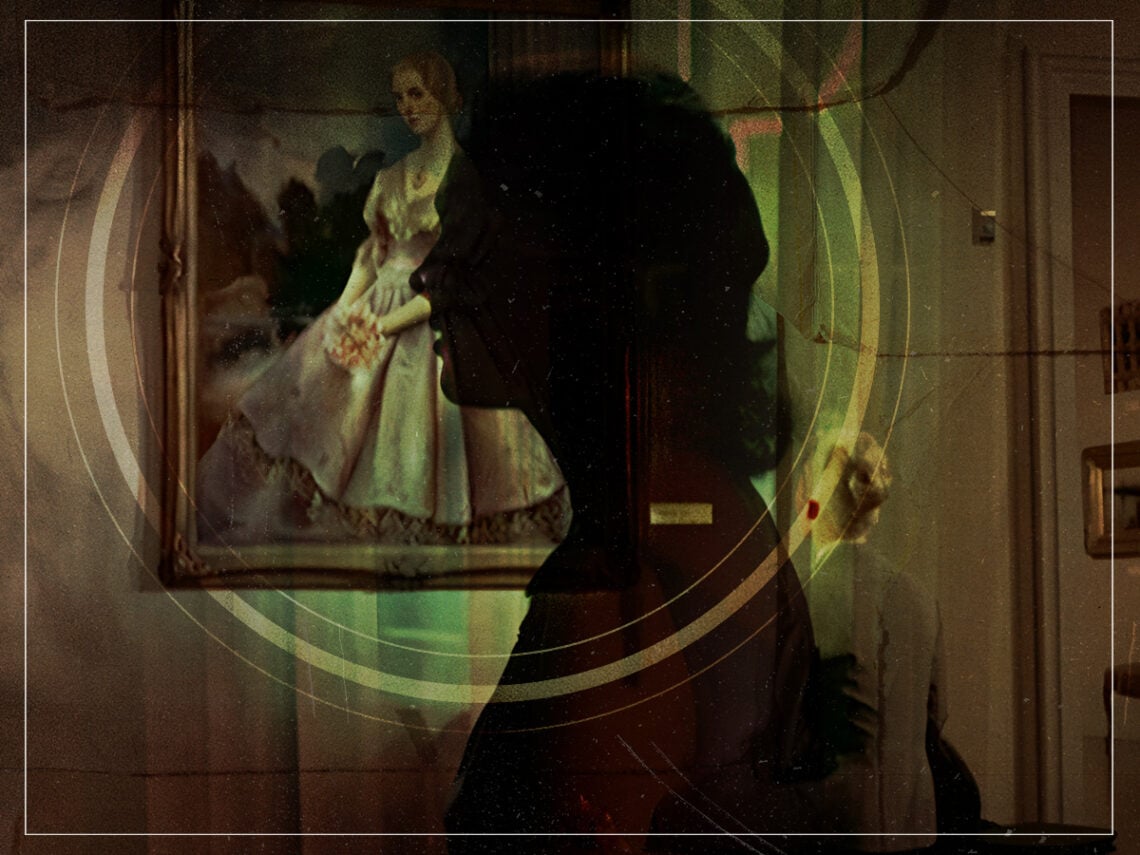
Out of all of Hitchcock’s colour films, it’s Vertigo that remains the most technically impressive and unforgettable, predominantly working with reds and greens to convey the film’s main themes of obsession, lust, death, deception, and fantasy. The film begins with Stewart’s Scottie, who suffers from acrophobia following a near-fatal fall, taking on a task from a friend, Gavin, who believes that his wife, Madeleine, is acting strangely. He asks Scottie to secretly follow her, but in the process, the protagonist falls for Madeleine – and she falls for him – resulting in tragedy when she jumps from a church tower, all while Scottie’s fear of heights prevents him from saving her in time.

Of course, Hitchcock had to include various dramatic plot twists, so when Scottie, now bereaved, meets a woman named Judy who looks strikingly similar to Madeleine, only with darker hair, he becomes obsessed. The colour that binds Madeleine and Judy is green, which frequently appears in clothing that the former wears, the car that she drives, and so on. Thus, when Scottie meets Madeleine’s ‘doppelganger’, he can’t help but project his fantasies onto her, with the prominent use of green helping to blur the lines between the two characters.
When Scottie first spots Judy, she is surrounded by green, and when she is dressed like Madeleine by Scottie, the green neon lighting from outside the window, illuminated to an electrifying degree by Technicolor, serves to emphasise Scottie’s preoccupation with bringing Madeleine back. This scene, in which Judy emerges in the clothes that make her resemble Madeleine, sees a haunting green light shine on her with a spectral, shadowy essence, as though the ‘ghost’ of Madeleine is haunting Scottie.
Green is typically representative of envy – he wants Gavin’s wife – but it can also symbolize renewal. When Scottie meets Madeleine, she offers him a new and exciting world, one far removed from his retired life, where his ex-fiancee, Midge, is one of his closest associates. He wants to reach into this desirable world of love and luck, but instead, he is thrown into mourning, with death and lust represented by the consistent use of red.
We eventually find out that Judy was ‘playing’ Madeleine all along as part of a murder scheme conjured up by Gavin. It was the real Madeleine who died all along by being bound at the top of the tower and pushed by her husband, although Judy is still left with feelings for Scottie once she goes back to being herself. When Scottie forces her to dress as Madeleine, making her forego her own identity in a quest to satisfy his own selfish desires, death becomes an unavoidable factor, and Judy tumbles to her death by accident, falling from the same place that Madeleine was pushed by Gavin earlier in the film.
Red is a strong and powerful colour, deep in hue and reminiscent of blood and pain as well as seduction and love. In one notable scene, Madeleine wears an all-green outfit in a room with bright red wallpaper, and this contrast between her outfit and the red symbolism that surrounds her seems to reflect a simultaneous binding of obsession, love, and danger, which will inevitably have catastrophic effects on the characters. Desire and envy will lead to death, something that is signalled early on when the title credits show a female eye in black-and-white, only for the whole scene to switch to bright red, as though Judy/Madeleine is looking directly into uncertain and dangerous territory.
Vertigo is masterful, not just because of its clever storytelling, but also because of Hitchcock’s attention to detail, using Technicolor as a narrative device that leaves audiences enraptured by the film’s visuals as much as its plot twists.
