


Alfred Hitchcock’s ‘Vertigo’ explained: Who was Carlotta Valdes?

The 1958 movie Vertigo is widely recognised as a landmark in cinema history for its extraordinary innovations in camerawork and technicolour, its exploration of the idea of cinema as a voyeuristic pursuit, and its gorgeous musical score. No other Alfred Hitchcock film ever entangled its audience in a deeper web of deception, either.
Vertigo’s plot has three layers, which interweave intricately at three specific points in the movie, all of which hinge upon the chronic fear of heights suffered by police detective John ‘Scottie’ Ferguson. The first, most basic layer is found in the opening scene, which causes Scottie to acquire his phobia after he sees a colleague fall to his death.
The second layer of the plot is resolved at the film’s climax, as Scottie’s lover, Judy Barton, falls to her death from the top of the bell tower of Mission San Juan Bautista. He’s implicated her in a murder scheme involving the wife of his college friend Gavin Elster. But he remains in love with her, and it appears the two will stay together until Judy stumbles backwards off the tower’s ledge, startled by a noise.
However, the third layer of the plot is the most complex, spans most of the film’s length and plays with our sense of reality. This layer concerns the story of Madeleine, Elster’s wife, whom he’s hired Scottie to follow.
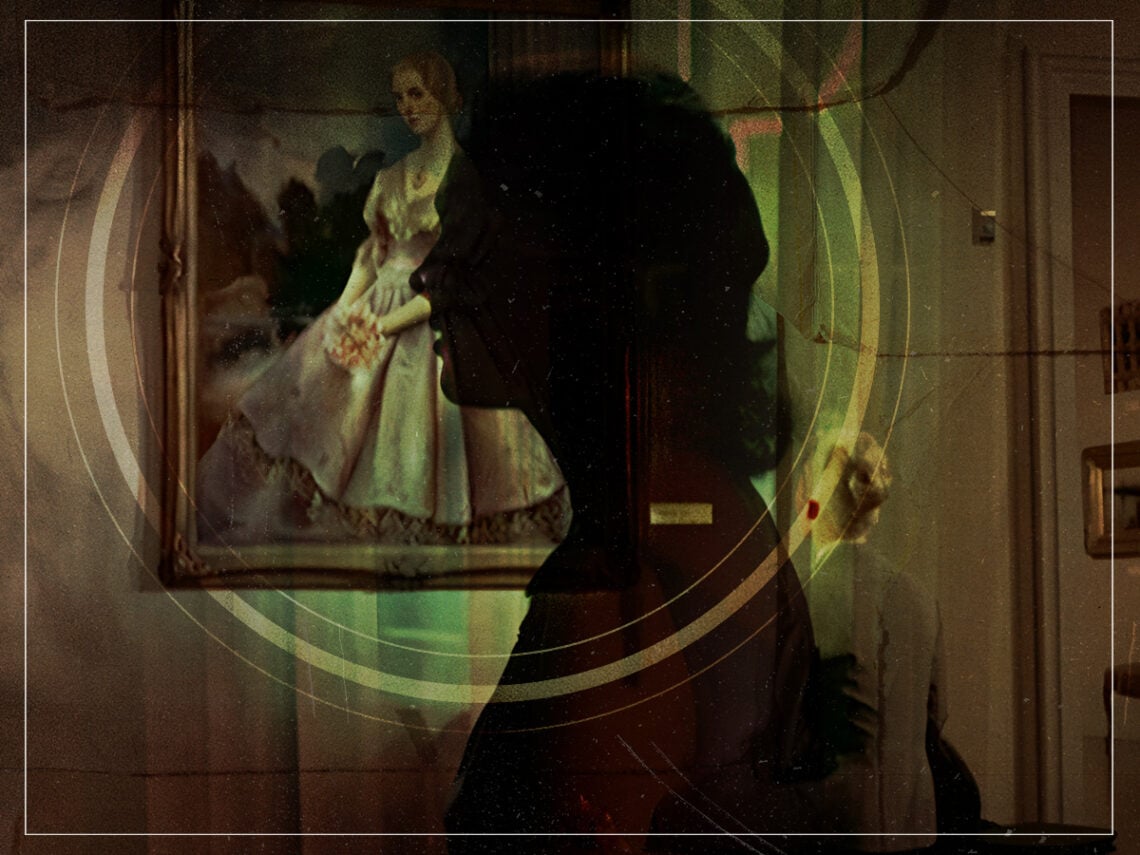
When he follows Madeleine to various sights around San Francisco, he eventually finds her sitting in front of a painting in an art museum, staring intently. Madeleine’s hairstyle and the bouquet of flowers she carries with her match those of the woman in the painting.
Scottie asks a museum worker who is in the painting. “That’s Carlotta,” he replies. “The portrait of Carlotta.” Carlotta Valdes, to be precise. A 19th-century resident of San Francisco who tragically committed suicide.
So, what does Carlotta have to do with Madeleine?
When he confronts Elster with what he’s seen, Scottie is in for a shock. “My wife Madeleine has several pieces of jewellery that belonged to Carlotta,” Elster tells him. In fact, Carlotta Valdes was her great-grandmother. “Now, when she’s alone, she takes them out and looks at them, handles them gently and curiously. Puts them on and stares at herself in the mirror. Then goes into that other world, is someone else again.”
Scottie tries to reason that this behaviour seems normal since Valdes was Madeleine’s ancestor, and she’s clearly upset by her tragic demise. “She never heard of Carlotta Valdes,” Elster retorts. Scottie then becomes convinced that the spirit of Carlotta Valdes possesses Madeleine, as Elster has implied.

He, in turn, becomes possessed with obsessive feelings towards Madeleine in the guise of a reincarnation of Carlotta Valdes. To the extent that when Madeleine runs to the bell tower at Mission San Juan Bautista, just as Judy will repeat at the end of the film and appears to commit suicide in a reenactment of Valdes’ death, it drives Scottie insane.
Hitchcock toys with our understanding of what we are watching, mirroring the deceptions inherent in any film’s plot in the confusion we share with Scottie over the real identities of Carlotta Valdes, Madeleine, and later Judy.
As it turns out, Elster and Judy conspired to kill his real wife Madeleine, whom Scottie never met, by pushing her off the bell tower and making it look like an accident. Because of Scottie’s vertigo, he couldn’t climb up the bell tower in time to see what happened. Judy had been pretending to be Madeleine all along, which is why she reminds him of her later in the movie even after changing her hair colour and style of dress.
And the real Carlotta Valdes?
She certainly has her painting hanging in the Legion of Honor art museum as part of the film’s plot. But the painting itself is a movie prop, designed by real American artist John Ferren based on a likeness of Kim Novak, the actor who plays Judy / Madeleine.
As far as we know, there was no real Carlotta Valdes at the Mission San Juan Bautista in San Francisco. But then again, she wasn’t actually real for Scottie, either. She was an ideal dreamed up and imbued in the Madeleine he thought he knew, who herself turned out to be an illusion.
In this way, the plot of Vertigo is a compound metaphor for the role art plays in our lives in general and how they structure Hitchcock’s works.
