


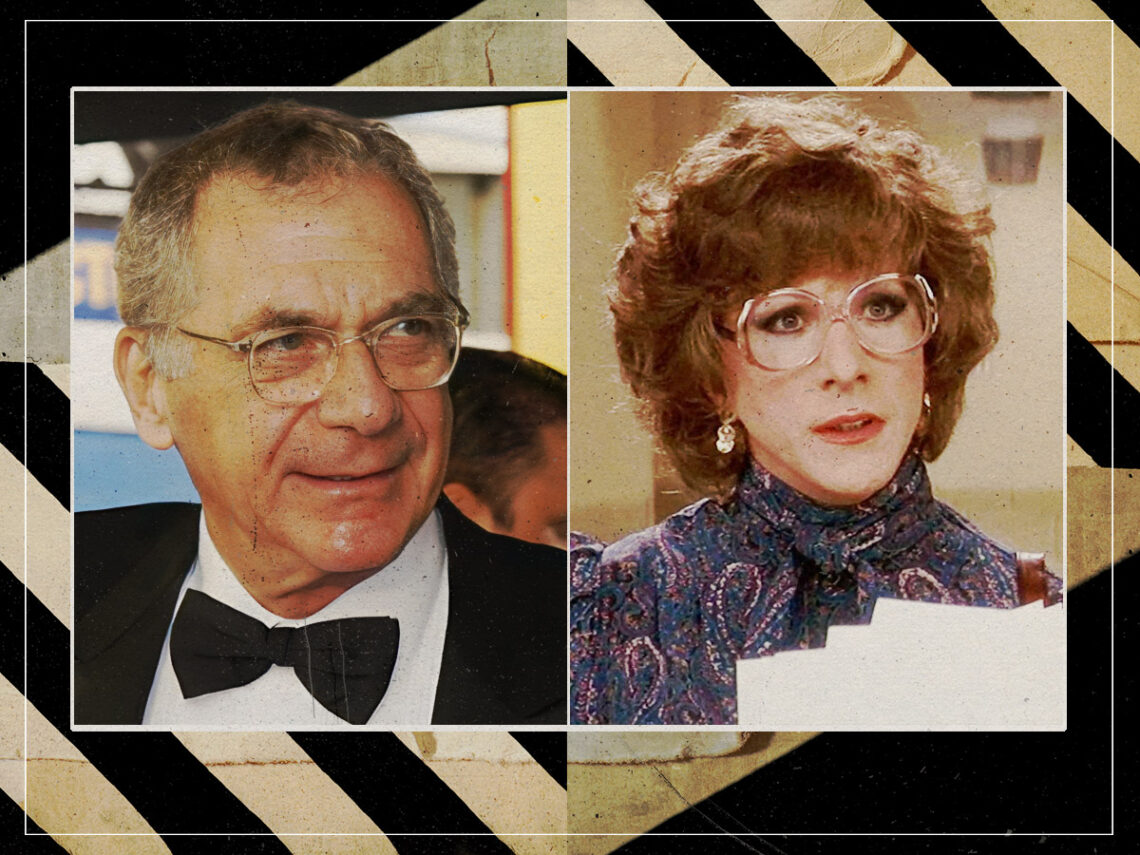
How Sydney Pollack tricked Dustin Hoffman into making ‘Tootsie’ and made an enemy for life

Ever wanted an excuse to mail a dead rat to a friend? Or to glue your own eyes shut? Well, if you’re a Hollywood actor, you’re in luck. You can fulfil your wildest dreams through ‘method acting’, an acting technique formed by Russian director Konstantin Stanislavski that encourages you to become the character you are playing.
In the eyes of Stanislavski, make-believe is far less convincing than simply transforming into another person, and many actors have sworn by this method in order to fully immerse themselves in a role. However, many actors have been criticised for going too far with this process, blurring the lines between their reality and the fictional world of their character, but in the case of Dustin Hoffman, this method surprisingly brought more peace and tranquillity to the otherwise chaotic set of Tootsie.
Tootsie was a charged project from day one. Sydney Pollack had always been a very assertive director, but he met his match when collaborating with Hoffman, someone who had contractual obligations to share creative control over the film after being heavily involved with the script from the beginning. It’s unusual for an actor to have this level of authority over the development of a project, which inevitably leads to many heated disputes and discussions.
Pollack was more focused on the overall flow of the film, preferring to think about the cumulative effect of each scene rather than the specific nuances of each moment. However, Hoffman’s creative process was very different, and he didn’t see each as a contributing puzzle piece but as its own complex thing that needed to be explored and fully fleshed out. Naturally, the duo would argue about their different approaches, and the production became increasingly fraught and delayed as they struggled to find a middle ground, constantly going back and forth about proposed script changes.
Not only this, but the lengthy process of transforming Hoffman into Dorothy each day also added a strain to the production, with Hoffman needing hours of hair and makeup to accurately portray the glamorous television star. But despite the tense atmosphere on set and a constant stream of setbacks, the crew were distinctly aware that they were making something special, with everyone marvelling at Hoffman’s commitment to playing Dorothy. Apparently, Hoffman would argue with Pollack, both whipping themselves up into a frenzy and then he’d disappear into his dressing room and emerge as the sweet-natured and giggly Dorothy, taking on her bubbly persona as he warmly chatted with the crew.
Everyone was amazed by how his portrayal of this character changed his attitude on set; everything became calm and civilised as he spoke softly and waltzed around in flamboyant dresses. And it was this idea that gave David McGiffert (the first assistant director) an idea. Would Dorothy remain in character when responding to criticism and script changes?
And so, as Pollack spoke to McGiffert about a significant change in the next scene, he had an idea. As Hoffman was leaving his dressing room after transforming into Dorothy, McGiffert ran Pollack’s new ideas by Hoffman, and to his surprise, Hoffman reacted to these changes as Dorothy exclaimed in her languid southern drawl that it was “a lovely idea”.
Throughout the remainder of the production, this became the ultimate taming tactic, with Dorothy remaining in good spirits and acting as the perfect collaborator whenever approached with any creative changes. Whilst many productions have been halted by the extremities of method acting, ‘Tootsie’ is one of the few films that was aided by this technique, slowly turning the production into an almost blissful experience for everyone involved.
