


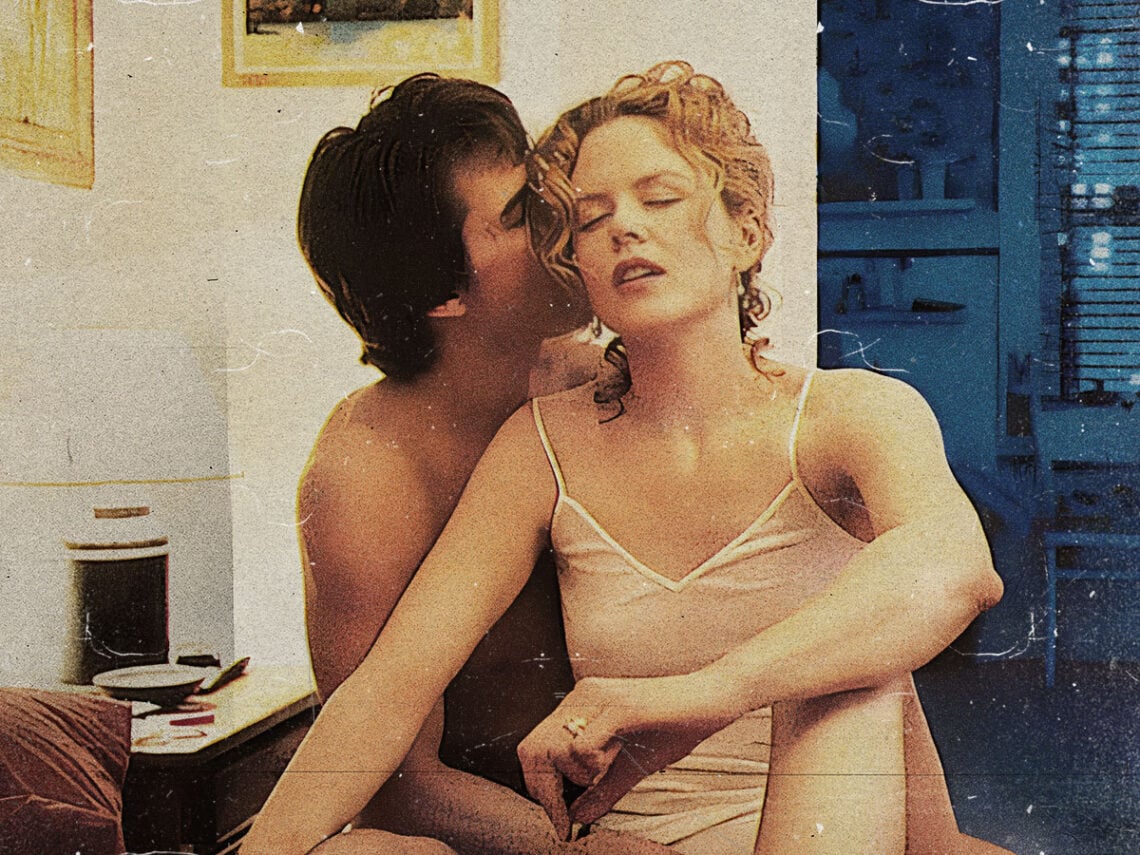
“Let’s make sex music!”: How the unique score for Stanley Kubrick movie ‘Eyes Wide Shut’ was made

When Stanley Kubrick hired Jocelyn Pook to write the score for Eyes Wide Shut, she was a relatively unknown composer on the cusp of her big break. Her work on the 1999 feature – Kubrick’s final film – would make her name, with Stanley offering something scarce in the world of film music: free reign. Even today, her score still sounds like nothing else – a monastic swirl of guttural chants and featherweight string arrangements.
“He looked at me right in the eyes and said, ‘Let’s make sex music!'” Pook told Dazed, recalling how the Eyes Wide Shut score came together. “I thought to myself, ‘what the hell is sex music? Is it Barry White?’ Stanley didn’t really care to elaborate; he just trusted me to answer the question.”
Such trust was rare for Kubrick, who had tortured the various composers hired to develop the score for 2001: A Space Odyssey and eventually replaced their original music with Lygeti and Wagner. For cues like ‘Navel Officer’, Pook, a graduate of London’s Guildhall school (where she studied Viola), provided artful string arrangments to evoke Bill and Alice’s transition from serenity to chaotic paranoia.
The score’s weirdness reaches its peak when Bill manages to sneak into the secret masked ball, where a man wearing a red cloak and a faux-Venetian mask summons a group of masked men and women and commands them to embrace. As they slip off their garments and meld together, Pook conjures up the darkness at the heart of this secret organisation with waves of warped vocals. “Yeah, that music was menacing and unsettling,” she said, “but I also wanted the strings to create this magic so that when the higher-pitched voice of the priest comes in, it transports you somewhere beautiful.”
To develop the cue, Pook decided to work “primitively”, feeding a cassette tape of priests singing into an old reel-to-reel machine and reversing the voices. The recording originally appeared on Pook’s 1996 album Deluge under the title ‘Backwards Priests’. Pook imagined the piece as a comment on homophobia in the catholic church, but Kubrick heard something dark and primal.
“It came completely out of the blue,” she explained. “I got a phone call from his assistant saying Stanley wanted to speak to me, and then he called me a few minutes later. I was already on the phone, so I left him on hold (as I didn’t want to abruptly end my conversation). The person I was speaking to was like, ‘You can’t leave Stanley Kubrick waiting, what are you doing!?’ We had a short chat on the phone, and he asked me if I had any more music he could hear. Literally, two hours later, a car showed up at my house. I handed the driver my cassette, and it drove away. The same car came back the next day and drove me to Pinewood Studios for a meeting. I thought, ‘Stanley doesn’t hang around, does he?'”
Kubrick sat Pook down and described his plans to film scenes of adultery and group sex. The most important thing, he told Pook, was that the score created a sense of dread while also sounding lush and sensual. Pook, then at the dawn of her professional career, was “incredibly daunted” by such a request. “The work was emotionally draining,” she recalled, “as it was a very meticulous way of working. But Stanley was not this dictator. He had so much confidence in me; he was very kind and fatherly. If I got something wrong, he was patient and supportive. I had this quartet that I played with in churches, and he would speak to me for hours about them, asking me every little detail about the most trivial things.”
Eyes Wide Shut marked the beginning of an illustrious career for Pook, with the composer going on to write music for Martin Scorsese’s Gangs of New York, Sarah Gavron’s Brick Lane and hugely successful stage plays like Adam and Memorial. Through each project, she carried the lessons Kubrick instilled in her. “Stanley gave me huge insight into how important it is to somehow both emotionally and intellectually immerse yourself into the ideas of a piece you are working on,” she concluded. “Without that, it would be very superficial, as you can’t properly respond musically. He was a true artist.”
