


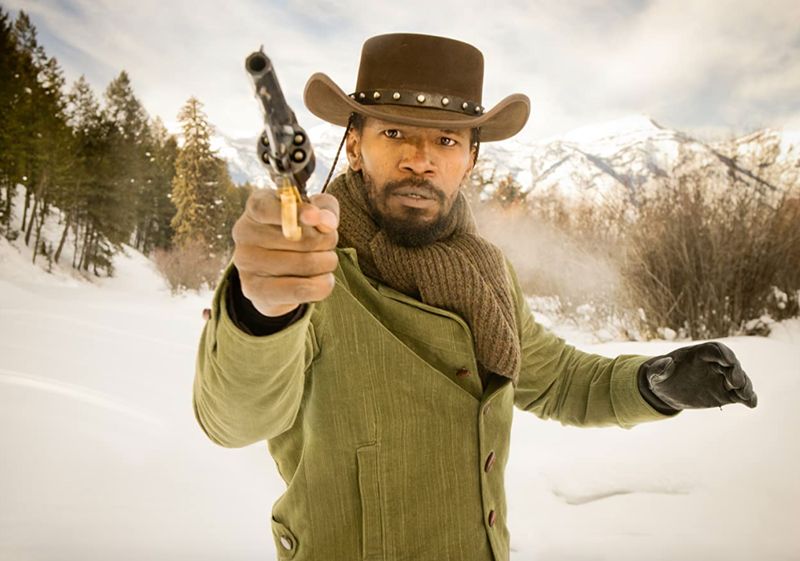
How Quentin Tarantino compares to the best directors Jamie Foxx has ever worked with

It would be quicker to list the great directors Jamie Foxx hasn’t worked with. He was directed by Michael Mann in Collateral, F. Gary Gray in Law Abiding Citizen, Edgar Wright in Baby Driver, Sam Mendes in Jarhead, and Oliver Stone in Any Given Sunday. That’s about half the list of esteemed filmmakers who have shared billing with Foxx. If we named them all, we’d be here until 2041.
Another famous name Foxx once called ‘boss’ is Quentin Tarantino. In the director’s bloody 2012 western Django Unchained, the Oscar winner played the titular role, a slave-turned-bounty hunter out to track down his missing wife. While Christoph Waltz won ‘Best Actor’ for his portrayal of Dr King Schultz, Django’s mentor, Foxx’s contributions were ignored by the Academy. He didn’t even earn an MTV Movie Award for the role.
Nevertheless, this experience was clearly important to Foxx. When talking with Movies.ie about the making of Django, he spoke very fondly of the maverick filmmaker. “I’ve been lucky,” he said, reflecting on his career. “I’ve been able to work with Oliver Stone, Michael Mann, Taylor Hackford, Sam Mendes, Bill Condon, Antoine Fuqua… I’ve been with some of the best guys and Quentin is the [sic] up there with them.” He called Tarantino “hip-hop” and praised his direct approach to a topic as sensitive as slavery. “He, in a sense,” he said. “Has blown the doors open and takes the rights to be able to do this subject matter.”
Tarantino had previously included typically-Black ideas in his movie Jackie Brown, but had never tackled something as overtly racial as slavery. “It’s one of the most courageous scripts I’ve ever read,” Foxx said of Tarantino’s handiwork, which ended up winning Best Original Screenplay at the Oscars. “To be able to take the role of a slave, like Gladiator, where the slave actually gets to take revenge and get his girl… you’ve never seen a Western that acknowledges slavery. It’s a western with slavery, it’s a love story, it’s so many different things. Only Quentin can make it happen.”
Though it definitely went against convention to make a freed slave the lead character in a cowboy movie, Tarantino was far from the first director to have a Black actor star in a Western. In 1960, the legendary John Ford cast Woody Strode in the title role of his film Sergeant Rutledge. The movie revolves around Rutledge being on trial for murder and the racism surrounding the case. Other early examples of Westerns starring Black characters include Take a Hard Ride, a spaghetti western starring Jim Brown, and the movies of Fred Williamson.
When discussing what made Tarantino different from the other directors he had worked with, Foxx singled out his age as a potential reason. “He’s young, man,” he said. “He’s out there. You’re finished shooting, you’ll go hang out and come back tomorrow.” He also marvelled at his ability to handle his extraordinary fame, saying, “when he gets out of the car at the restaurant, the cameras are on him and he knows it, and he uses it to fuel him.”
Though Foxx and Tarantino haven’t collaborated since Django, the latter has returned to the world of the Western. He put out The Hateful Eight in 2015, which also featured a Black actor, Samuel L. Jackson, in a prominent role.

Never Miss A Take
The Far Out Quentin Tarantino Newsletter
All the latest Quentin Tarantino content from the independent voice of culture.
Straight to your inbox.