


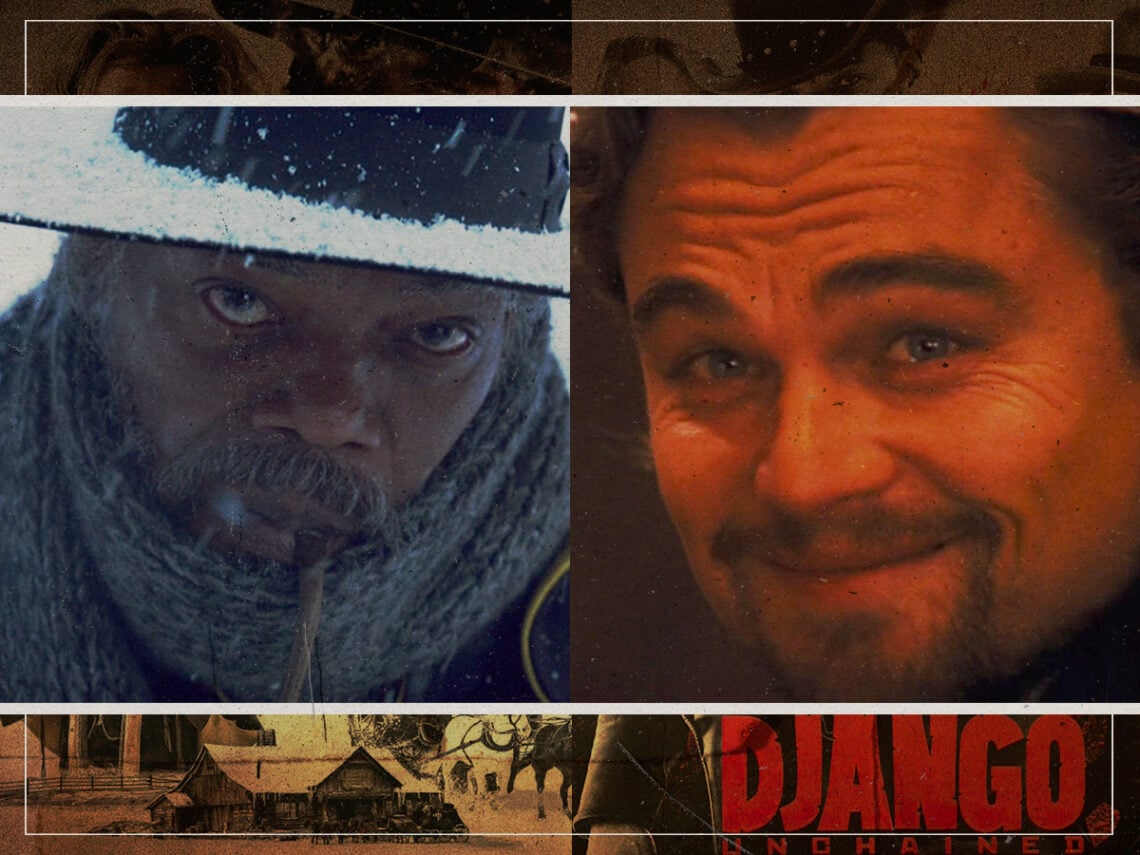
The background details that link Quentin Tarantino movies ‘Django Unchained’ and ‘The Hateful Eight’

For someone entirely dismissive of franchise fare at large, Quentin Tarantino has done a phenomenal job of creating a multiverse of his own, one that even incorporated period pieces Django Unchained and The Hateful Eight into its increasingly complex web.
Playing Marvel Studios at its own game before it was even a twinkle in Kevin Feige’s eye, Tarantino’s movies exist in two separate planes of reality. There’s one universe inhabited by the characters from Inglourious Basterds, Once Upon a Time in Hollywood, Reservoir Dogs, Pulp Fiction, and the aforementioned revisionist Westerns.
Much like their creator, the figures within those films have a soft spot for cinema, where they’d head down to their local multiplex to catch a screening of From Dusk Till Dawn or Kill Bill. Each of Tarantino’s features has at least one direct or subtle connection to another, but the ties between Django Unchained and The Hateful Eight become more pronounced when remembering the latter initially began life as a direct sequel to the former.
Tarantino had Jamie Foxx’s bounty hunter as the focal point of the story in a film titled Django in White Hell before realising that the narrative he wanted to tell would unfold much better were he to omit him altogether. As he explained, “I thought it should be a room of bad guys, and you can’t trust a word anybody says.” Django was firmly established as a hero and somebody the audience could root for, which didn’t fit into the atmosphere of The Hateful Eight.
Nonetheless, being a Tarantino film, eagle-eyed viewers were rewarded with a couple of nods towards Django’s adventures. When Samuel L. Jackson’s Major Marquis Warren first boars the stagecoach containing Kurt Russell’s John Ruth and Jennifer Jason Leigh’s Daisy Domergue, he’s standing behind a pile of corpses, and placed on top of that stack is the saddle sported by Django’s horse.
Later on, when the action shifts to Minnie’s Haberdashery and remains there for the rest of the runtime, the signature green corduroy jacket sported by the vanquisher of Calvin Candie can be seen sitting on the floor. Tarantino didn’t want to draw obvious attention to either of the sly winks, but Samuel L. Jackson took it upon himself to share those facts with the world, which presumably caused the director’s many devotees to frantically comb the background of every frame to see if there was anything else to uncover.
Naturally, his inbuilt lore is expanded in other ways, too. Tim Roth’s Oswaldo Mobray/Pete Hicox is a direct descendant of Michael Fassbender’s Lieutenant Archie Hicox from Inglourious Basterds, while Kill Bill Vol. 1 featured a background shot of a grave marked with ‘The Lonely Grave of Paula Schulz’, a nod to both 1968 comedy The Dreams of Paula Schulz and Christoph Waltz’s Academy Award-winning performance as Dr. King Schulz.
That one hasn’t been confirmed by Tarantino, but it fits neatly into his universe and serves as a tangential tie to The Hateful Eight by way of the man who turned Foxx’s Django into a bounty hunter in the first place.
