


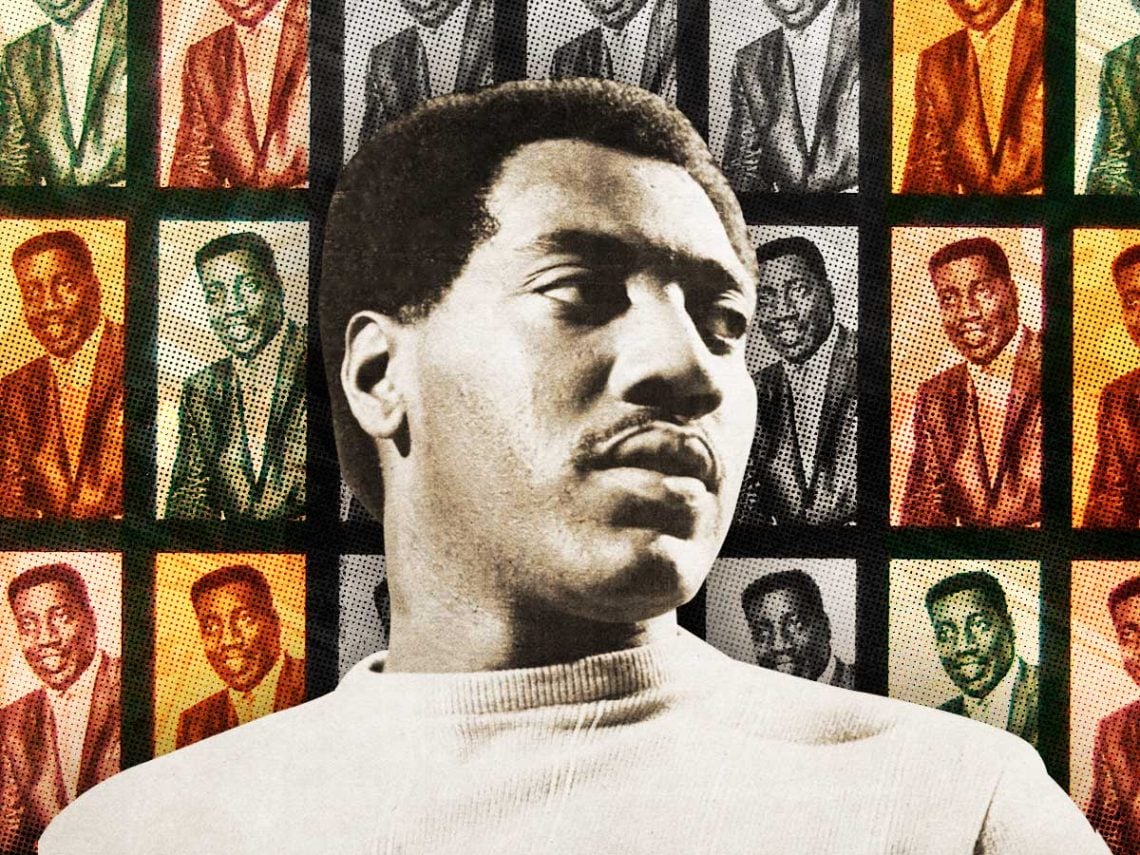
How the death of his hero created a “silent vacuum” for Otis Redding to fill

It’s very easy to listen to just about any Otis Redding tune and forget that, no matter which one it is, you’re hearing a man no older than 26. Redding’s voice, aside from being one of the most singular and soulful in pop music history, is also impossibly mature, seasoned and world-weary for its age.
Otis’s physical traits add to this disconnect, too. “What impressed me was his actual physical size,” recalled Mitch Ryder, who shared the stage with Redding at the latter’s last ever performance in 1967. “He put his arm on my shoulder during the song, and was holding me close,” Ryder told the New York Post as part of a 2017 retrospective on the 40th anniversary of Redding’s fatal plane crash. “He’s rocking back and forth, and every time he rocks, my foot comes up”.
Redding was married, had three kids, and, as evidenced by the private plane that ultimately spelt his doom, was living a very good life for an artist still in the infancy of his career. His first studio album, Pain in My Heart, was released in March 1964, when he was 23, meaning that the entire length of the ‘King of Soul’s’ career was less than four years. Thus, Redding’s original drive and vision for his career were still relatively fresh in his mind, and he had likely not even come close to reaching the height of his potential.
“I want to become two things,” Redding told a reporter early in his career. “First, an international recording and performing star. Then I would like to fill that silent vacuum that was created when Sam Cooke died.”
Sam Cooke’s shocking death, being shot at the age of 33 in 1964, had a profound effect on Redding, who’d grown up listening to him and emulating him as a performer. To his credit, no one could ever accuse Otis of imitating his hero. From the outset, even when covering Cooke’s songs on his early records, Redding always brought his own distinct voice and interpretation to each track, whether it was ‘You Send Me’ or ‘Nothing Can Change This Love’.
Cooke, of course, was the original ‘King of Soul’, and Redding, not short on confidence, believed part of his mission as a performer was to succeed Sam in that role, and to fill the hole that had been left behind in his absence.
One could argue whether anyone could “replace” a one-of-a-kind such as Cooke, but it’s hard to say that Redding didn’t achieve his goal. By 1967, he was the biggest star on the Stax label and was voted by Melody Maker magazine as the ‘World’s Number One Male Vocalist’.
He’d also done right by Cooke along the way, regularly paying homage through his recordings, which included many more of the former’s songs, and by paying his props to the man in interviews. Whether you prefer Sam’s original 1964 version of ‘A Change Is Gonna Come’ or Redding’s tribute rendition a year later, the future of soul music undoubtedly seemed to be in good hands going forward.
Ironically, one of the songs Redding was performing during his own final tour dates in 1967 was ‘Shake’, the last song Cooke recorded before his own untimely death. Redding’s final recordings became The Dock of the Bay LP, released in 1968, which immediately went to number one in both the US and UK.
