


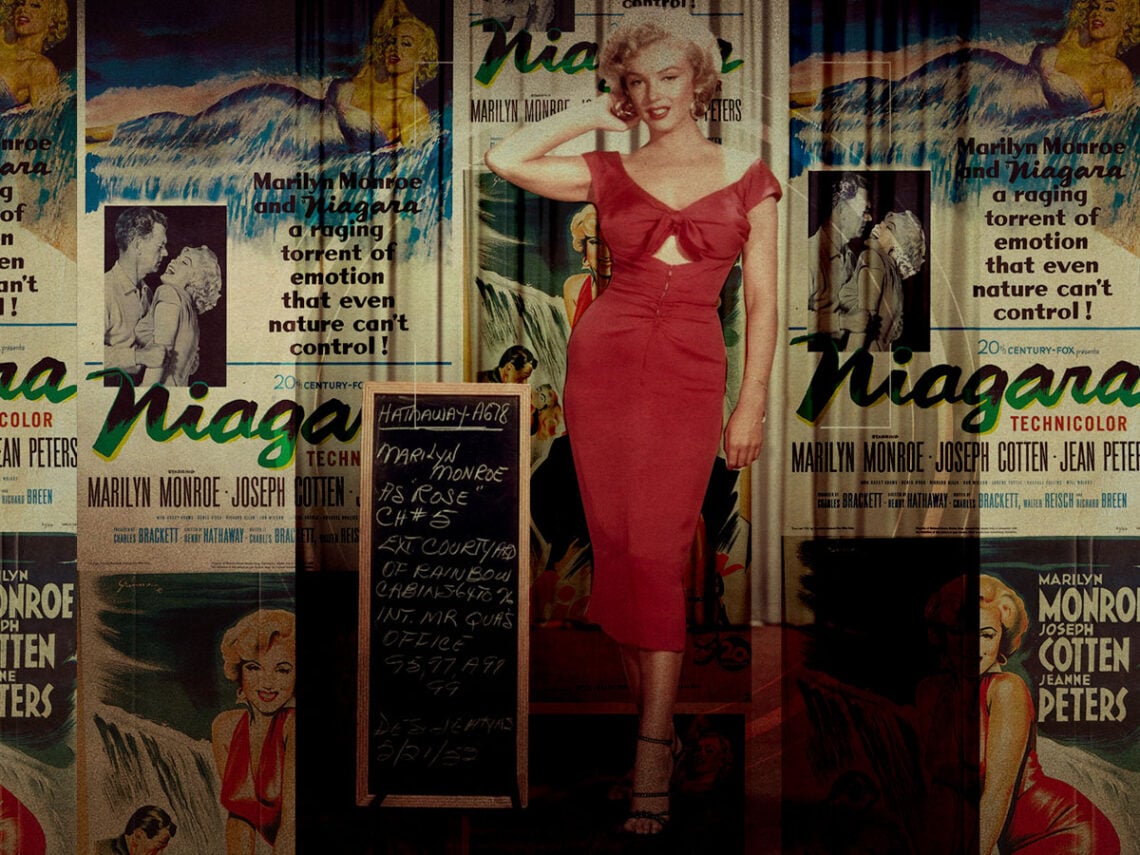
How ‘Niagara’ created and confined Marilyn Monroe

“The times being what they were, if she hadn’t existed we would have had to invent her, and we did, in a way”. – Molly Haskell on Marilyn Monroe
Marilyn Monroe does a lot of walking in Henry Hathaway’s 1953 Technicolor thriller Niagara. Dressed in brightly coloured, figure-hugging dresses and skirts, she is framed at a distance, making her way from one side of the screen to the other, moving slowly, appearing to be almost hobbled by the tightness of her clothes and the precariousness of her heels. In one shot, she walks away from the camera for nearly 20 unbroken seconds.
This 70-foot walk (some have even claimed that it was a full 116 feet) became a focal point of the discourse around the film and Monroe’s nascent stardom. The way her hips moved, the minuteness of her steps, the slowness of it, combined with so much lateral motion. It was dubbed “The Walk” and she was dubbed “The Body”. She had already changed her name, but now, the audience identified her by a common noun, albeit a capitalised one.
Before Niagara, Monroe had spent several years being built up by her talent agency and later her studio, 20th Century-Fox, to be a star. It was a process that had been cemented over decades, creating the movie star personas of everyone from Clark Gable to Rita Hayworth. She began with small walk-on parts in movies like All About Eve and Love Nest, with makeup, costume design, and lighting employed to plant the seed of adoration in the hearts of the audience. In 1952, she was the subject of a scandal-turned publicity boon when it was revealed that she was the model in a nude calendar from three years before. It garnered significant attention and created the ideal conditions for a breakout performance.
Released in February of 1953, Niagara was the most pivotal moment in Monroe’s career. The previous year, she had starred in Don’t Bother to Knock, a black-and-white film noir in which she played a babysitter struggling with psychosis following the death of her fiancé. Despite a paper-thin script, it remains one of her most moving performances, and the one in which her artistry was given room to shine. Niagara changed all that, capitalising on her notoriety as a pin-up model and sculpting her into an icon too enormous to be human. Its success prompted a backlash that would come to define her career, for better or for worse.
By the time Niagara was released, the nihilism of film noir, which had thrived during the war, was on its way out, replaced by colour-saturated musicals and melodramas that bolstered post-war optimism and patriarchal fantasies about white, heterosexual romance. Niagara fell somewhere in between. It stars Jean Peters and Casey Adams as a couple honeymooning at a resort overlooking Niagara Falls who become mixed up in the sordid relationship between married couple George and Rose Loomis (Joseph Cotton and Monroe).
George is a damaged man, both from the war and his impotence in the face of Rose’s rampant sexuality. When Rose and her lover plot to murder George, however, he turns the tables, throwing the man to his death in the Falls and seeking his revenge on his philandering wife. It’s a Technicolor melodrama with noir trappings, but it’s really just a vehicle for Monroe’s star persona. At every turn, her character pushes the boundaries of the puritanical Production Code.
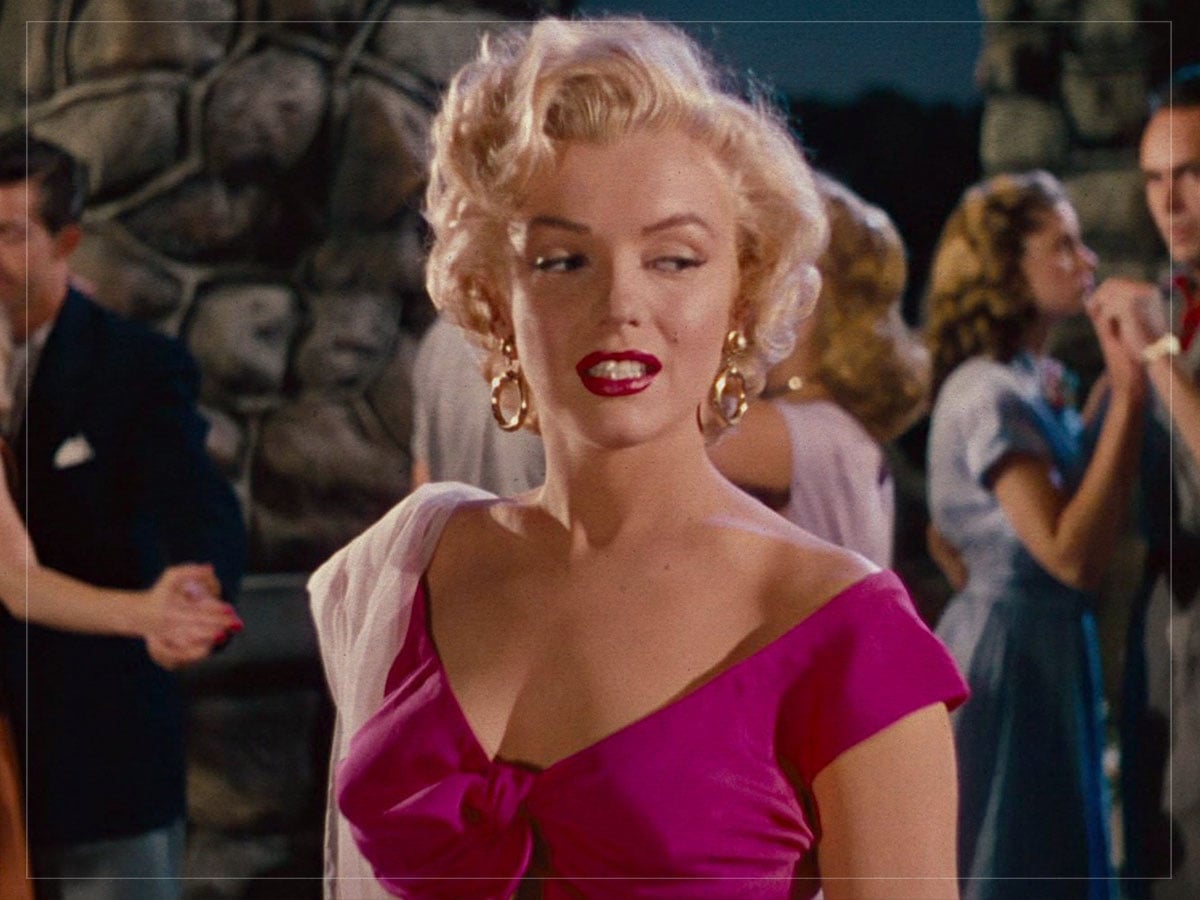
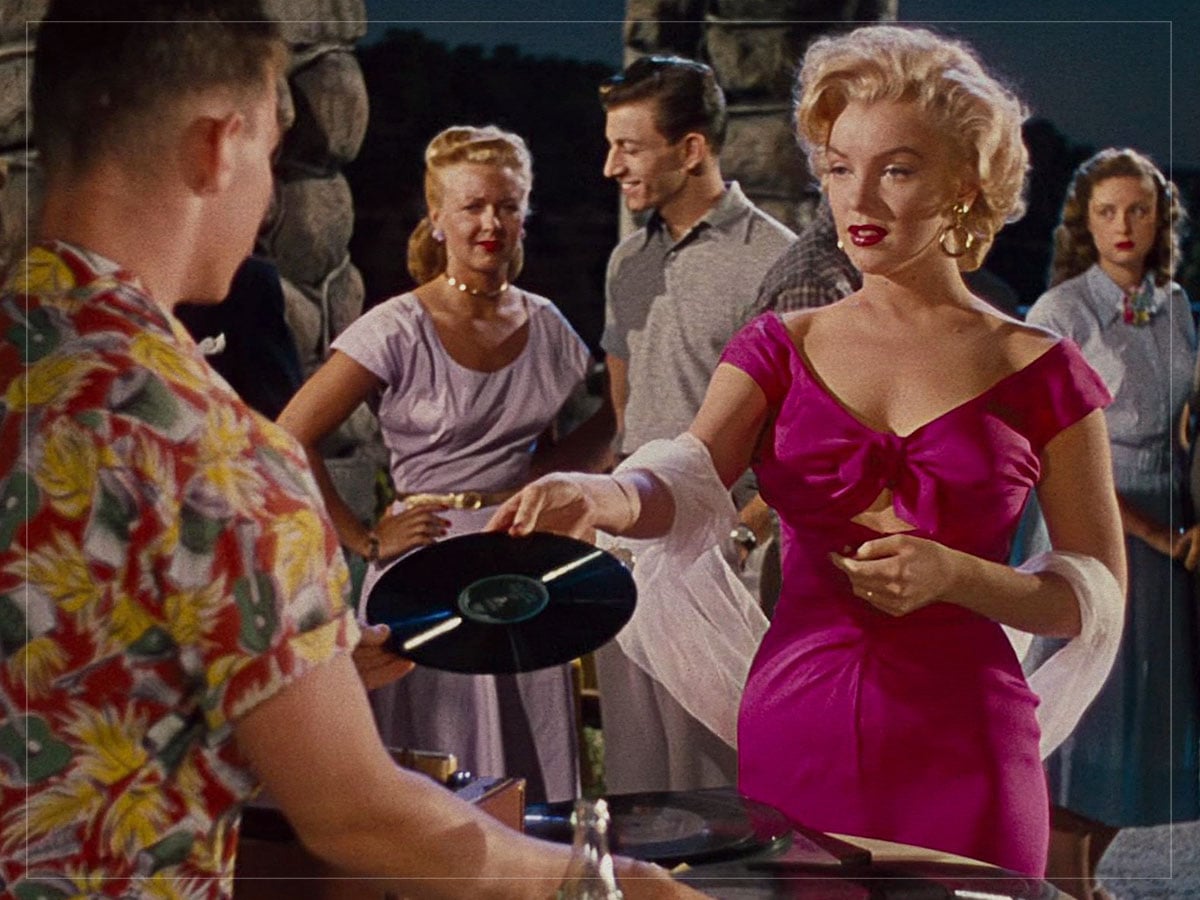
When we meet Rose, she’s lounging in bed, her shoulders bare and her legs splayed open under the sheet. Later that evening, when she takes a shower, she is clearly nude behind the translucent curtain, even though the scene was allegedly darkened in post-production. Emerging from the cabin at night and sitting next to the newly arrived honeymooners, she’s dressed in a violently pink dress with a plunging neckline and thick gold hoops in her ears. Her eyelids droop as she hums along to a record she’s just put on, and the lipstick on her lips glistens.
Even before that infamous walk, everything about Rose is suggestive, and the men around her, including the supposedly happily married men, leer at her. But it’s the walk that sealed the deal for audiences. “As I sat there in my seat in the balcony and watched Miss Monroe lying in bed with her legs flung about, I began to sink lower in my seat,” wrote one outraged female audience member in a letter to columnist Dorothy Kilgallen.
“When she tripped away into the distance with that ridiculously tight dress on and her derriere fanning the breeze and that silly walk, I sank lower.”
As this and letters sent to 20th Century-Fox demonstrate, Niagara was a resounding success at making Monroe an object of sexual desire, but the audience was disgusted by her character’s overt sexual appetite. At a time when men were allowed to be predators but no one was allowed to talk about it, adulterous women upset the marital order. Rose was sexually assertive, and, to quote the letter writer again, that made her an object of “shame” and “fear”. The studio course is corrected.
For her next film, the Howard Hawks musical Gentlemen Prefer Blondes, the executives made it abundantly clear that Monroe would be an entirely new type of woman in every way except one. A publicity booklet sent to exhibitors in the lead-up to the film’s August release was titled, in part, “Monroe Reforms”.
Her character, the accompanying article stressed, would have a completely new personality due to “the studio executives decreeing that her torrid sex appeal should be toned down and Marilyn herself deciding to be more dignified”.
Fear not, however, because Hawks promised that “nothing will change about Marilyn’s contours.”
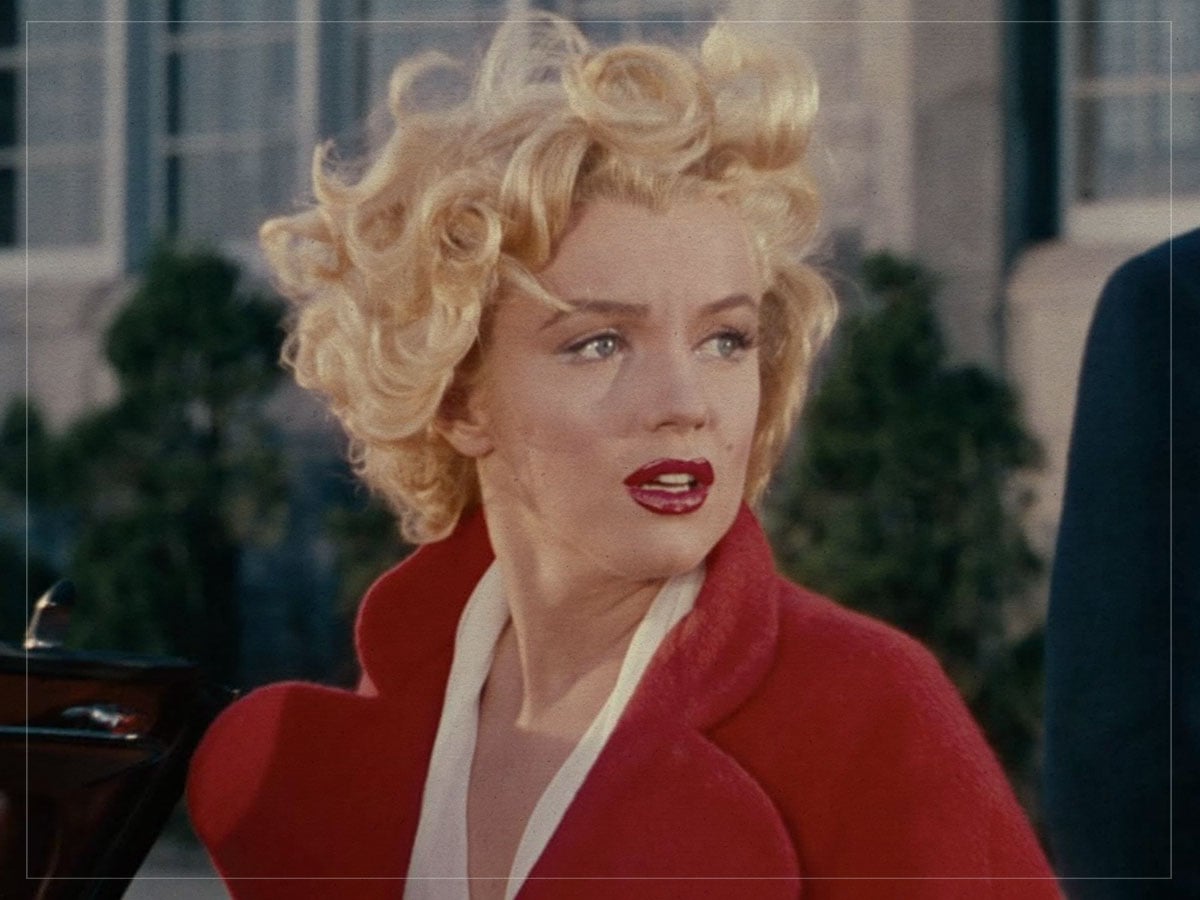
From then on, Monroe was almost exclusively cast as Technicolor “dumb blondes”.
Her sex appeal was only acceptable if she played characters who either weren’t aware of their effect on men or didn’t mean to have it. She could be rapaciously pursued by male costars, but she herself could never do the pursuing, unless her pursuit was signifying low self-esteem or a childlike need to be protected. As a result, the scope of her characters narrowed and calcified into a male fantasy. She would have to fight for the rest of her life to be given serious roles, and she would struggle to exist in the real world when nearly everyone who met her publicly or privately had, for their own ulterior motives, reason to view her only as that voided image on screen.
With all that came after, it would be easy to reduce Rose Loomis to a misfire by the studios to shape the bombshell image of Monroe. In fact, where Don’t Bother to Knock had given the star her greatest opportunity to act, Niagara gave her and her makeup artist Allan Snyder the greatest opportunity to establish her image as they wanted it.
“By that time we both knew exactly how she wanted to look,” Snyder said, explaining that, while they continued to evolve the look with successive movies, Niagara was where it crystallised.
Similarly, Hathaway, the director of the film, clearly saw Monroe as an actor, not an object to be photographed. She was “marvellous to work with,” He said. “Very easy to direct and terrifically ambitious to do better. And bright, really bright. She may not have had an education, but she was just naturally bright.”
He didn’t think anyone ever treated her “on her own level,” he reflected. “To most men she was something that they were a little bit ashamed of.” That included, he believed, her husband Joe DiMaggio.
As Molly Haskell wrote, “The times being what they were, if [Monroe] hadn’t existed we would have had to invent her, and we did, in a way.” This quote yet again robs the actor of the hand she played in creating her own persona, suggesting that she was simply an invention of the studio and the audience. But it is correct in one respect.
The sexual repression and misogyny of the time meant that Monroe could never be treated as sexually liberated. Scripts and studio executives had to reduce her to an impossibly “dumb blonde” in order to offset the power that her sexuality posed. Even if her characters were aware of their impact on men, they were too “pure” to weaponise it.
It is tempting to wonder what Monroe’s career might have looked like if the times were different. Perhaps if she’d been born in 1916 instead of 1926, she could have combined her acting and her look to play the sorts of complex femme fatales that actors like Barbara Stanwyck and Rita Hayworth got to play in the ‘40s. But by the time the mid-50s rolled around, dangerous women were relegated to B-movies, and sex appeal had to be non-threatening.
100 years after her birth, we are much more willing to view Monroe in the context of her time. But even now, analysis of her tends to fall into one of two camps: attempting to uncover the “real” Marilyn Monroe and attempting to explain what Marilyn Monroe, the icon, the entity, the commodity, says about us. Both of these directions ultimately leave out her artistry. Following Niagara, she had an uphill battle to prove herself as an actor, let alone an artist, and her tragic death in 1962 has made her one of America’s favourite victims of itself.
Decades later, it’s worth looking back at these earliest performances to see the star as she envisioned herself.
