


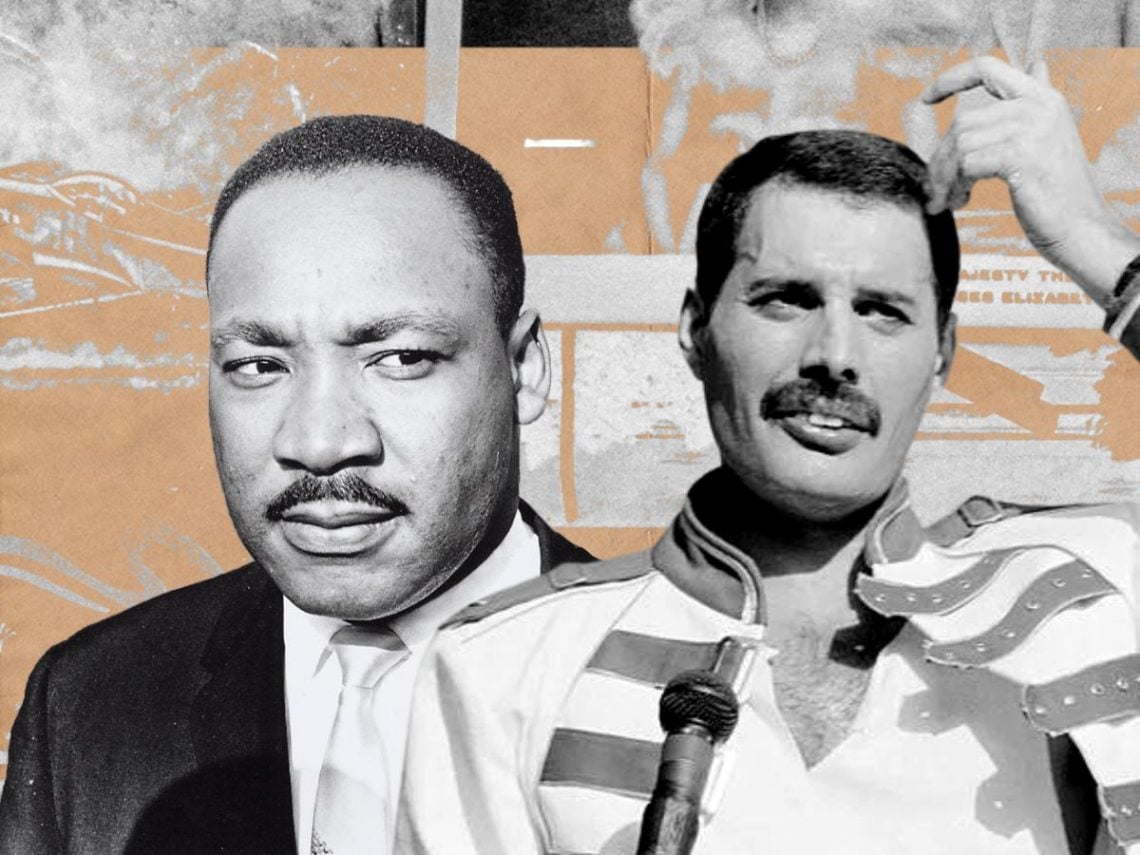
The story of how Martin Luther King inspired Queen song ‘One Vision’

Queen are regarded as one of the most effective rock pop outfits of all time. With their penchant for anthemic, stadium-sized songs, Freddie Mercury, Brian May, John Deacon, and Roger Taylor have long been touted as the ultimate classic rock band. The beauty of the band was their ability to transcend the traditional borders of rock and roll and create a theatrical spectacle that made them appealing to almost every music lover. After all, who doesn’t want to watch Freddie Mercury belt out a hit or two?
The band formed as a collage of varying rock styles. While they had certainly been influenced by the burgeoning heavy metal sound perfect by Black Sabbath and Led Zeppelin, the band also saw the inspiration of prog rock as vital to their progression, incorporating synthesisers and organs alongside May’s flourishing riffs. But while the music often floated between genres and styles, Mercury’s vision for the band’s sentiment never wavered. Queen were a band for everybody, and the group remained resolute in this notion when writing lyrics.
While most of the band’s lyrics were inspired by Mercury’s personal life and those of each member of the group, he did sometimes dip into other areas for his inspiration. While biblical figures such as Noah and Jesus Christ would appear in Queen’s canon, Mercury and the band would also use genuine, inspirational people of the world. One such figure was Martin Luther King Jr, the civil rights activist and one of the pivotal pillars of social reform in the 20th century.
Perhaps one of the ultimate era-defining moments of that century came when King delivered his landmark ‘I Have A Dream’ speech. It was a moment that rocked America and sent shockwaves around the world, providing a future that we could all be hopeful for, a future of inclusivity, equality and of community. While that vision may not feel much closer than when it was first uttered in 1963, the speech caught the attention of Mercury and inspired him to write one of Queen’s lesser-known anthems.
While many reports have suggested that the song was originally inspired by Queen’s watershed Live Aid moment, during which Mercury gave quite possibly the finest live performance of all time, this was quickly dispelled by Roger Taylor. While Mercury had always been the main contributor of lyrics to the band, it was roger Taylor who took centre stage with this piece, using King’s speech as the original inspiration. “It’s credited as a Queen composition, but to be honest, I’d say it was mainly Roger, Brian and Freddie that did most of the writing for it,” confirmed John Deacon.
The lyrics were propped up by Brian May’s perfect riffing, which allowed Mercury to focus on the song’s vocal melody. This provided one of the sillier moments of the band’s studio time, as the group threw random pieces of imagery to the track’s melody in an attempt to flesh out Taylor’s lyrics: “Yeah, I had a, sort of, set of lyrics that I think I used for two songs actually, with sort of amendments,” confirmed Taylor.
“I think it started with those lyrics, and we literally wrote the song between ourselves in the studio, around those lyrics really. We were all throwing in bits of chicken bone.” The recording process saw the band lose themselves in the enjoyment of making a song and would encourage Mercury to sing: “One shrimp, one prawn, one clam, one chicken”
As a homage to this process, at the end of the track, Mercury sings: “Just gimme, gimme, gimme, gimme… fried chicken!”. Discussing it, May explained: “When you get to the end, there’s this big long lead-up, but there’s still the feeling that what you want to do is throw it away. Otherwise, you’re taking yourself too seriously.”
There you have it, the dichotomy of making music. Something which can be so neatly inspired by one of the most influential figures the world has ever known can also be attached to some of the group’s most irreverent lyrics. While ‘One Vision’ may have a hidden smirk, its sentiment for a unified world is one that would have likely pleased Martin Luther King Jr.
