


Good moods for good times: How Left of the Dial get festivals very right

With the basics taken care of, now we can have some fun. That’s the motto of Left of the Dial festival, it seems, and no one can stop going on about it.
I’m standing outside Rotown on Friday Night, interviewing south London band Curser, and almost every other answer leads back to the fact that all weekend the bands drink for free. No one can quite believe it, and as they sincerely shout out the festival, talking passionately about how good the experience has already been, it’s not so much about them being kept nice and tipsy, but it’s about them being kept at all, being treated well.
Behind the stage they played on the night before, there’s an artist bar – no card machine necessary, just a wristband. Almost as if to prove its mythical existence, the band’s singer, Herbie Jones, re-emerges with a cold beer in hand as a gift for me – a real one, not a warm rider can. It feels magical because, for bands playing on the continent for the first time, it genuinely is.
But this isn’t a story of free drinks, despite what all of our hungover states might suggest. This is a story of how the festival does it right and makes it great, simply by being good to its artists.
At Left of the Dial, all the basics are taken care of – drinks, accommodation, travel costs for those coming particularly far, as well as real food, not just hummus and bread for crap sandwiches. The foundation of their hierarchy of needs is solid and sorted for them. Any expenses are mostly covered by the festival, and because of that, in the absence of stress, there is space to relax. They can move up the levels to genuinely enjoy their shows and bring the audience along for the ride.
It’s rare for bands to even really want to stick around at a festival after performing. At other events, when I grab an artist for a chat elsewhere, they’re going to pack up and head home quickly to save money or conserve energy. Here, they even hang around after their last set, some choosing to stay an extra day and watch others play or just join in on the festivities – why wouldn’t they?
Pretty quickly, it becomes clear that this is why the atmosphere at the event is so special.
So often, festivals are touted as the happiest places on earth, cliché captions pop up on your timeline every minute to express the wild bohemian nature of making friends and memories. But trust me when I tell you it’s true here. There is a palpable sense of joy, fun, togetherness, even as a storm was battering down on us. You watch a band one day, and then the next you’re standing next to them, dancing in a crowd. You meet a stranger dancing in that same crowd, and later on, you’re getting a drink with them, swapping details and staying friends. There is an ease and an openness felt in every one of the many venues, and it all seems to come from the stage where the bands themselves are smiling, too.
“It trickles down into the way you interact with people,” Green Gardens’ guitarist Jacob Beaman muses. “I was thinking last night we were at the artist bar, just stood outside, and I was thinking, ‘oh, when I’m old and I’ll be saying ‘I had it so good in my days, because I played this one festival where I got free drinks and free food on every day that I played,” he says, laughing at the bare minimumness of it all, but that nice, pinch-me type of moment leads to a good show, a good day and a good night.
Overworked and underpaid, in the UK, underfunding leaves no room for fun. “There’s no money,” Cracknell says, and that’s the issue: “You can’t take an inch. There’s nothing to give, really.” There, you get “a tin of beer and 50 quid” and feel somehow like a burden, despite being the stars.
Fuzz Lightyear’s Varun Govil felt that too, stating, “No one wants you there in the UK”. In Europe, though, festivals providing a quantifiably welcoming attitude change things. “Getting a free meal with every show is unheard of back home,” Govil says, whereas across Europe, a venue or event providing a band with a proper meal is typically written into the contract.
In an interview back in 2024, Play Dead were in Paris when we discussed that same thing. “In London, you lose money playing a show,” drummer Elias Brewin said, “Then you come here, and you get a good amount of money. They always give you accommodation and food. There are people that can actually make a wage gigging around here.”
Perhaps more importantly, from a punter’s perspective, people can actually have fun. Creating a comfortable place to enjoy themselves, either as a band or a festivalgoer, is clearly a high priority. “Everyone’s really lovely, and just wants things to go well, which should be the bare minimum, but still feel special,” Govil says, and within that exchange, it’s like the bands and the festival shake hands in an agreement on now just having a nice time with the basics all sorted.

However, given that Left of the Dial are still a relatively new event, it’s not that they’re buying their way to a good time. It’s more than that, as Cracknell adds, “A lot of festivals in the UK aren’t funded properly, so they don’t necessarily have good people running them. They’ve just got the bullies of the promoter world, who have their foot on your throat.”
Out of all the festivals I’ve covered in my career, no organisers have ever been as nice or friendly or helpful as Left of the Dial’s team. In an interview with them ahead of the event, they spoke about a nice surprise they did for a band, organising for an organ player to learn their song and play it to them, just because. That kind of organic care and desire to make things great for everyone leads the way, as the planners told us from the start, “We try to take care of everybody – artists, crew, ticketholders – the best way we can, because that’s how we want to be treated.”
“The Dutch know how to party,” Fuzz Lightyear say, and every band I interview backs up how the crowds are all committed to fun. The same goes for the event planners. It’s shown best in the silliest moments and the way the event is utterly dedicated to them. Little jokey extras like sing-alongs and music quizzes don’t make them money; they’re not going to draw in customers, but they make the weekend great.
Once again, they make it special across the board, as when the band’s needs are sorted, and they’re in a good mood, they can get silly too. Take YAANG playing on a moving bus, for example. Watching the trio screaming and cackling along with their crowd each time the vehicle went over a speed bump or took a harsh corner was joy on another level, and especially on a level I’ve genuinely never seen from a band. Gigs are supposed to be fun for them, but I’ve never seen artists look as happy as they did as they finished their set and slumped into their seats, smiling wide at each other. It wasn’t just the victory of a good gig. It was three friends who had just shared a good time.
“That was the most fun I think we’ve ever had, ever,” they tell me as their own conclusion. When I bump into them again later that night, all their sets wrapped up, the good mood is still as vivid. Drunk for free, fed for free, their beds for the night sorted; the festival not only gave them a great experience, but cleared the way to make sure they could enjoy it.
No festival takes it to the places Left of the Dial does with an adventurous 150+ act lineup alongside a busy schedule of sidequests to enjoy. It doesn’t just break down barriers between artist and audience, but smashes them to smithereens. The bands are right there dancing alongside you, and that’s how they want it to be. They want the bands to have as much fun as anyone else, and so they ensure that it can happen. As Beaman said, it trickles down.
Good moods don’t come from financially crippled, exhausted bands who want to play the set and then fuck off, with the sense that the promoter would rather that be the case too. Good moods don’t come from a team that cares about delivering a lineup, getting the ticket money, and that’s it. Instead, good moods come from a full belly and a cold beer.
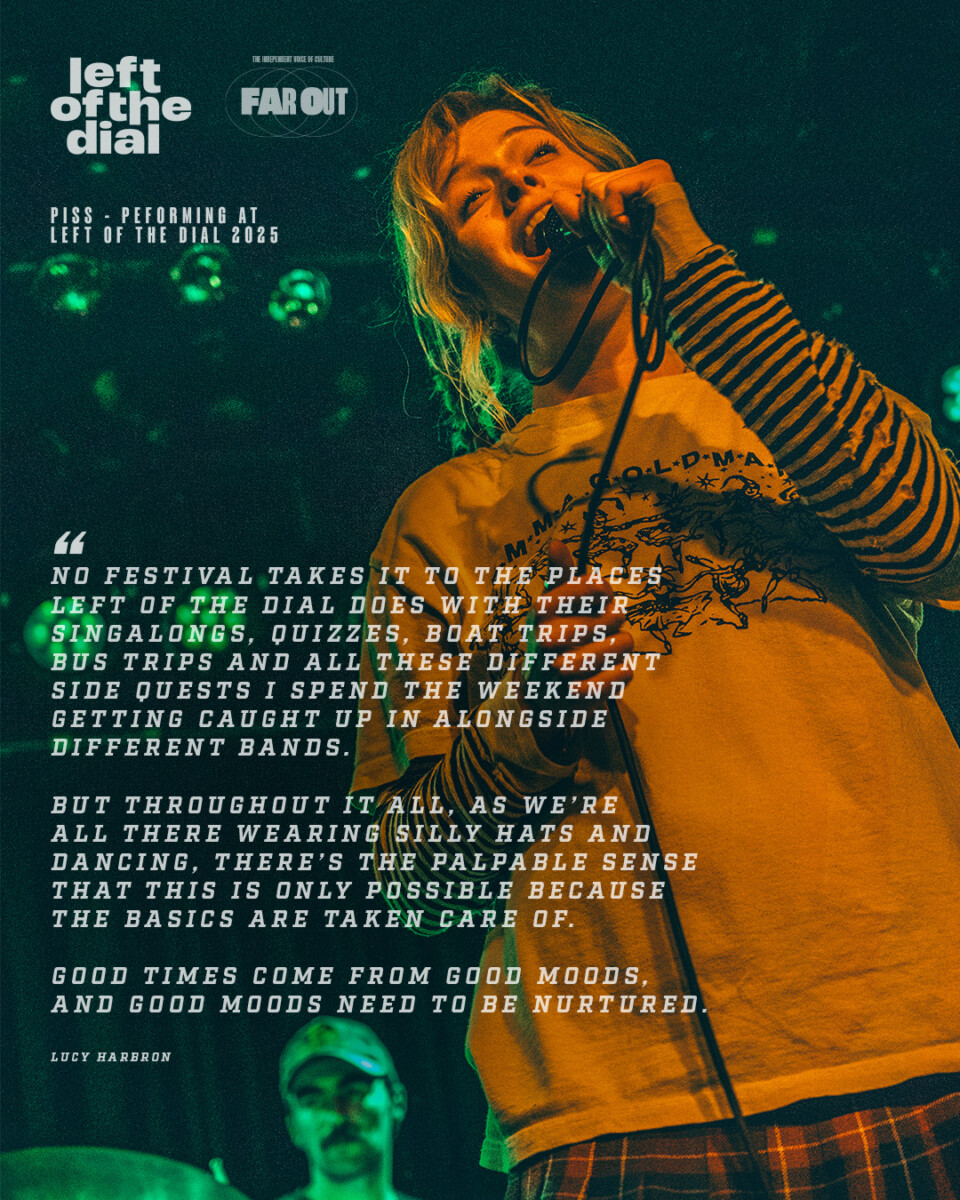
Good times come from good moods, but good moods need to be nurtured.
