


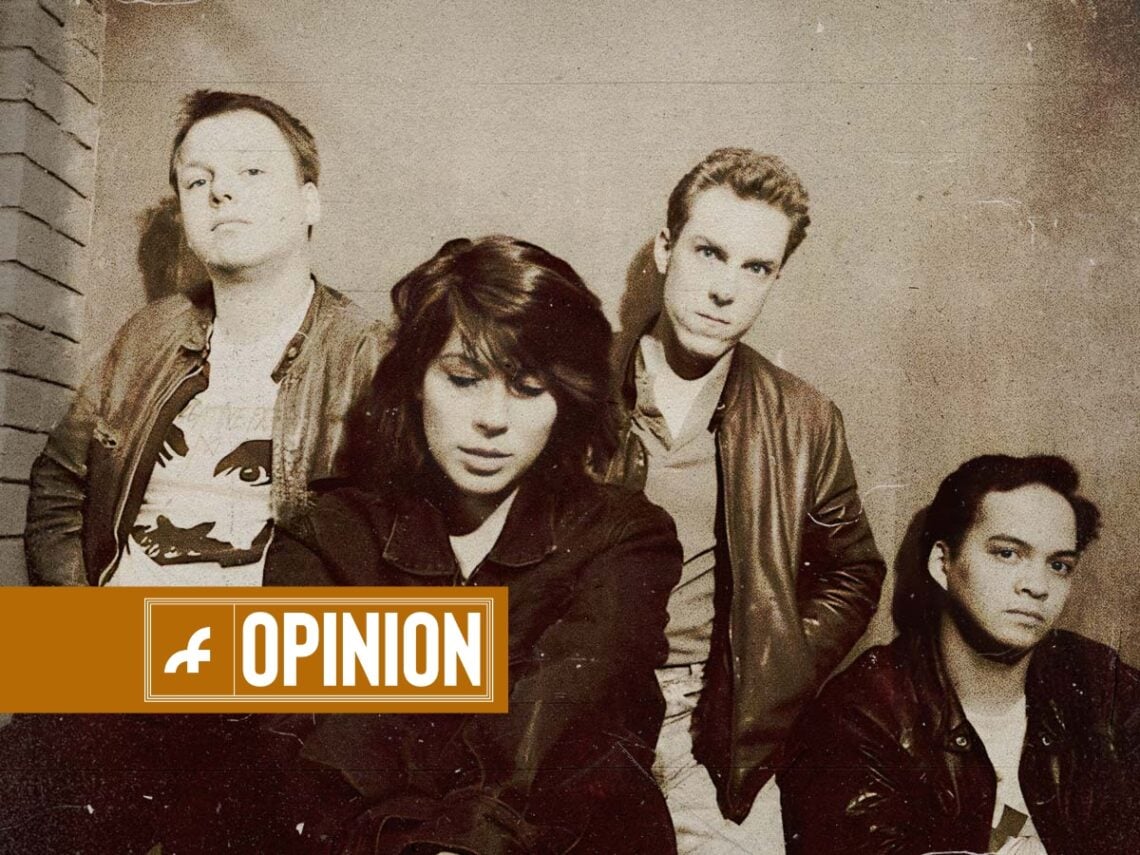
Hear Me Out: Pixies are nothing without Kim Deal

When Pixies entered the scene in the 1980s, alternative rock music would never be the same again. Their debut EP, Come on Pilgrim, was released in 1987, with their first album, Surfer Rosa, appearing the following year. Their music prioritised soft/loud dynamics, a trait which the music industry is incredibly familiar with today. However, back when Pixies emerged, the band helped to pioneer the technique, inspiring a new wave of artists to do the same.
Subsequently, Pixies defined ’90s alternative rock, especially inspiring the grunge movement. Nirvana’s Kurt Cobain was so enamoured by Pixies’ sound that he once admitted they were the main inspiration for their hit song, ‘Smells Like Teen Spirit’. Cobain later told RS: “I was trying to write the ultimate pop song. I was basically trying to rip off the Pixies. I have to admit it.”
He continued: “When I heard the Pixies for the first time, I connected with that band so heavily I should have been in that band — or at least in a Pixies cover band. We used their sense of dynamics, being soft and quiet and then loud and hard.”
However, keeping the Pixies’ music afloat were magnificent basslines played by Kim Deal. The musician joined the band after answering an advertisement, despite having no training in the instrument, given that she was a guitarist first and foremost. Regardless, Deal taught herself how to play the bass and swiftly made her mark, playing rich basslines that weighted the songs down. Whereas lead vocalist Black Francis was quick to throw in some aggressive yelps and screeches, Deal provided a sense of stability with her strong rhythms.
Deal’s delicate vocals, meanwhile, often relegated to the background, added another layer of dimension to the songs, providing something different to the wealth of their male-dominated contemporaries. When Deal was given a chance to sing lead vocals, which was tragically rare, she proved that Pixies would be nothing without her. On ‘Gigantic’, one of the band’s best songs, Deal sings about a taboo relationship between a black man and a white woman, and her tender vocals contrast perfectly with the rest of the band’s instruments – including her prominent bass guitar, which opens the song on its own. The track also sounds distinctly ahead of its time, and it’s hard to believe that ‘Gigantic’ was actually released in 1988.
To solidify her presence, even Cobain told Melody Maker in 1992 that Deal was the best part of the Pixies. The Nirvana frontman said: “The main reason I like them is for their songs, for the way they structure them, which is totally unique, very atmospheric. I wish Kim was allowed to write more songs for the Pixies because ‘Gigantic’ is the best Pixies song, and Kim wrote it.”
However, Deal reached a point of dissatisfaction within the band, with Francis becoming increasingly controlling, allowing Deal to have little creative input. Thus, she moved on to her own project, The Breeders, a band that are just as good as the Pixies, although they don’t often receive the same respect. The almost all-female lineup was a stark contrast to many alternative rock bands at the time, and this undoubtedly inspired many budding female musicians.
Meanwhile, the music that the Pixies have made without Deal pales in comparison, with their recent albums, Beneath the Eyrie and Doggrel, failing to reach the heights of Surfer Rosa and Doolittle. Unfortunately, the band took Deal’s skills for granted, and drummer David Lovering admitted in 2014 during an interview with Brooklyn Vegan: “When we were in the lurch when Kim Deal left it was a tough decision. Basically, no one can replace Kim Deal. It would be impossible to do.”
Indeed, Deal’s talents as a bassist, despite preferring her guitar, helped cement the Pixies as one of alternative rock’s most important bands. With The Breeders, Deal proved how much she had been held back in the Pixies, creating songs such as ‘S.O.S’, sampled in The Prodigy’s ‘Firestarter’ and the iconic ’90s anthem ‘Canonball’. Deal was a vital part of the 1980s and ’90s alternative rock scene, and it’s about time she received more recognition for her talents.
