


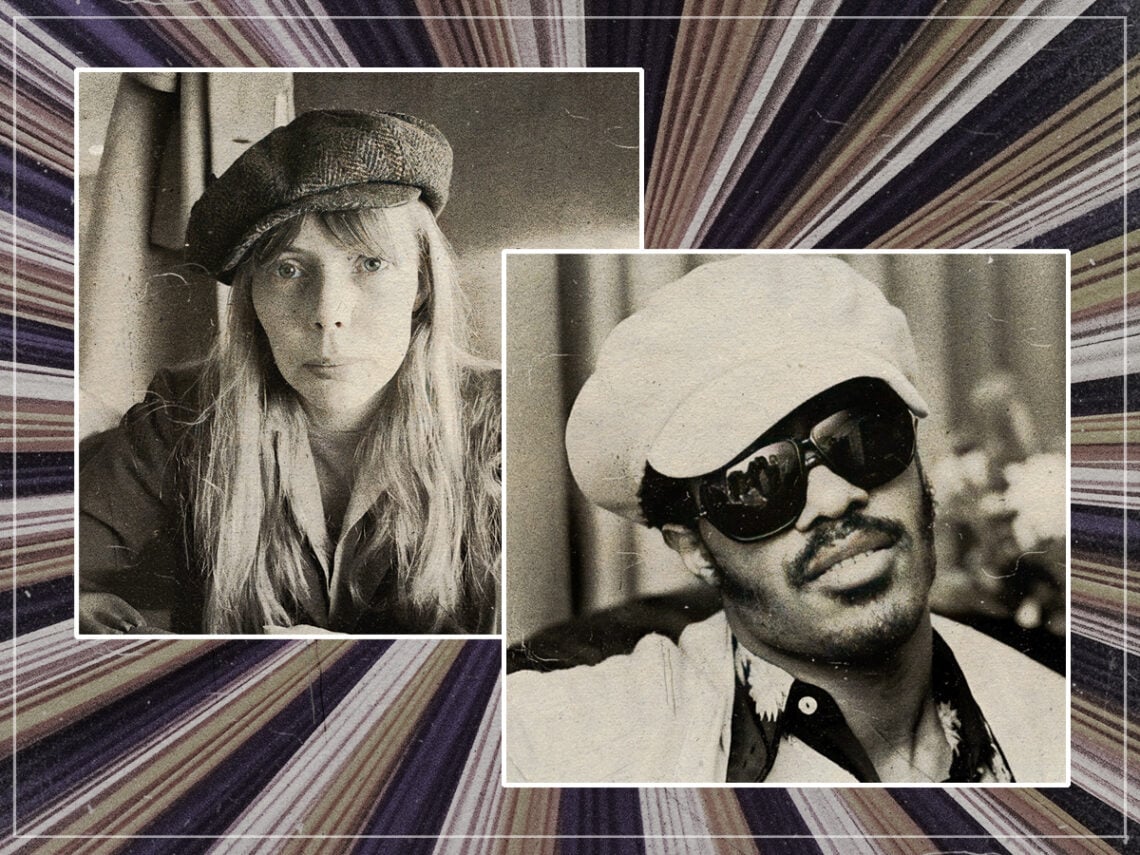
How Joni Mitchell inspired Stevie Wonder: “That’s the kind of influence I like”

Some of the most valuable musical influences serve as guiding stars rather than complete blueprints. They transform sounds, emotions, melodies, or chords to fit a new essence. For instance, Joni Mitchell and Stevie Wonder are both immensely accomplished musicians in their own unique ways, rendering direct comparisons all but futile. Mitchell’s impact on Wonder serves as an exemplary showcase of artistic excellence, revealing the potency of forging new directions rather than constructing an entirely novel foundation.
By the late 1960s, both Mitchell and Wonder embarked on unique artistic departures. Mitchell’s ‘Both Sides Now’ and Wonder’s ‘My Cherie Amour’ paid homage to the era’s prevailing pop conventions and pushed the genre’s boundaries. While Mitchell aimed to create music that complemented her evocative lyrics, Wonder began to delve into innovative instrumentation, seeking to craft a musical journey that would captivate and unite his audience.
Throughout the decade, Wonder more than solidified his status as one of his generation’s most gifted singer-songwriters and musicians. In the 1970s, his success reached its zenith, notably with the iconic ‘Superstition’, showcasing the distinctive sound of the Hohner Clavinet keyboard. His albums ‘Innervisions’, ‘Fulfillingness’ First Finale’, and ‘Songs in the Key of Life’ all received the prestigious Grammy Award for ‘Album of the Year’, a remarkable accomplishment as he became the sole artist to win this award with three consecutive album releases.
Much like her counterpart, Mitchell’s journey mirrored this pattern: she emerged as a significant figure in the 1960s, but it was her iconic 1971 album Blue that significantly contributed to her status as one of the greatest artists in history, thanks to timeless hits like ‘A Case of You’, ‘River’, and ‘All I Want’. While both artists made substantial offerings to the music industry, the striking parallels between their careers were not merely a matter of chance.
When Mitchell was interviewed by Elvis Costello in 2004, Costello asked Mitchell whether she was aware that she “had given a license to other people”. Her response included Wonder himself: “I think that [Stevie] Wonder told me that he had heard me coming in on the radio from Windsor [Ontario],” she explained. “That I had influenced some of his pieces. It wasn’t like he copped the lick or anything like that, but basically, he went in a more adventurous chordal direction than he would have had I not existed. That’s the kind of influence that I like. It is not copying.”
In terms of being a lyrical influence, Mitchell didn’t really resonate with the idea, despite the poeticism within many of her tracks becoming significant focal points for a lot of artists that followed. “Paul Simon started piling up a lot of words,” Mitchell joked, “More than the bar could handle, and I stopped! If that’s what it sounds like, I better cut that out.”
While both Mitchell and Wonder’s styles and genres differ, discovering their similarities is like stumbling across new layers of your favourite artists. While Mitchell often remains introspective and personal, and a lot of songs by Wonder are rooted in social and political commentary, both resonate deeply with their respective audiences and have made unmatched contributions to the world of music.
