


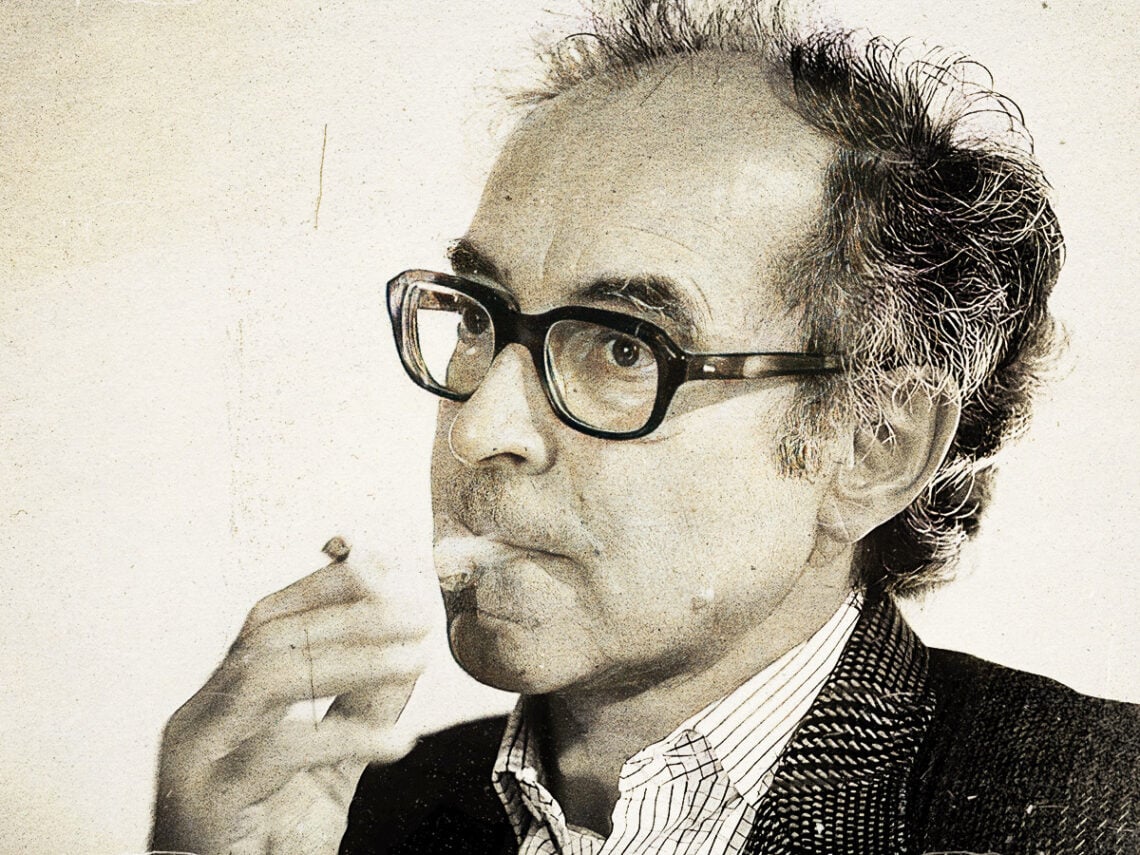
How Jean-Luc Godard inspired Quentin Tarantino to break the rules

In the late 1950s, a group of young film critics from the French magazine Cahiers du cinema decided to reinvent the cinematic landscape, fed up with the domineering nature of the Hollywood studio system, which limited personal creativity.
The most prominent names to pick up a camera and experiment with new stylistic and thematic ideas included François Truffaut, Jacques Rivette, Eric Rohmer and, perhaps the most well-known, Jean-Luc Godard. Born in 1930, Godard wasn’t introduced to cinema until the mid-1940s; however, as the 1950s rolled around, he began attending film societies, spending all his time watching movies.
He once explained, via Godard Biography: “In the 1950s cinema was as important as bread—but it isn’t the case anymore. We thought cinema would assert itself as an instrument of knowledge, a microscope… a telescope…At the Cinémathèque I discovered a world which nobody had spoken to me about. They’d told us about Goethe, but not Dreyer. We watched silent films in the era of talkies. We dreamed about film. We were like Christians in the catacombs.”
Godard made his first of several short films, Une femme coquette, in 1955, before making his feature debut with 1960’s Breathless. The film was revolutionary, thanks to its unique formal style, quickly becoming one of the most influential efforts of its time. The film was inspired by various influences, from American film noir to Italian neo-realism. However, Godard experimented with techniques that had rarely been seen on the big screen before.
The director largely improvised the screenplay as shooting progressed, choosing real locations rather than sets and using handheld cameras to capture the action. Godard gave Truffaut a vague outline of his idea, telling him, “Roughly speaking, the subject will be the story of a boy who thinks of death and of a girl who doesn’t”.
The movie is best known for its pioneering editing style, which prioritised arresting jump cuts, often during events and dialogue. Godard aimed to keep audiences on their toes by drawing direct attention to the artificiality of the cinematic medium, demonstrating that we should actively consume the action on screen rather than having it passively spoon-fed to us.
As his career progressed, Godard continued to release boundary-pushing movies, from Vivre sa vie and Masculin Feminin to Tout Va Bien and Wind from the East, the latter two emerging from his radical political period. Godard consistently experimented with new modes of filmmaking, honing a distinctive style that has greatly inspired modern directors, from Wes Anderson to Quentin Tarantino.
The latter has cited Godard as one of his biggest cinematic inspirations, even naming his production company A Band Apart after the filmmaker’s 1964 movie Bande à part. Tarantino has always been a big fan of Godard’s “inventiveness” and “breaking [of] the rules”, which evidently inspired him while beginning his own filmmaking career.
Tarantino burst onto the scene in the early 1990s with Reservoir Dogs, which was lauded as one of the most important independent movies of all time. Godard’s influence on Tarantino’s style is apparent, from his unconventional editing, often using non-linearity, to his manipulation of the cinematic form. Through Godard, who began his filmmaking career using small budgets, improvisation, natural lighting and on-location shooting, Tarantino learnt that a great film could be made with minimal resources. If your passion and dedication are strong enough, they will carry you half the way to greatness.
While Godard’s work became more experimental as the years progressed, Tarantino was able to utilise the skills he learnt from studying Godard’s films to become one of the most successful mainstream filmmakers in modern cinema. Although Godard isn’t the biggest fan of Tarantino’s work, movies like Reservoir Dogs and Pulp Fiction might not have turned out as successful without Godard’s influence.
Tarantino once summed up his adoration for the director by saying, “To me, Godard did to movies what Bob Dylan did to music: they both revolutionised their forms.” Tarantino’s unique cinematic style owes much of its success to Godard, who truly transformed cinema with his radical approach to form and content.

Never Miss A Take
The Far Out Quentin Tarantino Newsletter
All the latest Quentin Tarantino content from the independent voice of culture.
Straight to your inbox.