


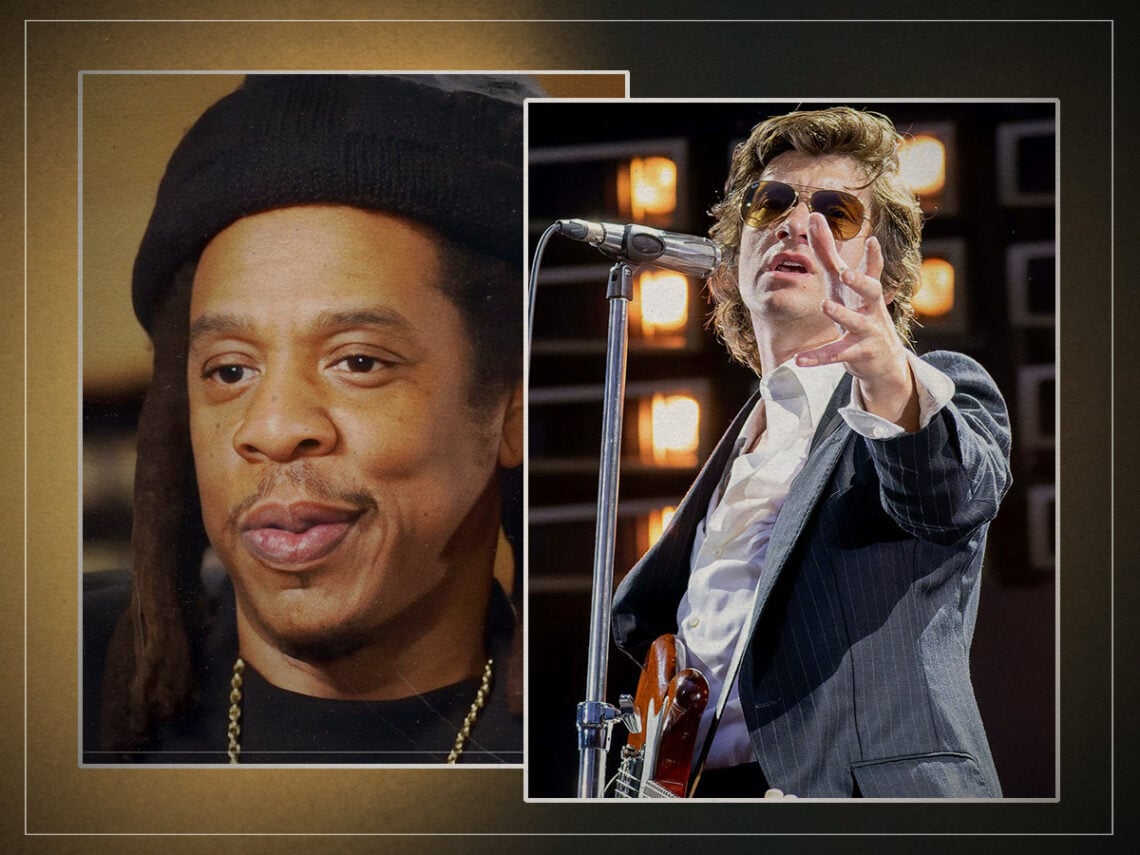
How Jay-Z inspired the Arctic Monkeys: “It was instantly fun”

What was it about Arctic Monkeys‘ AM album that made it so popular? Sure, the riffs on their lead singles ‘R U Mine?’ and ‘Do I Wanna Know?’ did a great deal of heavy lifting, so did the band’s tailor, who kitted them out in the finest suits LA had to offer. But the credit is largely to be attributed to the rhythm sections.
Heavily, it waded through the sludge of this sultry brand of rock the band had crafted. Sticky bass notes were smashed down on the floor by Matt Helders’ kick drum, which combined to create a groove in which these tales of sexualised fantasies and late-night debauchery could flourish. It was very much R&B, packaged into the monochromatic steel of rock and roll.
That creative idea landed the record at the top of the charts and catapulted the band into a place of transatlantic stardom they hadn’t yet experienced. This was the album that changed it all and, dare I use the dirty phrase, broke America.
But it’s largely unsurprising given the influences on the record. The band have regularly cited West Coast hip-hop as a reference point, both lyrically and rhythmically. There was a subtle arrogance that matched the swagger of the basslines, and suddenly, American audiences were no longer asking what a Smirnoff Ice was but instead what part of England these new rockers hailed from.
But this transition didn’t happen overnight as the band were browsing American radio stations in between tour shows. No, ever since their humble beginnings, they were taking influence from the world of hip-hop. Turner’s observational musings could quite easily be compared to The Streets, while the caustic rhythms of Roots Manuva could be heard in Helders’ drum parts.
“I would play along to hip-hop and rap, as I was learning,” Helders explained to Drumeo, adding, “It was instantly fun to play along to, because there was loads of space to do fills”.
The space was introduced on AM, à la West Coast hip-hop, but years earlier, it was artists from its warring coast that influenced a young Helders. “I used to watch, after school, we used to, me and Alex, the singer, I remember like we taped MTV, like Jay-Z Unplugged and he had like The Roots were his band. And I remember thinking like I hadn’t seen sort of rap music with a live band be pulled off in that way back then.”
But those influences weren’t stored away for 15 years and later unveiled on the groove-laden AM. No, Helders took what he saw from Questlove and Jay-Z, and put it onto some of their earlier records, namely Fluorescent Adolescent. “I think I just, it comes out in, maybe some of the kick drum patterns in some of these songs, like the way certain things are swung is probably from that.”
Whatever be the album you pick up on it, it’s safe to say hip-hop has been a major influence in the band’s evolution. Which is maybe why fans put off by their last two records are yearning for the days of yesteryear when Helders’ swagger was more unshackled.
