


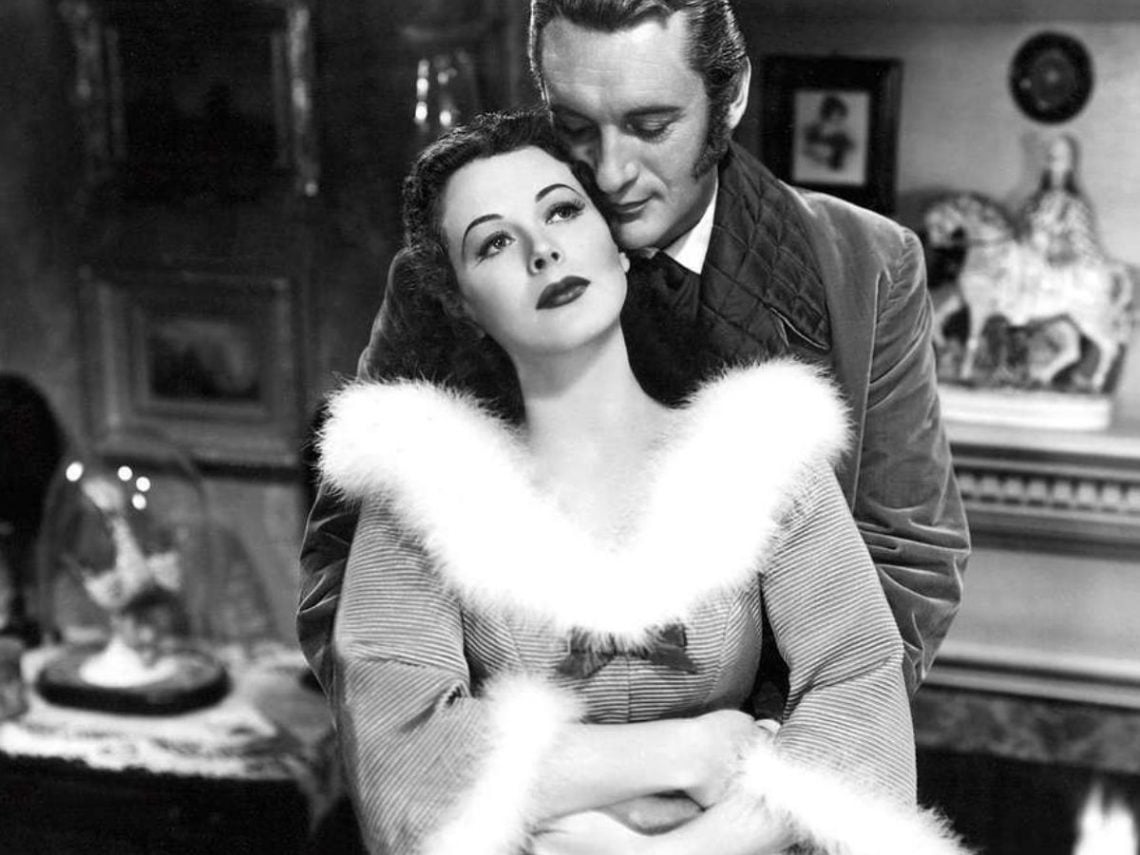
How did Hollywood star Hedy Lamarr influence the development of wi-fi?

During the Golden Age of Hollywood, women were routinely boxed into several archetypal categories, like the femme fatale or the ingénue. While this hasn’t disappeared—many films still rely on tired old stereotypes—during the prime years of American cinema’s evolution, women were rarely seen as multi-faceted individuals, something that Hedy Lamarr challenged.
The actor was born in 1914 in Austria, her real name being Hedwig Eva Kiesler. When she was just a teenager, she began acting, leading her to take the main role in the 1934 film Ecstasy, directed by Gustav Machatý, when she was just 18 – a performance that would become both groundbreaking and controversial. The young Lamarr appeared nude in the film, as well as acting out a sex scene that featured a close-up shot of the actor having an orgasm. Compared to today’s standards, there is nothing particularly shocking about the film, but in the early ‘30s, people were truly taken aback by the inclusion of explicit and overtly erotic content.
After Ecstasy, Lamar’s next role was in 1938’s Algiers, her first American film. She had been discovered by Louis B. Mayer from MGM Studios on a ship, leading her to start up a successful Hollywood acting career. Roles in movies like Lady of the Tropics, Comrade X, Samson and Delilah, and Ziegfield Girl followed, making her one of the era’s most popular stars.
Yet, Lamarr wasn’t just a talented and gorgeous actor, as she was best known – she was also an inventor. Most crucially, the actor was responsible for coming up with an idea that would pave the way for inventions that, today, we wouldn’t be able to live without, like wi-fi, Bluetooth, and GPS.
Her interest in inventions and science emerged at an early age, and she was constantly coming up with interesting ideas, but in 1940, the technology she conjured up turned out to be revolutionary. While attending a dinner party, she met the musician George Antheil, and they bonded over their naturally inventive minds, deciding to work together to create a way to aid Allied Forces during World War Two.
From her time married to the domineering arms dealer Fritz Mandl, who possessed fascist sympathies and whom she soon left, Lamarr had learned a great deal about the intricacies of war, such as the need for a system to guide torpedoes without enemies intercepting and blocking via radio technology. With Antheil, the pair took inspiration from his musical compositions to come up with a better way for communication that could easily guide torpedoes without the Nazis intercepting, using frequency-hopping technology. Their idea was patented, but that’s sadly as far as Lamarr and Antheil’s idea got, with the Navy rejecting it.
Still, Lamarr was eventually praised for her pioneering idea, which influenced the creation of vital communication-based technologies that we rely on today. She was inducted in the National Inventors Hall of Fame in 2014, 14 years after her death. On her tombstone reads the words, “Films have a certain place in a certain time period. Technology is forever.”
