


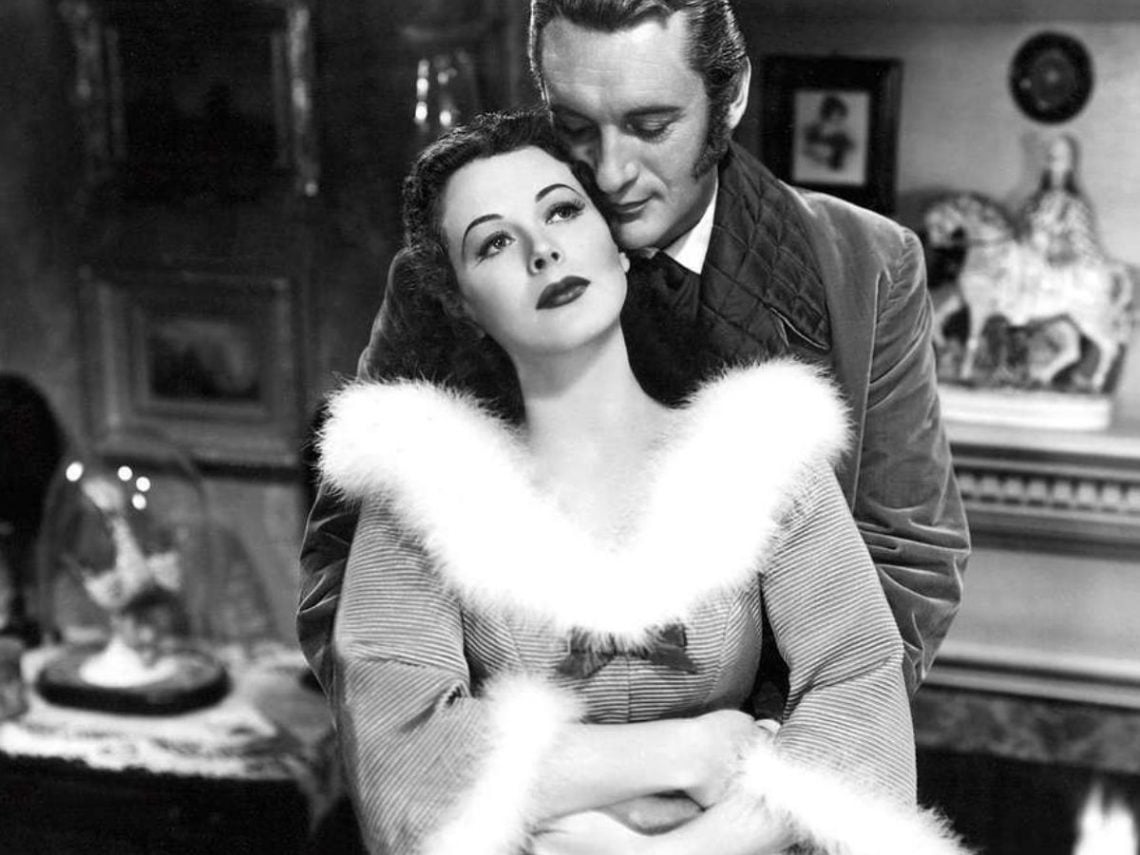
Hedy Lamarr: Escaping fascism to become “the world’s most beautiful woman” in Hollywood

The talented, groundbreaking and timeless Hedy Lamarr was one of classic Hollywood‘s most profitable and sought-after faces. She was instantly recognisable by her provocative femme fatale appearances that exerted the utmost power and feminine energy. The Austrian-born American film star, born Hedwig Eva Maria Kiesler, gifted cinema with one of its most intriguing yet underrated star stories through her roles and contributions outside the film industry.
The star’s pre-Hollywood life consists of the typical rags-to-riches tale that captivates audiences and critics alike, combined with some monumental historical events. Born in 1914 in Vienna, Lamarr grew up in a Galician-Jewish family and balanced a passionate interest in theatre and music alongside her family’s religious practices. When she was 18, she met with the wrath of controversy owing to her erotic cinema appearances during her early career in Czechlovokia starring in risque films like Ecstasy. She soon married Friedrich Mandl, an Austrian military arms merchant and munitions manufacturer who was the third-richest man in Austria and 15 years Lamarr’s senior.
The actor had become the object of the merchant’s obsession. He was infatuated and obsessed with her after seeing her perform in a play in the early 1930s. The couple’s marriage earned her parent’s disapproval, not because of the age difference or Mandl’s obsessive ways, but because he had connections to Benito Mussolini and Adolf Hitler, two of the most dangerous Fascist leaders in history. Despite her heritage making her a target, Lamarr refused to leave her husband for this reason.
However, her parent’s superstition proved true as Lamarr eventually found the marriage unbearable. After watching her husband host parties for the regimes and suffering under his possessive and controlling nature, including banning her from any erotic performances, the actor wanted out. She wrote in her autobiography: “I knew very soon that I could never be an actress while I was his wife. … He was the absolute monarch in his marriage. … I was like a doll. I was like a thing, some object of art which had to be guarded—and imprisoned—having no mind, no life of its own.”
Lamar hatched a plan to liberate herself from such an overwhelming marriage, disguising herself as her maid and fleeing to Paris. Other accounts claim she tricked Mandl into letting her wear all of her jewellery for a dinner party, then disappeared afterwards, never to be seen again.
This is where the story of the Hollywood icon begins. Upon arriving in London in 1937, Lamarr crossed paths with the head of MGM himself, Louis B. Mayer, during his scouting for talent, almost as if it was fate. After turning down an initial offer of $125 a week, Lamarr booked the same New York linear as Mayer and impressed him into offering $500 a week.
One name change later, as advised by Mayer to distance Lamarr from “the Ecstasy girl”, who then offered a tribute to the silent film star Barbara La Mar, the actor was taken to Hollywood under the relentless promotion of “the world’s most beautiful woman”. From here, Lamar transformed from an erotic amateur actor turned runaway to a glamorous breakout star, thanks to her magnetic role as Gaby in the 1938 drama Algiers. Accounts claim this unknown actor caused gasps to erupt from the crowds when her face appeared on screen, immediately immersing audiences and maintaining their attention.
In the early ’40s, Lamarr then found herself typecasted as the dark yet irresistibly seductive femme fatal, a polar contrast to Marilyn Monroe’s ‘ditzy’ blonde bombshell roles around the same time. Her performance in this era included the controversial Manon DeVargnes, a seductive islander whose erotic and sexualised energy stemmed from her mixed-race identity (which Lamarr disappointedly performed in brown face), in Jack Conway’s 1939 drama Lady of the Tropics. Boom Town followed this performance, again directed by Conway and released in 1940, and Clarence Brown’s Come and Live With Me with a Lamarr playing a role that had a similar backstory to her own.
Lamar again played an erotic and seductive part in 1941’s White Cargo under Richard Thorpe’s direction, taking on another POC role as an Arab woman called Tondelayo. Her most successful role came with Samson and Delilah, released in 1949 and directed by Cecil B. DeMille. Lamarr played Delilah, a woman mentioned in the sixteenth chapter of the Book of Judges in the Hebrew Bible. The actor showcased her perspective on her typecast career and the public perception that came with it, claiming, “any girl can be glamorous; all you have to do is stand still and look stupid.”
The irony of this is that Lamarr was anything but stupid, concealing an engineering ability against her striking beauty and seductive energy. One positive trait the actor could expand on and perfect through her marriage to Mandl and the regime meetings she oversaw was their emphasis on applied science. Lamarr, who had an interest in this field growing up, fostered her knowledge and physical skills through these talks, going on to contribute a historical landmark in technology.
During the Second World War, Lamarr overheard the news that radio-controlled torpedoes had been proposed, but the enemy’s ability to jam the guidance system negotiated their course. The actor shared this with her friend George Antheil, an avant-garde composer, raising the idea that a frequency-hopping signal could prevent the torpedo’s radio guidance system from being tracked or jammed. Alongside her friend, Lamarr employed her self-taught and practised engineering skills to develop a radio guidance system for Allied torpedoes, focusing on frequency hopping to combat the threat of Axis power’s jamming. This development was achieved by synchronising a miniatured player piano mechanism with radio signals, which was granted as U.S. Patent 2,292,387.
Lamarr and Antheil’s work goes beyond war technology, as it is the blueprint for Bluetooth and GPS technology, meaning contemporary society’s most valued devices resulted from a (Jewish) woman’s vision and execution, with the exciting detail that she was a Hollywood star. The actor and composer both received the Electronic Frontier Foundation Pioneer Award in 1997 for their contributions and later were introduced into the National Inventors Hall of Fame in 2014.
Lamarr’s film career remained just as successful and rewarding, as she was cited as one of cinema’s greatest actors of all time and was honoured with a Hollywood Walk of Fame star in 1960. However, her personal life experienced hardships of failed marriages, estranged relationships with her children and seclusion until her passing at age 85.
Lamarr’s story, one of the many that harmonise the industry and global politics, is one of Hollywood’s most fascinating yet underrated, recounted in Bombshell: The Hedy Lamarr Story, a documentary released in 2017 and directed by Alexandra Dean. Co-producer Susan Sarandon told The Big Issue she had to help create a tribute to someone “so strong, as well as brilliant”, adding: “her story was the injustice of the idea that just because you’re beautiful, you can’t have brilliant ideas.” It is a story that combines history, politics, science, technology and the art of cinema through one remarkable and iconic woman.
