


‘Papa’s cinema is dead’: how German cinema evolved after World War II

Understandably, it took German cinema a long time to outrun the lingering shadow cast by World War II, when the industry had been reduced almost entirely to a state-approved propaganda machine where creativity and imagination were rendered worthless under a totalitarian regime.
Many filmmakers had fled the country before the conflict even began, with Fritz Lang famously fleeing to America to continue his career after Joseph Goebbels reportedly hand-selected him to head up the Nazi Party’s propaganda film division. Producer Erich Pommer, stars Peter Lorre and Marlene Dietrich, and filmmakers Douglas Sirk and Billy Wilder all enjoyed major success in the United States after emigrating, which was endemic to what the medium had become on home soil.
Following the war, measures were put in place to safeguard the future of German cinema, which included funding being shared between a larger number of smaller production companies, as well as limitations on foreign imports. Attendance was up, but films from outside of home shores were the most popular by far, with only 40% of the market share being occupied by local movies.
Economic downturn dealt another hammer blow, with the 1950s coinciding with a huge drop in attendance, shuttering many production and distribution outfits as a result. The number of screens was cut almost in half, and volume dwindled significantly from 123 features made in 1955 to just 65 ten years later. There was a balance that needed to be struck between quantity and quality, which came along at just the right time when an intrepid band of would-be auteurs ended up changing the face of German cinema to usher in its brightest period in a long time and perhaps at its most influential ever.
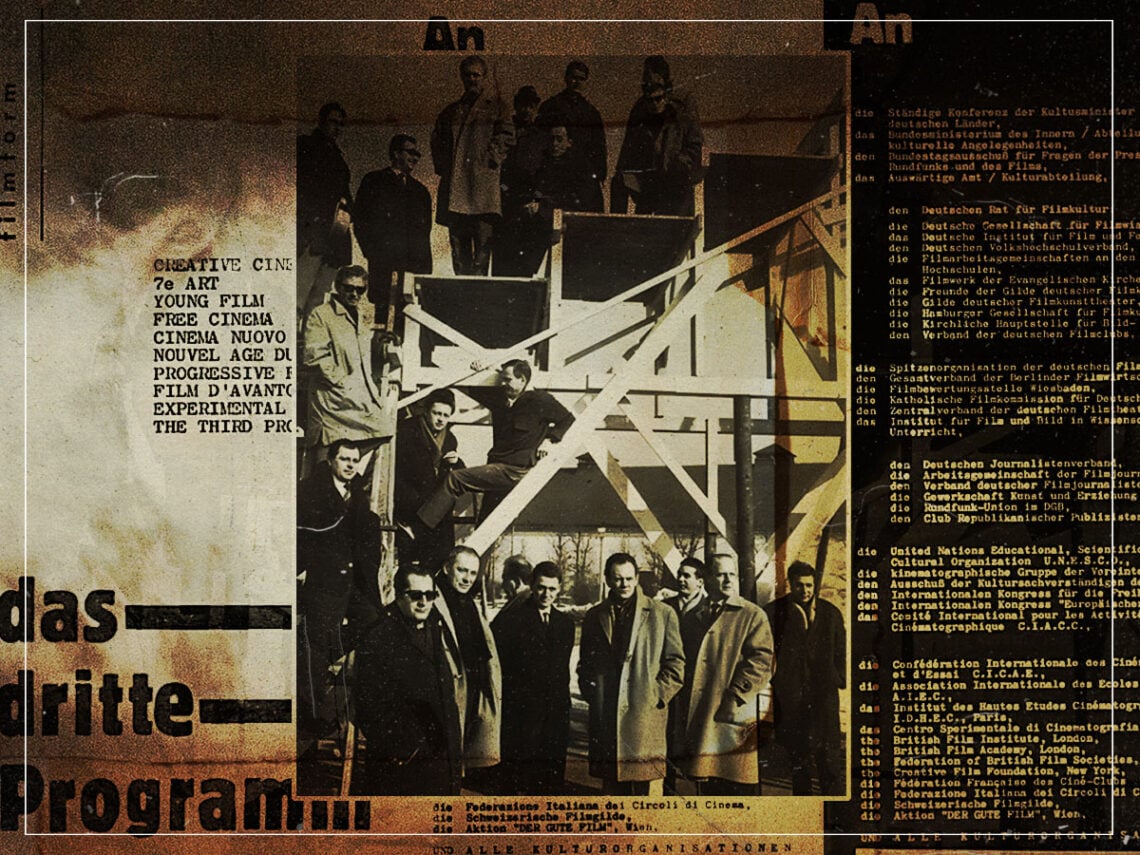
In the early 1960s, Germany’s stifled system got the shot in the arm it so desperately needed, which began in earnest when 26 filmmakers signed a declaration at an international short film festival that would become known as the Oberhausen Manifesto. On February 28th, 1962, the call to arms was issued to establish a new era in cinema, severing ties with the past in order to carve out a brighter future.
Even though it doesn’t appear verbatim in the manifesto, it became associated with the term “Papas Kino ist tot,” which translates as “Papa’s cinema is dead.” Evocative and self-explanatory, the 26 signatories had largely been born in the 1920s and 1930s and sought to capitalise on their disassociation with the downturn of the wartime years and post-war era to put their own stamp on the medium.
In terms of global recognition, unbridled originality, and even ticket sales, German cinema was at its lowest ebb in a long time. Backed by more than two dozen auteurs-in-waiting, they took it upon themselves to repaint filmmaking in their own image by taking on daring stories, adopting stylistic expressions that flew in the face of the established norm, and backing themselves to the hilt.
Paul Verhoeven’s mentor Rob Houwer, existential maestro Alexander Kluge, Academy Award-winning documentarian Haro Senft, and future Stanley Kubrick collaborator Franz-Josef Spieker were among the 26 who signed the Oberhausen Manifesto. Still, their legacy didn’t truly begin to take shape until the filmmakers who wanted to follow in their footsteps appeared on the scene to usher in the ‘New German Cinema’ movement.
Among them were the maverick Werner Herzog, the influential and uninhibited Rainer Werner Fassbinder, the thought-provoking Wim Wenders, and Margarethe von Trotta, to name a few. Using the mandate of the Oberhausen Manifesto as their launchpad, nothing was off limits for the new generation of directors who’d been inspired by the people who’d themselves been inspired to blaze a new trail for future creatives to follow. Things were bleak from the 1940s right through to the dawn of the 1960s, but that’s when a seismic change was finally instigated at long last.
Prior to the dawn of New German Cinema, the majority of local works were genre films. Westerns, noirs, crime thrillers, and horror were the order of the day, with originality and imagination being stifled by the limitations imposed upon filmmakers by the rigid terms and conditions that powered the industry. Fortunately, when it was most needed, the inspiration and influence of the Oberhausen Manifesto gave way to a bold, bright, and daring new era.
Sexual boundaries and taboos were explored and pushed in films like Rosa von Praunheim’s It Is Not the Homosexual Who Is Perverse, But the Society in Which He Lives and Volker Schlöndorff’s Young Törless. There were also powerful slice-of-life dramas that shone a light on the travails of everyday post-war existence in Alexander Kluge’s Yesterday Girl and Fassbinder’s Ali: Fear Eats the Soul, while existential ruminations helped define Helma Sanders-Brahms’ Under the Pavement Lies the Strand and Herzog’s Aguirre, the Wrath of God.
Nothing was off-limits for New German Cinema, and that was apparent in the creative and narrative risks its most noted luminaries built their reputations on taking. In direct contradiction to the two decades previously, their concern was not on crafting a project that would make the most money but utilising cinema to its purest and fullest extent as a conduit to reflect genuine social, societal, and economic concerns without sacrificing an ounce of authorship.
