


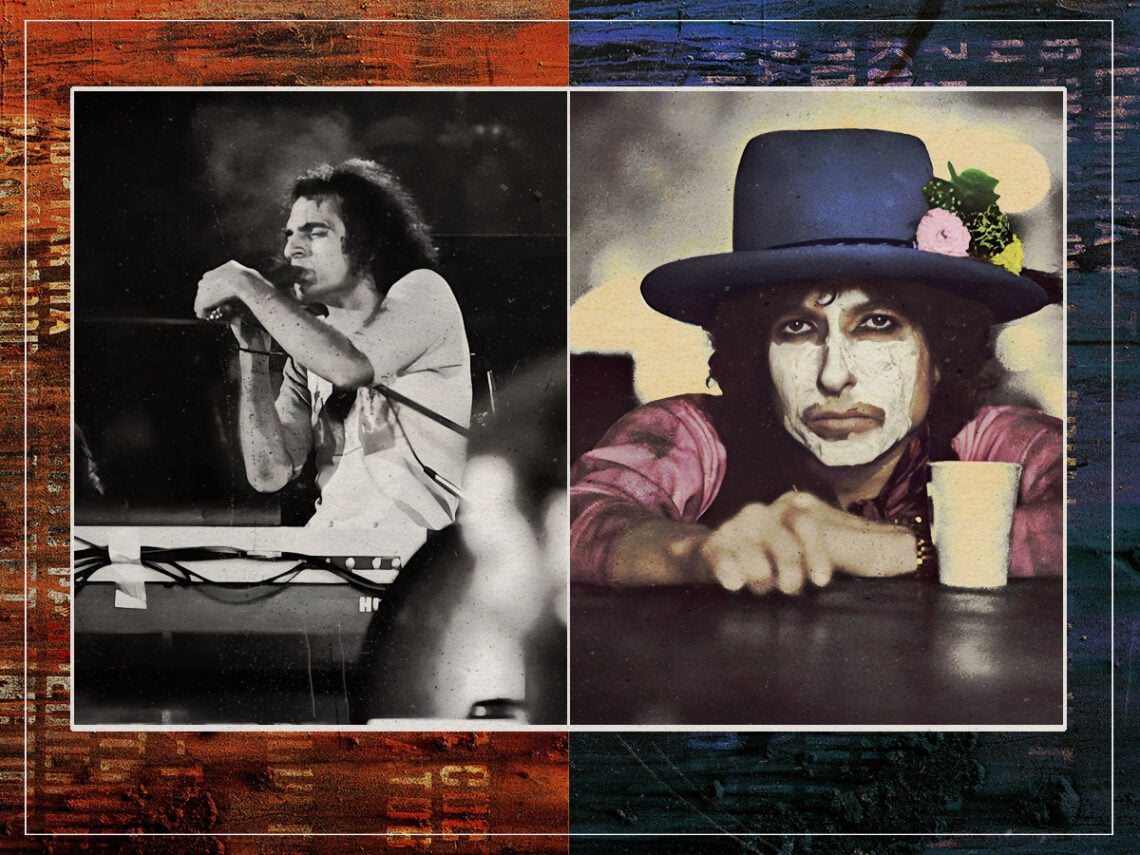
“I was really excited”: The story of how Donald Fagen almost became Bob Dylan’s keyboardist

It’s probably fair to say a small part of every musician is obsessed with Bob Dylan and his cultural impact, whether it’s good or bad. Dylan not only set the precedent for what genuine artistry looks like in the industry but also invited generations of others to match his prowess—or rather, he dared them. Ignited by the fact that no one will ever come close, Dylan remains untouchable, even after all these years.
Calling Dylan a genius is like calling the sky blue, but less easy or obvious is pointing out what, exactly, makes him so great. Usually, when discussing Dylan, something about his complexity, his enigmatic way of operating, or how he injected traditional folk and rock with a strange, unexpected sense of realism and abstraction, the kind no one knew what to do with except sit back and enjoy, is mentioned.
However, we rarely give credence to Dylan’s ambivalence toward external factors and figures and often mistake his silence for mystery instead of obliviousness or indifference. The skilled wordsmith might be precise in his songwriting without ever giving too much away regarding messaging, themes, or specific influences, but how much can we misinterpret his self-effacing manner for a genuine enigma?
According to Donald Fagen, understanding Dylan is most straightforward when he’s positioned as a culture rather than an artist. “The thing is, Bob is a culture. And I don’t think we have anything to do with that,” he explained in 2021. “I do think popular music fulfils a lot of the function of poetry. And yeah, Bob’s the one who broke it open. There are other people. [Bertolt] Brecht, who used popular music for his own purposes.”
However, Fagen’s relationship with Dylan is a complicated one. While he has frequently complimented his artistry while acknowledging the monumental impact he had on music, he has also shared moments when he felt embittered by the singer, even if the reasons why feel less indirect than expected. For instance, Fagen has directly expressed interest in working alongside Dylan in the past, including one situation where he responded to a newspaper ad calling for unknown, qualified musicians to join him.
At the time, Dylan’s bass player, Rob Stoner, recognised Fagen’s name and contacted him to let him know he would speak to Dylan and get back to him. However, Fagen never had his call returned, and didn’t hear from them again on the matter.
“As far as I’m concerned,” Fagen told Brian Sweet in Steely Dan: Reelin’ in the Years, “Dylan passed up a good thing. Sorry, Bob, I’m not available anymore. I’m too busy. I inquired about joining Dylan’s band, but when I did, I was quite secure in my own endeavours. I’m in Steely Dan, and it was basically a whim.”
When asked whether he almost became Dylan’s keyboardist a handful of years back, Fagen recalled a slightly different turn of events. “Out of nowhere I wrote a letter at one point to Albert Grossman, this is when we were just writing songs in Brooklyn, and nothing was happening,” he said. “So at one point I just wrote a letter to Albert saying I was available. He never wrote me back. Actually, I got a call in the ’70s from [Stoner].”
He continued: “He asked me if I wanted to come out because there was going to be another leg of this tour, and I was really excited. But it never happened. I thought, oh this will be great, I had a few months with nothing to do.” Another intriguing aspect of Fagen’s interest in Dylan is that he seems to praise the artist one minute while criticising him the next.
Although his rejection might seem like the obvious reason, it remains unclear why he has criticised Dylan’s approach so harshly in the past while expressing admiration for him more recently. Regardless, one certainty that emerges is that Fagen’s complex feelings towards Dylan are not unique; many others share similar mixed emotions towards the artist and his tendency to distance himself from anything or anyone he considers unremarkable.

Never Miss A Tale
The Far Out Bob Dylan Newsletter
All the latest stories about Bob Dylan from the independent voice of culture.
Straight to your inbox.