


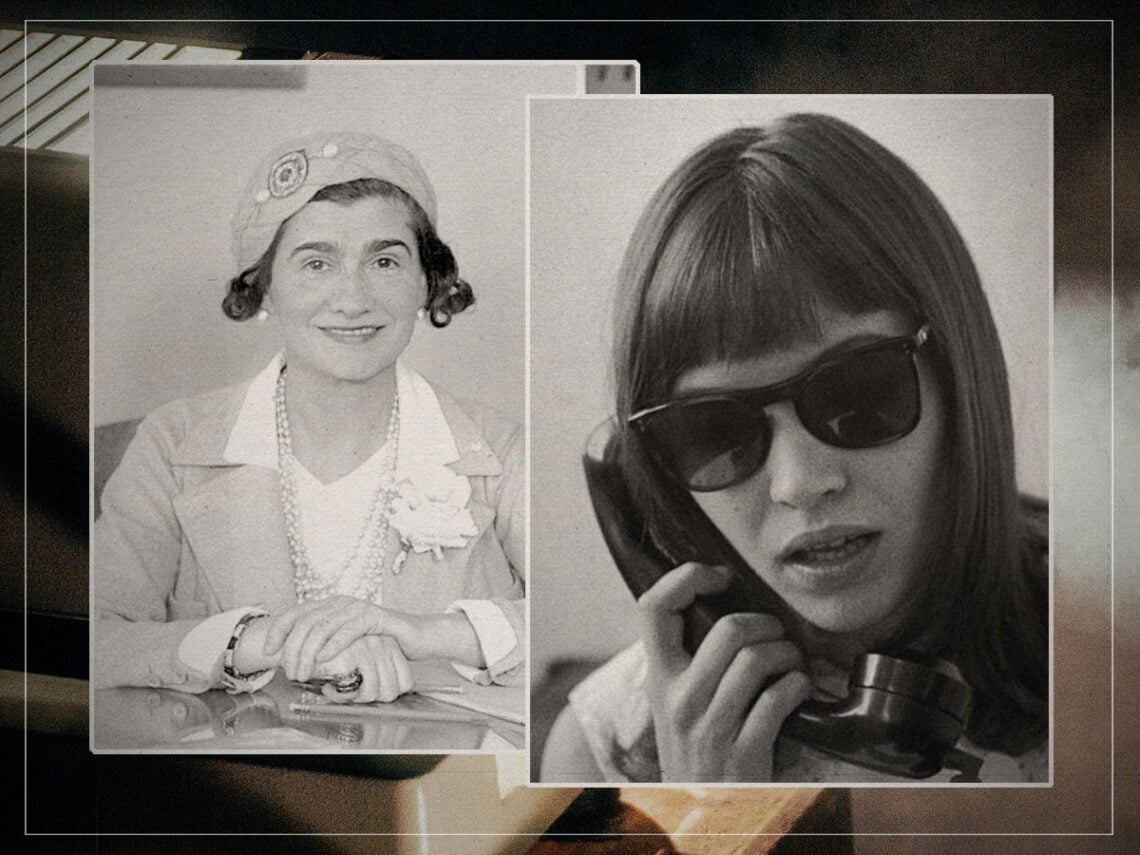
How Coco Chanel changed Anna Karina’s life with one piece of advice

Many critics have labelled Anna Karina a muse. While she certainly provided a lot of inspiration for Jean-Luc Godard – who cast her in seven of his films and was married to her between 1961 and 1965 – to refer to Karina as simply a muse is incredibly reductive. The actor’s story is one of perseverance and self-discovery, with Karina growing up unhappily, often in foster care, due to her abusive stepfather. Yet her dreams of becoming an actor were ever-present, and when she could no longer take her living situation, she hitchhiked to Paris and never looked back.
Paris was a place of opulence and opportunity for Karina, who had grown up in Denmark. Cinema was thriving in France, and she was intrigued by the idea of being a star, but she wasn’t able to attend acting lessons, instead doing some commercial work as a model or performing in cabarets.
Karina went on to star in many classic works of cinema over the course of her career, from Vivre sa vie and Pierrot Le Fou to The Nun and Chinese Roulette, but when she first arrived in France, she was essentially living in poverty. With no money and nowhere to live, she found shelter with the help of a priest, assuming a new life away from the abuse of her stepfather and the discouraging remarks she frequently received from her mother.
With a stroke of magnificent luck, a teenage Karina on the cusp of adulthood was scouted by an agency after spotting her in a Parisian cafe, and with nothing to lose, she agreed to pose for some photographs. She wrote (via Port Magazine), “I was in a cafe called Les Deux Magots in Saint- Germain-des-Prés and was approached by a woman who asked me in English – I couldn’t speak much French at the time – if I wanted to take some fashion pictures. I was afraid of what she might ask me to do, but I did the shoot. The pictures came out in a magazine called Jour de France, and with my paycheque, I went up the Eiffel Tower!”
In all honesty, Karina wasn’t that natural in front of the camera, but with more experience in the form of various advertisement jobs, she began to gain more confidence.
Before Karina eventually attracted Godard’s attention and make films like Le Petit Soldat (which wouldn’t end up being released until 1963 due to the controversial nature of its content) and Une femme est une femme, she met someone who would change the direction of her career. While on the set of a shoot for Elle, she met Coco Chanel, the creator of the eponymous fashion house, who asked Karina about her desires to become an actor.
The controversial fashion designer gave her some advice that she decided to listen to, and it certainly worked. “At the shoot there was a strange lady in a big jacket who looked at me and told me in English: ‘I believe you want to be an actress… You need to learn French. What’s your name little girl?’ I told her. ‘Hanne Karin Bayer.’ ‘No: Anna Karina – call yourself that.’ It was Coco Chanel. I took her advice.”
The name change worked, and as she started to frequently act in French films, people began to recognise her name, which sounded strikingly similar to Anna Karenina. This wasn’t a coincidence, and it helped people to associate Karina with femininity and romance. Like the character, Karina maintained a charismatic appeal, allowing her to flourish in a variety of popular films over the years. She remains one of France’s iconic figures, yet it was Chanel who encouraged her to learn the French language, subsequently changing her life.
