


Revisiting Jean-Luc Godard’s stunning ‘Vivre sa vie’

Released in 1962, Vivre sa vie (My Life to Live) was Jean-Luc Godard‘s fourth film and his third collaboration with Anna Karina, whom he had married the previous year. Telling the tale of a young woman named Nana, Vivre sa vie is divided into twelve tableaus that chronicle her descent towards prostitution and, ultimately, tragedy.
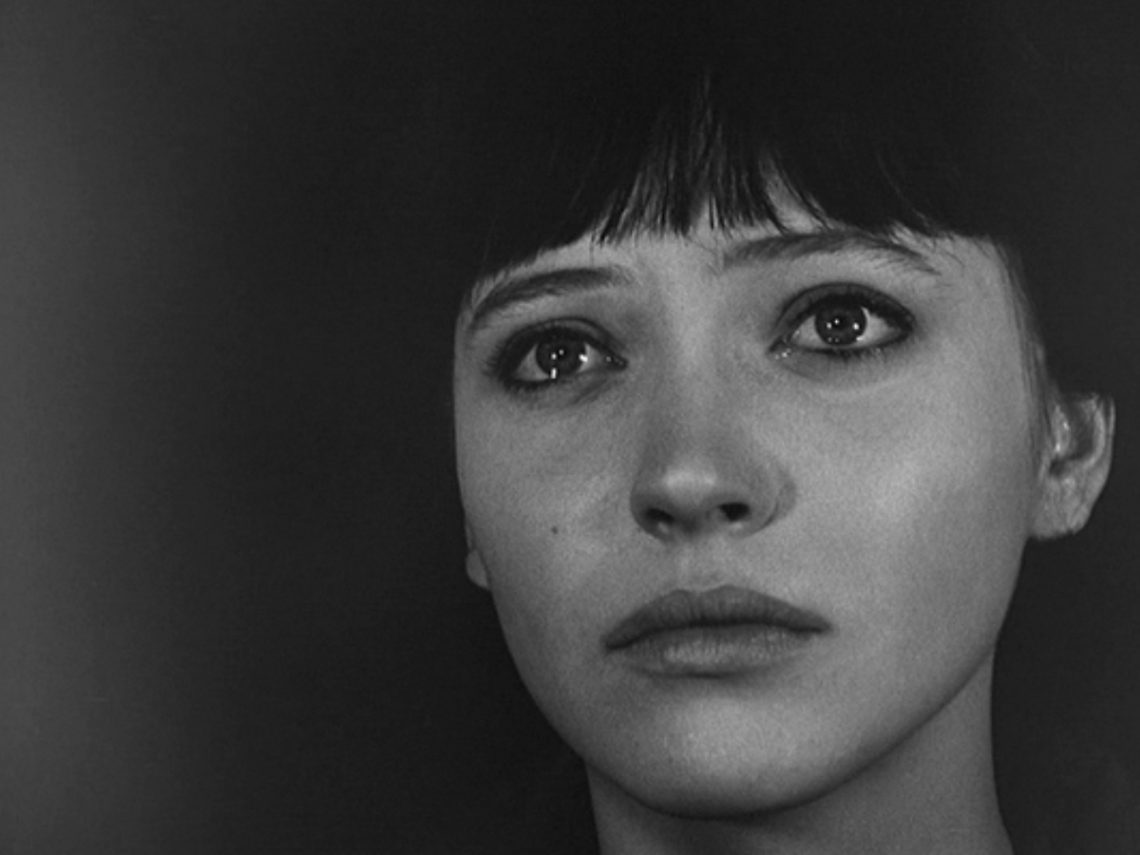
The film opens with three shots of Karina’s face from different angles as if profiling her. She looks uncertain and sad – her innate beauty partially obscured by dark shadows. However, as soon as the first tableau begins, and thus spoken language, Nana’s face is taken away from us, and the conversation between her and her husband, Paul, is shot from the back of their heads. Instantly, Godard asserts dominance with his camera, using the Brechtian idea of ‘epic theatre’ to make audiences critically consider what they are consuming. Brecht proposed that an audience shouldn’t emotionally connect to characters; a play should provoke criticism, self-reflection, and the recognition of social injustice. This concept can be applied to Godard’s often emotionless portrayal of Nana’s life, culminating in the unsentimental and absurd depiction of her death. In this opening tableau, the audience must work hard to figure out Nana’s emotions as her face is concealed from us, and we are forced to consider every line spoken between the two.
Godard purposefully alienates us, emphasising the isolation felt as a woman and as a member of capitalist society, forced to give ourselves away to a higher power. Thus, Godard’s inclusion of a quote by Michel de Montaigne is perfect: “Lend yourself to others, but give yourself to yourself.” In Vivre sa vie, Nana’s decision to leave her unhappy marriage to start a new, independent life is her step towards giving herself to herself; after all – this is her ‘life to live’. Yet, in a patriarchal, capitalist world, Nana struggles to be free. To gain financial independence from her husband, she sells her body for money, giving herself away to apathetic men. She becomes an object of consumption, reflected in the final tableau, where she is literally handed back and forth between her pimp Raoul and his associates. According to writer Susan Sontag, “Godard makes no effort to exploit the beautiful […]. He uses techniques that would fragment, dissociate, alienate, break up.” She declares, “The rhythm of Vivre sa vie is stopping-and-starting.” The staccato pace of the film emphasises Nana’s journey southwards – her fate is predetermined from the beginning when she tells Paul, “I want to die.”
Yet despite Godard’s Brechtian notions, Karina’s tender portrayal of Nana prevents the film from feeling completely cold. Between these obscured takes of emotional detachment, Godard also includes images that inspire great empathy, such as Nana crying whilst watching The Passion of Joan of Arc in the cinema and her nervous first encounter with a client. In these moments, you understand everything about Nana’s internal strife and lack of autonomy in a man’s world.
Vivre sa vie paints a picture of a harsh world where women cannot truly be free. The world is cruel to Nana, as it is to plenty of women. Nana’s death comes at a moment when she finally seems happy – she has met a man she loves and is willing to quit prostitution to be with him. Yet this is foretold in a scene between the two, where the man reads The Oval Portrait by Edgar Allan Poe. The story follows a man who becomes so obsessed with his wife – his muse – that he dedicates himself to painting her portrait with perfect likeness. In the process, he fails to recognise his wife’s ailing health, for he does not stray from his canvas. Once he is finished, he declares, “This is indeed Life itself!” only to discover his wife has died.
Interestingly, the actor is not the one reading the lines, but Godard himself, via voiceover. This adds an extra layer to the story by weaving Karina and Godard’s interpersonal relationship into the film. After framing Karina in the same way the wife is described in Poe’s story, Nana is shortly killed outside. When Vivre sa vie was filmed, Karina and Godard’s relationship had become increasingly rocky following her miscarriage. Thus, the film reflects Godard’s worry about Karina slipping away from his grasp. Vivre sa vie reveals the cracks in their relationship, which eventually came to fruition in Le Mepris.
Described by Sontag as a “perfect” film, Vivre sa vie is a thought-provoking character study that aims to explore what it means to be free. Blurring the lines between emotional coldness and empathy, Godard’s film forces us to look at the state of Nana’s world, which has been corrupted by consumerism and male power. Can Nana’s life be her’s to live? Vivre sa vie ends by providing us with the bleak answer.
