


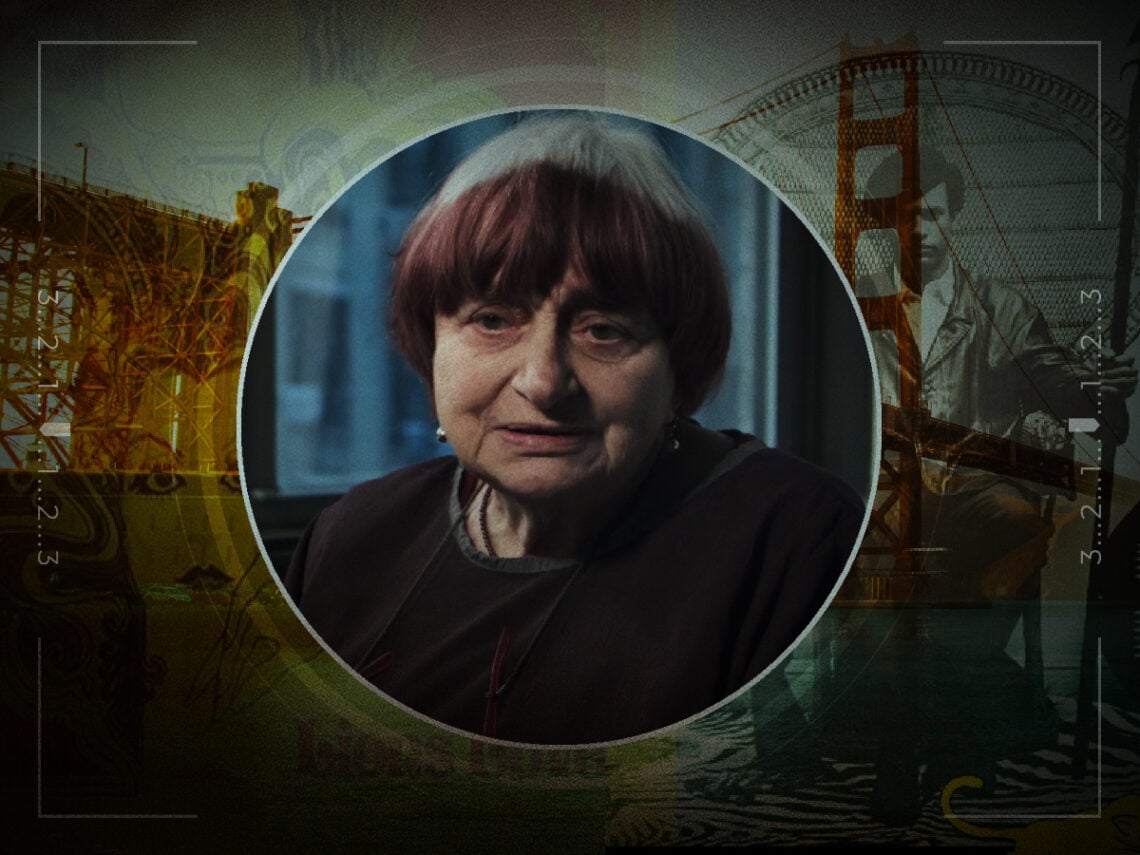
“In love with that strange city”: How California inspired a new era for Agnès Varda’s filmmaking career

Born in Brussels, Agnès Varda soon came to call France her home, relocating to her mother’s native Sète when she was 12 years old. While she then came to be one of France’s defining filmmakers, a key member of the Nouvelle Vague, she would also find new creative life in sunny California.
You wouldn’t think that someone whose work was so intrinsically linked to France, whether that be the streets of Paris as depicted in Cleo from 5 to 7 or the fishing quarter of Sète in her debut feature, La Pointe Courte, would thrive so well in America, specifically that very specific hippie era of 1960s LA, but Varda loved it. She wasn’t sure at first, though, only going to accompany her husband, The Umbrellas of Cherbourg director Jacques Demy, for a job, but soon she had no other feeling than the urge to create.
She told Criterion, “I followed like a nice little wife, but I said, ‘OK, I make my condition: if I don’t like America, I go home’”. She needn’t have worried, though, for “The minute I think I put my foot in Los Angeles I loved it. I became in love with that strange city”.
The subculture that was thriving, advocating free love and peace, captivated Varda, and she wanted to turn her camera towards the revolutionaries, the hippies, the activists, and the sexually liberated; thus, her first short in California was Uncle Yanco, released in 1967, which saw her visit a distant relative she’d never met before, an ageing hippie painter surrounding himself with the sea, and Varda captured it with bright, glittering brilliance, its azure waves gleaming in the sun. It’s a fun short that highlights the filmmakers’ curiosity, and she breaks down cinematic frameworks by drawing attention to the very existence of her film as a documentary, including the clapperboard and the helping hands who hold up a red love heart to frame the pair.
The following year, she made Black Panthers, a short documentary on the political organisation following the arrest of Huey P Newton, which saw her interview various members of the party, where she facilitated her subjects to discuss not only Newton but also the role of women in the group. The filmmaker was developing her skills as a documentarian here, and this was her most important subject to date as she immersed herself in the action, filming protests and advocating for the visibility of a group concerned with the fight for civil rights in America.
While she had made politically-charged films before, this was her most explicit and unwavering to date, and she’d go on to follow this with further socially-conscious films, like the abortion centric Women Reply, and later down the line, her documentary masterpiece The Gleaners and I.
Then came her LA feature Lions Love (…And Lies), featuring American actors like Warhol factory star Viva and Hair’s Gerome Ragni and James Rado as hippies with a propensity for taking all their clothes off. The throuple believe in the hippie movement of the era, which Varda depicts through this foreign lens, absolutely enthralled by this quest for freedom and living so carefree.
“All that freedom they were proposing, all the peace and love business,” she said, “My taste for discoveries and investigation, curiosity and finding a shape for film… I think I captured something of that time.” Thrown into a new country, a new culture, in fact, Varda had every opportunity to try something new, and as a result, her films seemed to get more experimental and more curious.
“All life is about borders, you know, language, borders, ethnic borders, and in the cinema I try to erase the borders,” she said, “Or make them move between documentary and fiction, black and white and colour, and cinema and art.”
Therefore, expanding her artistic practice across borders proved to be the key in unlocking a new side of her creativity, and as a result, she continued to stand as one of cinema’s most ambitious and unique filmmakers for decades to come.
