


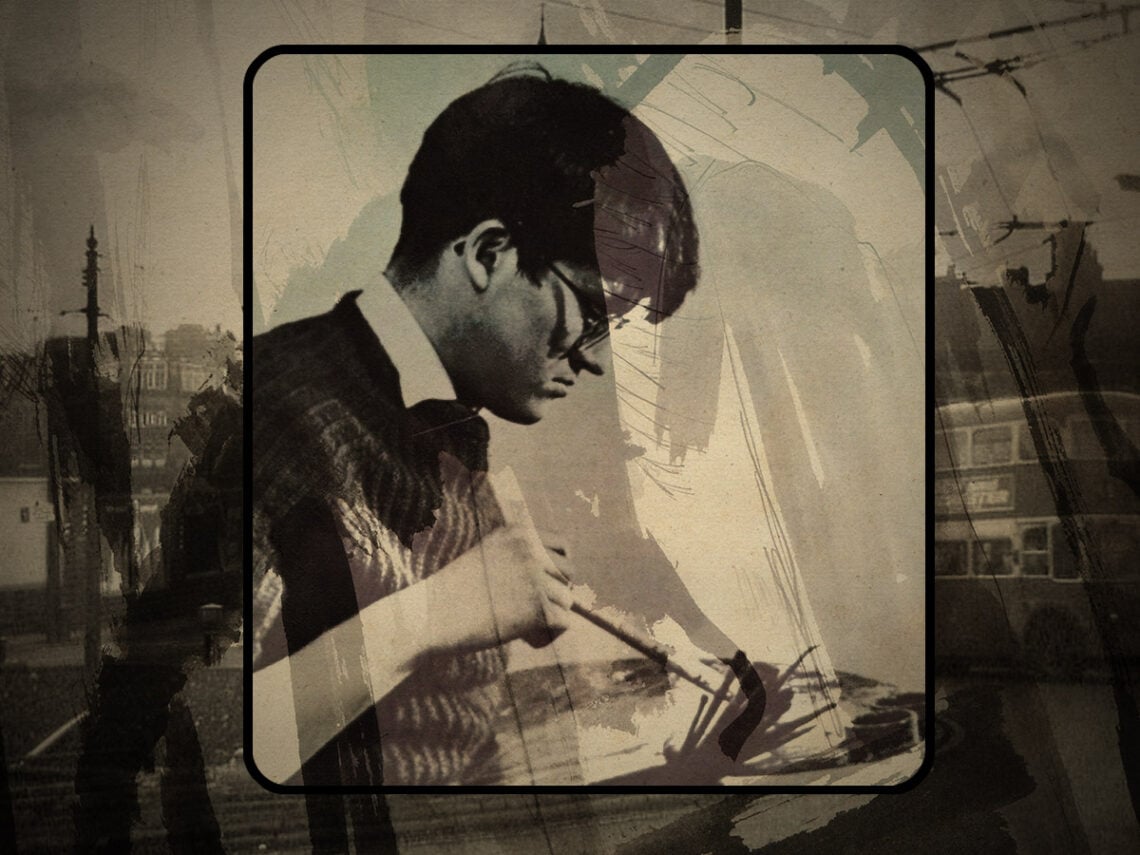
How Bradford sparked David Hockney’s creative fuse

The image of bright blue swimming pools, eroticised male bodies, palm trees, sharp lines met with squiggles and shapes – this is often what we think of when David Hockney’s name is brought up. Bright colours and unnatural visions of natural landscapes, captivating portraits, mixed media – he is easily one of the most iconic artists of our time.
While Hockney’s California period is perhaps his most recognisable, with his painting ‘A Bigger Splash’ constantly reproduced, it’s important to remember where the artist comes from. Bradford, the West Yorkshire city, has long gotten a bad reputation for high levels of crime, but it’s an artistically rich and culturally diverse area, and it has long inspired many artists, like Hockney and even the Brontë sisters, to greatness.
He grew up on Hutton Terrace in a working-class family, and from a young age, he had a desire to create art, despite the limitations of his upbringing… If you were working-class, the job of an artist was out of the question; instead, manual labour or working in a factory or a shop was the norm, but Hockney – a budding artist who discovered his homosexuality at a time when it was illegal – was never going to give in to what was to be expected of him.
Hockney began his artistic education at home, painting and drawing in this terraced house, taking inspiration from his local surroundings. While he would come to paint the much more exotic world of California in the late 1960s, in the early 1950s, you can see the influence of working-class life in artworks like Fish and Chip Shop.
Depicting a rather familiar sight – a customer placing his order over the counter while a man gets to work frying some fish – Hockney brought warmth to this scene, giving a sense of beauty to an otherwise mundane business exchange. But Hockney recognised the importance of such an image; fish and chip shops are a British working-class staple, and there’s often a sense of community to be found in local chippies, with the artist bringing this to his yellow-tinged, nostalgia-laden lithograph.
For years, the print was hung above the fryers of the very chip shop, Sea Catch, in the Bradford village of Eccleshill, but it has since been sold at auction for several thousand pounds – Hockney had made the print while experimenting with lithographs during his time at Bradford School of Art, which primed him for his future education at the Royal College of Art in London, which allowed him to develop his style even further.
Yet, his interest in domestic scenes during his teenage years were pivotal to shaping his early forays into portraits, like those of his parents he captured in their home, or mundane scenes turned larger-than-life, and additionally, the breathtaking surrounding landscapes of West Yorkshire’s countryside undoubtedly left an impact on Hockney, who has always been fascinated by beautiful vistas, a wide stretch of vivid green or blue – hills, trees, and fields depicted on canvas with a lucid hypnotism.
In recent years, he has taken to depicting many pastoral scenes via both hand-painted and iPad drawings, going back to his roots by using the Yorkshire countryside as inspiration – clearly, the scenes that shaped his childhood and sparked his imagination have never left him.
If you’re ever in Bradford, you can immerse yourself in Hockney’s brilliance by visiting Salt’s Mill in the gorgeous village of Saltaire, which features plenty of originals made by the artist over the years. The downstairs shop, where you can buy art supplies and books, is lined with drawings and paintings by Hockney, a fitting tribute to an artist whose desire to become a legendary artist was first formed among the historic streets of a once-thriving industrial landscape encased in luscious stretches of pastoral beauty.
