


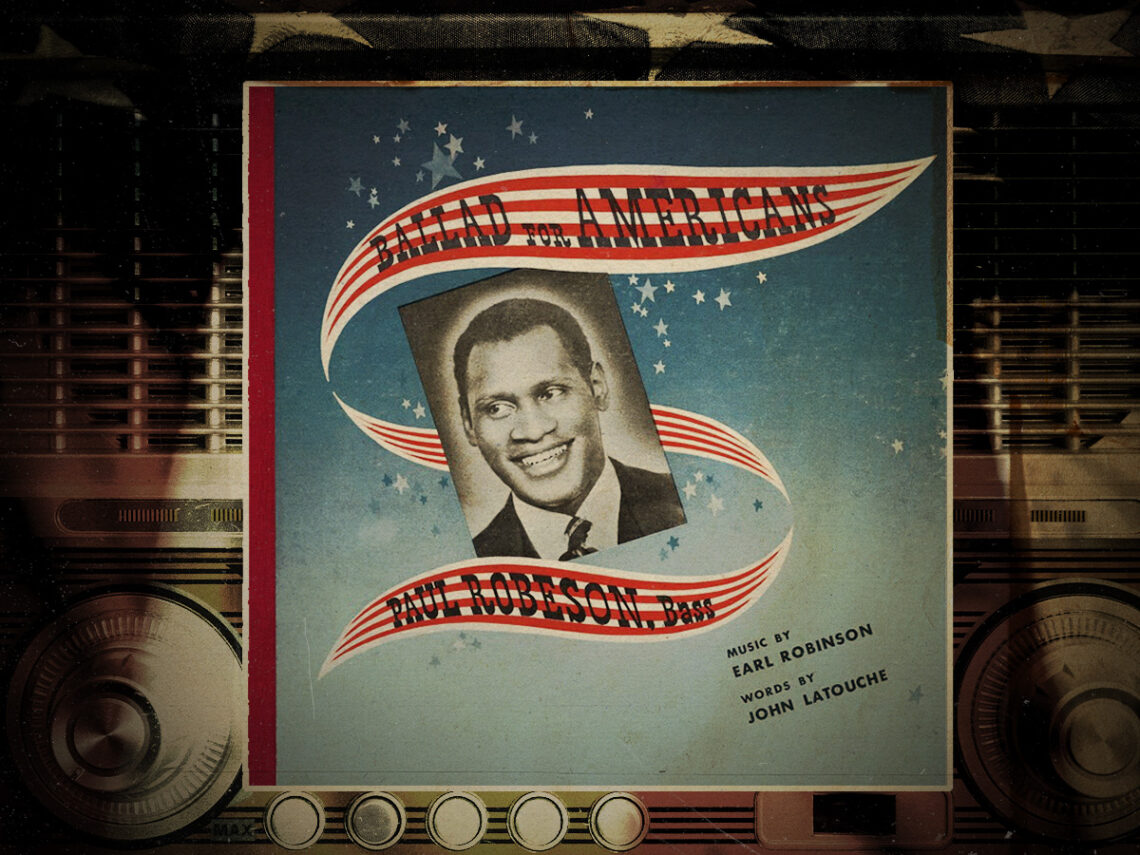
‘Ballad for Americans’ by Paul Robeson: How America’s most famous song was banned into obscurity

America, Home of the Brave and Land of the Free; where free speech is everything. Enshrined in law by the First Amendment. Well, that’s how it’s supposed to be, anyway.
But you don’t need to know too much about American history to know that the land of free-speech is actually incredibly quick to ban, blacklist, suppress and censor any songs, books or films which threaten to question the status quo.
‘Strange Fruit’ was blacklisted by radio, as was the entirety of the catalogue by The Weavers, owing to the group’s left-wing politics, ‘Rumble’ was banned for the fear of inciting teen violence, Elvis was threatened with arrest in Florida if he didn’t stay still while performing, and Loretta Lynn (‘The Pill’), Chuck Berry (‘Brown Eyed Handsome Man’), Paul McCartney (‘Ebony and Ivory’) as well as countless others, had their work restricted on radio, but the legendary baritone Paul Robeson suffered under America’s repressive and regressive censorial iron-fist more than most.
Robeson was multi-talented, able to act, sing, organise and debate, and play (American) football, and when he won a scholarship to the famous Rutgers College in New Brunswick, New Jersey, in 1915, he was the only Black student in the university. From there, he progressed to New York University School of Law, and throughout his academic career, he rose to the top of his classes as valedictorian before graduating with a degree in law, while also competing in the NFL with first the Akron Pros and then the Milwaukee Badgers.
Somehow, he also found time to carve out a reputation as a fine singer, remarkable for the depth of pitch and emotion that he could achieve, as well as a fine actor, having been cast in plays and musicals such as Taboo and Shuffle Along.

Having received his degree, Robeson briefly worked as a lawyer but soon left the profession, having encountered too much racism in the courts. It seems as if he would have made a success of himself no matter what he turned his hand to next, and so it proved when he returned to the stage as part of the Harlem Renaissance arts scene in New York, landing the lead role in Eugene O’Neill’s All God’s Chillun Got Wings.
It was during his time with this production that Robeson had his first brush up against censorship, too, as the opening night was pushed back owing to a national scandal about the content of the play.
From there, he continued to appear on stage on both Broadway and in The West End, with The Emperor Jones and Othello, and began to feature in films, such as Body and Soul, and Camille, and was even booked to start leading concerts, singing spirituals and hymnals in his earth-shaking baritone. In 1925, he was signed to his first recording contract with Victor Records.
Nowadays, he is best remembered for his astonishing and haunting renditions of songs like ‘Sometimes I Feel Like a Motherless Child’, ‘Old Man River’, ‘Joe Hill’, ‘Go Down, Moses’ and perhaps his biggest unlikeliest and most controversial hit, ‘Ballad for Americans’, which sold 40,000 copies when it came out.
The song, a ten-minute recounting of the often bloody and brutal history of America, which doesn’t pussyfoot around the country’s complicated colonial past or turn a blind eye to human nature, with words by John La Touche and music by Earl Robinson. When Robeson first performed the song, live on CBS radio in 1939, he received a 20-minute standing ovation, which lasted twice the length of the song itself. The song spoke about immigration and freedom, the suffragettes and workers’ rights, as well as emancipation, political science, liberty, freedom and equality.
But this was America, Home of the Brave and Land of the Free. Where free speech is enshrined in law by the First Amendment as an unshakable and unwavering right, where everyone is created equal; only, some are created more equal than others, and Robeson, with his incredible talent, charisma, education and humanity, was not deemed equal enough in the eyes of the state.

As his celebrity grew, Robeson became more and more outspoken on progressive social issues. A fierce socialist, he used his platform as every progressive person should to spread the message that a better world is possible, to fight against the horrors of colonialism, racism and fascism and for civil liberties and civil rights. He took an intersectional approach to his activism, realising early on that every struggle against fascism is united and interlinked and needs to be fought on all fronts.
In the end, he became too much of a threat to the state as a figurehead for the left-wing, and especially as a figurehead for the Black rights and anti-racism movements. Just like Malcolm X and Dr King would be later on, just like Stokely Carmichael was, and Angela Davis or Huey Newton and George Jackson would be down the line, as well, he needed to be stopped, silenced and his influence compromised.
Through the 1940s, his popularity with the people grew (it’s reported that he was making $100,000 per year from concert appearances until 1947) while disapproval from within the political class was growing by the day. What is more intimidating to the American establishment than a well-educated, charismatic Black man who has the ability to unite people in their struggle against the oppression of the state, from all across the lines of sex, race and class?
In early 1950, NBC banned him from appearing on the television programme Today With Mrs Roosevelt and in July of the same year, the state department revoked his passport, preventing Robeson from performing overseas. By now, he was having his concert and personal appearances repressed and cancelled, as well, and within a short amount of time, his career was effectively over, with his income from performing a paltry $6,000 by 1952. An example had to be made of Paul Robeson so that everybody knew, if you were thinking about following in his footsteps, you’d better think twice.
His name was retrospectively expunged from records of awards he had won, both for his footballing achievements and also honours received from the NAACP, and works which mentioned him were banned from school libraries. In 1956, he was hauled before the House Committee on Un-American Activities, as anybody with even half-way left-wing leaning tendencies was at the time, where he robustly rebuked that it was the board itself that was the “un-Americans”.
Yeah, the self-same America, where free speech is everything, enshrined in law by the First Amendment, and you can’t let anybody tell you otherwise, for that would be Un-American.
