


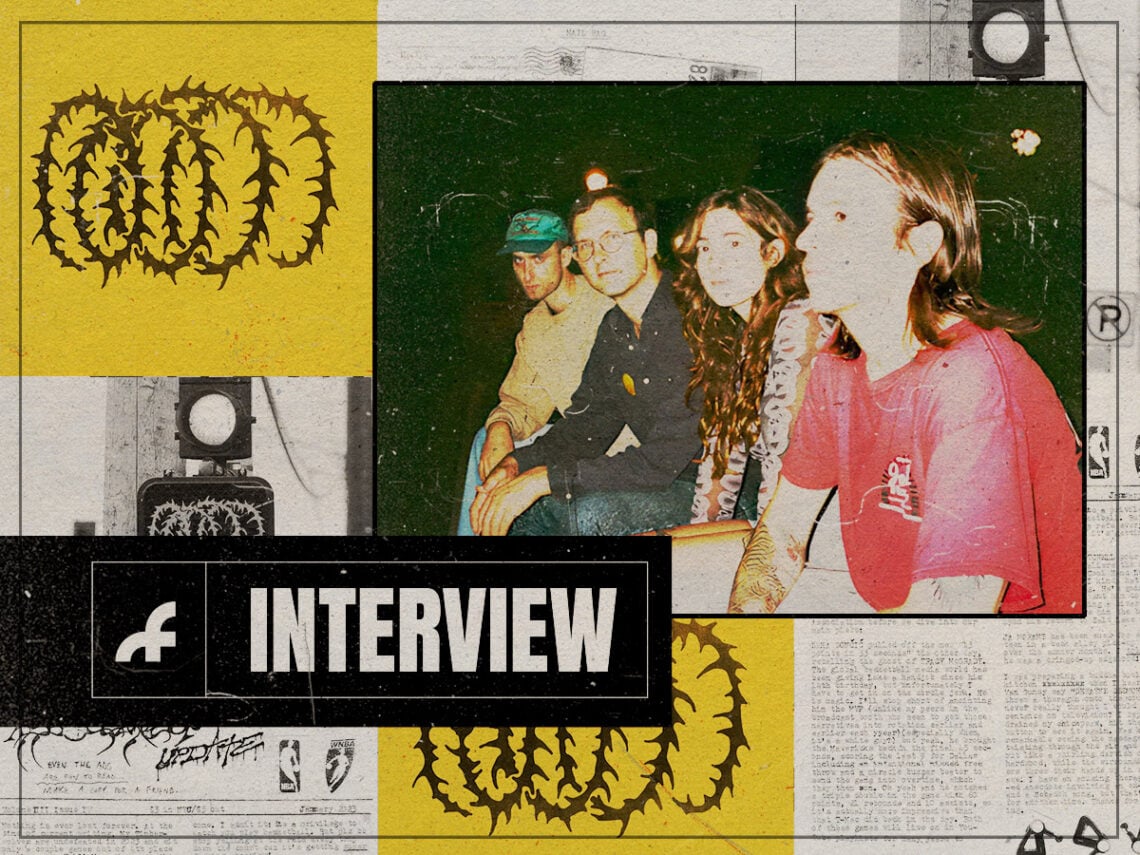
Hotline TNT discuss the new album, Third Man Records, and DIY ethics in the modern age

Hotline TNT, the brainchild of Will Anderson, are undoubtedly one of the most exciting and distinctive bands in contemporary alternative rock. Arriving with shoegazing textures on their second album, Cartwheel, Anderson has further refined the dazzling array of influences on their debut.
Recently, Hotline TNT took a major step forward by joining Jack White’s Third Man Records. While being on a label attached to such a prominent name might take some getting used to for Anderson, the group seem to be moving into their future headfirst. The band emerged as little more than a bedroom project, so their triumphs should serve as an encouraging example for those wanting to make the dream of music as a vocation a reality.
I caught up with Anderson over Zoom ahead of Hotline TNT’s show at The George Tavern in the Big Smoke on Friday, November 10th. He was in positive spirits despite a bout of jetlag. Another sign of success. He had flown in from Chicago and, alongside the band’s bassist Oggy, was decamped at a friend’s for a few days before Hotline TNT got up and running on this side of the Atlantic. Anderson explained that he had come to London a few days before their shows as they’d enlisted a fill-in third guitarist who resides in the city, and he wanted time to teach him their songs.
I wasn’t expecting to cover the topic so early. Still, this naturally brought us to one of the most fascinating aspects of Hotline TNT: the fact that Anderson manages to navigate being in such an active band with a rotating cast of members. Keen to get to the bottom of this complex inner-working, I wondered if this was a challenging state of play for their leader. As if there was ever going to be another answer, Anderson said straightly, “Yes.”
The Hotline TNT leader maintained that despite the situation’s complexity, it makes sense in other ways and, importantly, keeps things fresh. His answer also alluded to the contemporary reality of being a professional musician, wherein other unavoidable aspects of modern life sometimes take precedence, and members are pulled in different directions.
He said: “It’s always hard to keep rotating people in and out. But it makes sense because I try to get people playing in the band that are really fun to be around and are into the music, but those people often stop and have their own lives and projects to deal with, too. I don’t expect people to drop everything for my vision or anything like that. But that’s really what it is.”
“I don’t want anyone to get too comfortable. That’s the thing,” he said dryly, with a wry smile slowly cracking. “No, I would prefer if it was the same people the whole time, if I’m being honest. But I don’t hold it against anyone. And it makes sense. It’s just the nature of the beast. I’m in my mid-30s, and so are the others, for the most part. We’re not a scrappy DIY band as much as we used to be.”
Many of Anderson’s favourite groups changed lineups and still managed to produce quality, and he’s not the only one doing it currently either. He explained, “There are tonnes of people in New York and Chicago and Minneapolis who are in eight bands, and especially when it comes to drummers, they’re usually in about 30 bands.” He joked again: “That’s why Mike our drummer, he’s got me right where he wants me. Anything he wants to do… I’m not gonna let him go for anything.”
This was two days before Cartwheel arrived. As such a momentous release was edging ever closer, I was keen to understand how Anderson was feeling in the run-up to their Third Man debut. In the spirit of the conversation, he was feeling cheerful on this front too, with this mindset informed by people enjoying the new body of work.
“I’m excited,” he said. “I think it turned out good, I think people are rocking with it. So I’m happy about that. I’m feeling good. I don’t know what to say really about it. I mean, my approach wasn’t that different from any other album. As far as collaborating with people in the recording process goes, it was marginally more than I had done before, but it’s still kind of the same songwriting process. I played everything myself, pretty much, so…”

It was intriguing that Anderson contended that although he worked with engineer-producers Ian Teeple and Aron Kobayashi Ritch on Cartwheel, things had stayed essentially the same in the recording process. You get the sense that on the new offering, perhaps as a natural part of a competent musician’s arc, Anderson has moved ever closer to his ultimate creative vision.
He also reveals that despite the highly distinctive guitar tones that colour Hotline TNT’s music, he doesn’t have a go-to pedal and amp set-up. “If there’s an amp and guitar, you should be able to get the songs out there,” Anderson said. “And obviously, you can tell I care about making the songs fuzzy and distorted. We can usually get there no matter what’s around. You just turn the overdrive up, and we’re good.”
I wondered if this attitude was indeed a result of his overarching DIY ethic. Continuing on his righteous course, he provided the conversation’s most profound point: “Yeah. That’s what I hope. I say this in every interview, but I do think good music will cut through all that stuff, you know, whether it’s gear or a record label, or genre, or a scene, it should hopefully transcend all that stuff, if you got good songs.”
It was then a case of ascertaining whether anything in particular informed Anderson’s DIY ethic, from his approach to songwriting to penning the band’s fanzine – Association Update – and plastering his phone number over the band’s merchandise. While punk had an influence on this, he maintains that being DIY comes, before all else, from being a music fan, plain and simple.
“I didn’t get into punk until I got to college. So, I would consider that part of growing up because when I got to college, that was a big part of my identity. But yeah, I think it all comes from me being a music fan. And beyond just music, I’m a fan of stuff like fanzines and seeing bands interact with their fans in cool ways. And I’m like, ‘Oh, if I’m in a band, I want to do that.’ I could name specific things, but there are lots. SST, Hüsker Dü, Sonic Youth, all that stuff.” Before this revelation, Anderson’s approach did feel like an unadulterated ancestor to that of America’s 1980s underground. In response to that suggestion, he added: “That’s the number one coolest shit to me. I don’t see bands doing it that way that much anymore. And I’m like, ‘Well, I’m gonna do it that way.'”
I did wonder where he thinks the DIY approach fits into the contemporary era. “I think there’s still room for it,” he starts. “It’s weird because as the band is growing, we’re kind of – not by any one person, or organisation or anything – but just as we grow, we do end up getting mushed into the boxes of the contemporary music business: ‘Okay, now we’re on a record label. Okay, now I have a booking agent, and we have to play this show and announce it at this time.'”
Offering an example of how it plays out for him and the friction this mindset can create within the modern industry, he continued: “When it was all DIY, I was just like, ‘I’m going to make the poster and put it up myself. And that’s what it is, and nothing else, it’s simple.’ So now, the two things are fighting a little bit. I don’t know. I think the things we do on our own get the better response from fans and people who are music fans and are interested in what we’re doing. It’s hard because I just want to keep doing stuff like that. But then you got the label and the booking agents saying, ‘Well, you can’t just do it that way all the time. You got to do this and that.'”
It is intriguing that a man so dedicated to DIY should be on a label run by one of the most influential artists of the 21st century, regardless of Third Man being independent. While there might be a conflict between his ethos and being on such a label, he expresses gratitude to Third Man for being appreciative of his outlook and working to facilitate it more professionally. Wasting no time addressing the elephant in the room, he clarifies that he hasn’t met Jack White and knows little about him.
He explains: “I assume he knows we exist. But all the Third Man business has been through people who are not Jack. And I will say that they’ve been really great to work with. Of all the labels we talked to, they seemed the most artist-friendly. And that’s been true. They were interested in Hotline because of what I was already doing. So they wanted to be like, ‘Here’s the resources. Here’s the press push we’re going to do, but you keep doing your thing.’ And that was really what I was looking for when I made the jump. However, it’s still hard for me at times to let go of some of the stuff that we’ve been doing our way the whole time.”
Outlining how this push and pull between his instincts and being on a prominent label can manifest, Anderson says only a few weeks ago, he and his team conflicted about show posters for a tour. Instead of sorting the posters by himself as he would before, now there’s an agency involved and technical elements such as dimensions that he is forced to consider. While he says components of being a musician such as these don’t seem as cool to him anymore now that the DIY aspect is not as full-frontal, he did concede that he understands things change for artists as they take it up a level.
Having all these new forces now affecting his process, Anderson says that, on the flip side, he has been able to let go of some of the old workload. However, new things have emerged that are equally as time-consuming. More money is coming into the band, so he’s working less as a substitute teacher, and it is helpful to have the team behind Hotline TNT, but he adds, “My life doesn’t feel less busy.” In another sobering point about the state of the contemporary music industry, he notes: “I’m still on the roster. Like when I’m back in December, I’m sure I’ll pick up some shifts.”
Concluding, Anderson leaves me with an exciting remark about the future of Hotline TNT: “We’re gonna tour the hell out of this album, and then next summer, start making the next one. I’ve already got some skeletons for half the next record; demos, and stuff like that.”
