


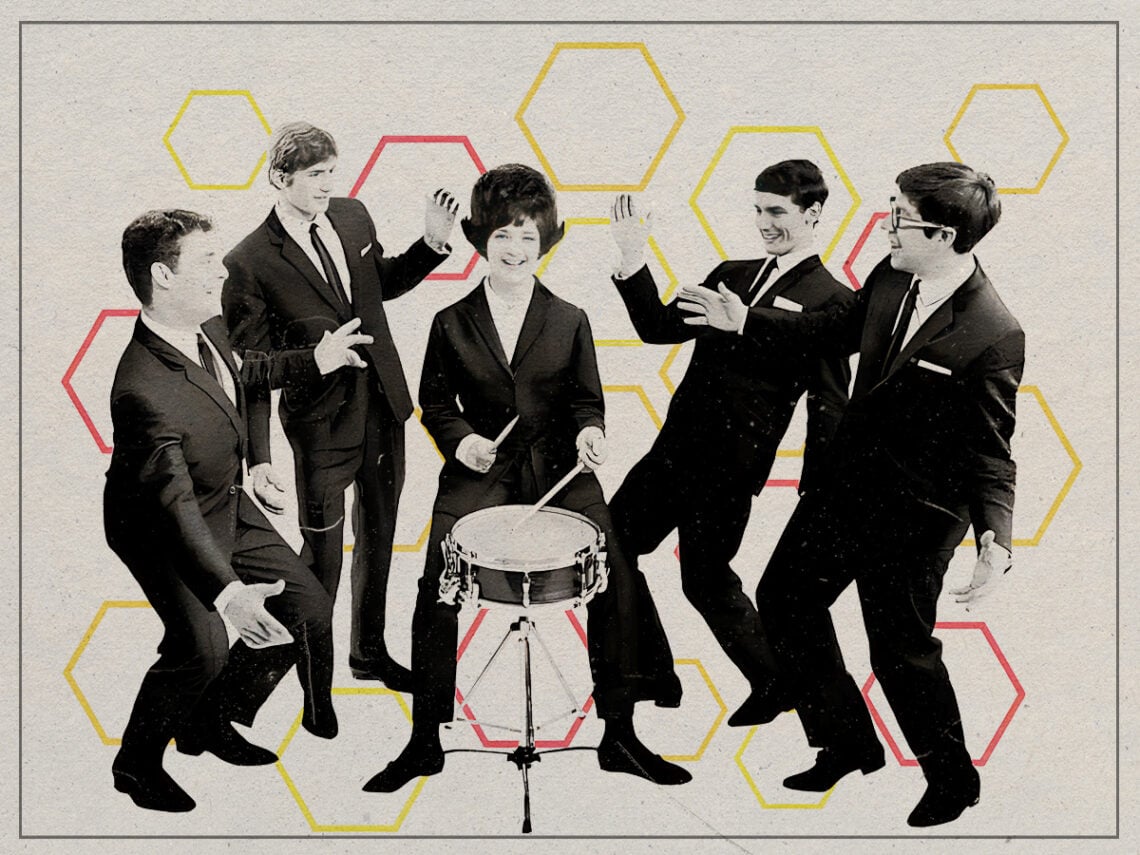
Honey Lantree: The pionnering drummer who challenged 1960s sexism

Female names are rarely mentioned when discussing groundbreaking drummers who played a pivotal role in shaping a musical era. Yet, Honey Lantree stands out as an exception, leaving an incredible mark on the music industry as the drummer for the 1960s rock band The Honeycombs. As one of the few women in the spotlight during that era, her contributions to the band’s success and her trailblazing presence in the world of rock and roll have unquestionably cemented her legacy.
Lantree’s journey into the world of music began in the suburbs of London. Growing up with a passion for rhythm, she honed her skills on the drums, defying gender norms prevalent in the music industry. Her unique talent and dedication to her craft set her apart from the crowd. In 1963, Lantree became an integral part of The Honeycombs, a band that would soon make waves in the music scene. Comprising Lantree on drums, her brother John Lantree on bass, Denis D’Ell as the lead vocalist, Alan Ward on rhythm guitar, and Martin Murray on lead guitar, The Honeycombs were ready to take the era by storm.
The band first burst onto the scene with their debut single, ‘Have I The Right?’, in 1964. The song quickly climbed the charts, reaching number one in the United Kingdom and making a significant impact in the United States. Lantree’s energetic and distinctive drumming style became a defining feature of the band’s sound, adding a layer of excitement and flair to their performances. The success of ‘Have I The Right?’ paved the way for The Honeycombs to tour and share their music with audiences around the world.
Lantree’s role as the drummer for The Honeycombs challenged gender stereotypes in the music industry at a time when female musicians, especially drummers, were a rarity, and she proved that creative talent was not only specific to male musicians. Her presence inspired countless aspiring female musicians to pursue their passion for percussion. While reflecting on her status as a woman in what was seen as a man’s world, she later said: “I didn’t sit there thinking, gosh, I’m doing this and I’m a girl. It was only when we went to play a gig in Hackney that it suddenly dawned on me, ‘Everyone’s looking at me’.”
During a time when many bands struggled to break through due to The Beatles’ unprecedented success, The Honeycombs managed to strike gold with a winning combination of an irresistibly catchy song and the uniquely distinctive production skills of Joe Meek, renowned for his work on The Tornados’ ‘Telstar’. In 1965, however, following the success of their debut smash, The Honeycombs struggled to follow up.
At the same time, media criticism was rife with commentary on maintaining a female drummer. D’Ell told Record Mirror: “How can it be a gimmick just because we’ve got a girl on drums? Honey plays with us purely and simply because she’s the right drummer for the job.”
Lantree also said in 2014: “I played on every single track we ever recorded.”
Nonetheless, despite the band’s relatively short-lived career, The Honeycombs, led by Lantree’s rhythmic prowess, made a lasting impact on the 1960s music scene. ‘Have I The Right’ emerged as their sole top ten hit on both sides of the Atlantic. In the subsequent year, Lantree and D’Ell collaborated on another Howard-Blaikley composition titled ‘That’s the Way’, which secured a number 12 position on the charts.
While the decade is largely regarded in history as the era dominated by bands like The Beatles, The Honeycombs’ fusion of pop and rock, coupled with Lantree’s dynamic drumming, carved out a niche that distinguished them from their contemporaries.
