


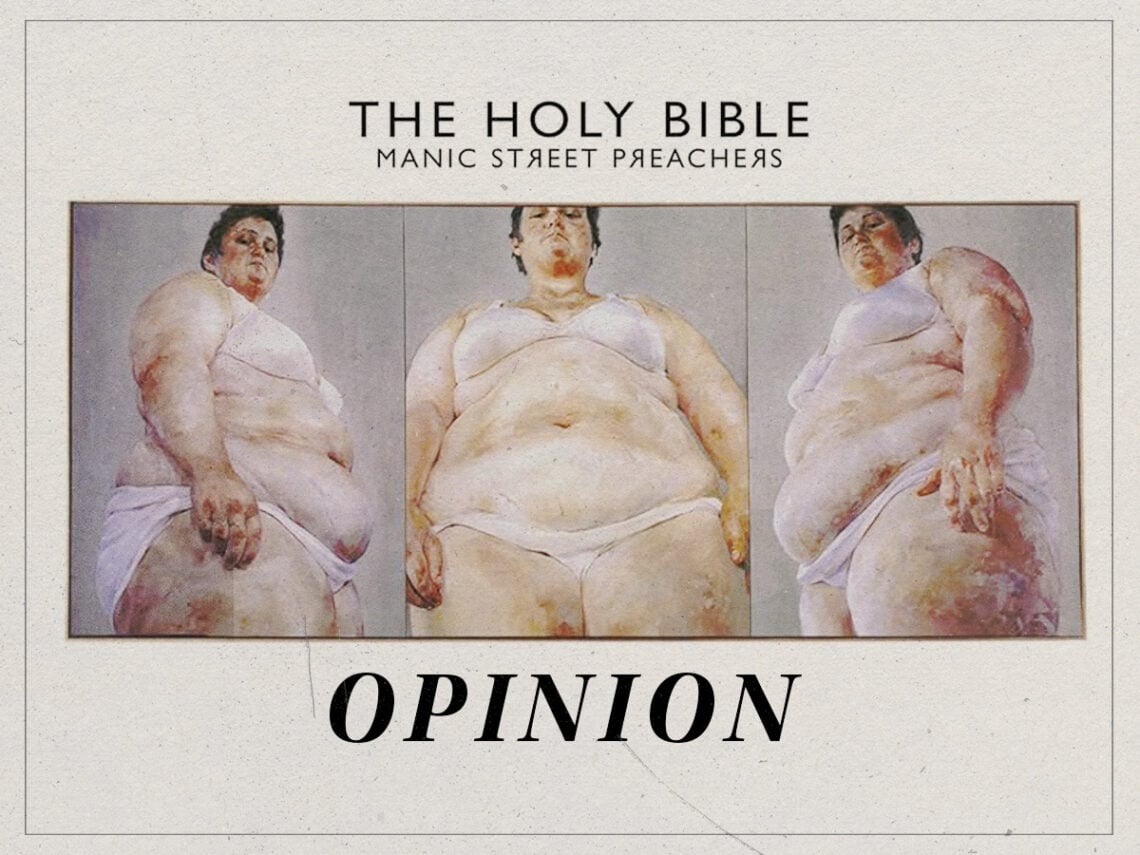
Hear Me Out: ‘The Holy Bible’ by Manic Street Preachers is a perfect album

Though I am loathe to begin talking about this masterpiece by the Manic Street Preachers, one of the darkest, most harrowing and most spectacular rock albums ever made by invoking Chris Martin; I promise there’s a point to it. When Coldplay were working on an album with Brian Eno, their frontman recalled a conversation he had with Eno regarding The Verve’s ‘Bittersweet Symphony’.
Martin called the song “perfect”, which Eno pushed back on. When Martin asked why, Eno responded that a perfect song should do everything, and there was no way you could dance to The Verve’s one hit. Martin said that hardly matters. In so many words, he was saying that the song attains perfection by achieving everything it sets out to do. It takes a hell of a statement for me to agree with the man who named his child Apple over literal Brian Eno, but here I am.
I agree with it because I believe that The Holy Bible, by the Manic Street Preachers, is perfect. Yet, I also think twice before recommending it to anyone. The question is, does that really make it perfect? Surely, if something is perfect, one should be able to recommend it to anyone with a song in their heart. Not so much here. The Holy Bible is a bilious, corrosive album, every moment a trip deeper into a void that remains a litmus test of a listen 30 years after its release.
Often, what happens to albums like this is that they soften over time. Records that begin life as the heaviest, darkest records of their time serve as inspirations for others to go further. The Holy Bible belongs in the company reserved for Black Flag’s My War, Joy Division’s Closer, and Danny Brown’s Atrocity Exhibition as records whose darkness and vitality transcends time. Ones that prove that ‘alternative’ music is sometimes a marker of genuine counter-culture art and not a marketing slogan.
How did the Manic Street Preachers make this album perfect?
Therefore, in no way is this album for everyone. This is an album that’s regularly held up as its chief lyricists’ final will and testament, mainly concerned with anorexia, death, fascism, imperialism, suicide and the Holocaust. It’s a record that sees the musical hub of the band, singer and guitarist James Dean Bradfield and drummer Sean Moore scrambling to cram lines like “Big Mac / Smack / Phoenix, R / Please smile, y’all” into something vaguely resembling a pop song.

To add to its mystique, its chief creator, lyricist and ‘guitarist’, Richey Edwards, disappeared barely six months after its release. However, the album’s release and Richey’s tragic loss are so connected that this is no mere case of proximity leading to association. Edwards’ distressingly public and well-documented spiral of the previous few years shows up in The Holy Bible, to the extent that the record becomes a document of that headspace in its most focused form.
Thus, the perfection of this album comes from what I alluded to earlier. The sheer intentionality of the piece. There isn’t a moment of this album that isn’t exactly what the creators envisioned, and there are many stories from the album’s creation to back this up. The best example of this comes from an interview Bradfield gave to Sun Zoom Spark in the mid-1990s, where he detailed what inspired the album highlight ‘Archives of Pain’.
He said, “It started out as a riposte to that line in Therapy?’s ‘Trigger Inside’ (“Now I know how Jeffrey Dahmer feels”) and, even though I really like Therapy?, we just couldn’t agree with it, so decided to come up with a modern response.” This was the case with each song on the album. In an interview with Mojo magazine in 2001, Bradfield said that the songs began when bassist and fellow lyricist Nicky Wire “would give Richey just titles and then Richey wrote under the title.”
Yet despite, or perhaps even due to it, the ferocious discipline and focus the band threw themselves into exploring the darkest avenues of its chief architect’s psyche, they couldn’t prevent themselves from landing somewhere they didn’t like. As Bradfield went on to say in the Sun Zoom Spark interview about ‘Archives of Pain’, “It went on to become a capital punishment diatribe, and by the time we’d finished the song, we sounded like a bunch of right-wing cunts.”
He elaborated, saying, “It’s basically O level Sociology, left and right eventually meet and they become impossible to differentiate from each other. And I thought that’s what we’d become when one side becomes totally fucked up.” This band of working-class kids, so proudly commie they would later become the first Western band to play in Castro’s Cuba, had fallen so far down the rabbit hole that they were devastated to see what they’d done responding to it.
Because Bradfield isn’t too far off with his analysis. ‘Archives of Pain’ is a brutal, discomforting listen in a very different way to the rest of the record. Lines like “If hospitals cure / Then prisons must bring their pain” and “There is never redemption / Any fool can regret yesterday” could be cribbed from any conservative talking head from the last century.
The sheer, boiling fury of its delivery is one of Bradfield’s best vocal shows in a career stuffed with utter magic. It’s the sound of empathy for the oppressed becoming disgusted with their oppressors, turning into a drive for retribution. If a cynic is a heartbroken idealist, ‘Archives of Pain’ shows a much, much darker avenue that an idealist can go down if they conflate justice with vengeance.
‘Archives of Pain’ is not alone here. Album closer ‘PCP’ gets worryingly close to parroting the “PC brigade” nonsense dribbled out today by men so oppressed that they are regularly featured on mainstream news networks. Lines like “PCP—a PC police victory / PCP—a PC Pyrrhic victory / When I was young PC meant Police Constable / Nowadays I can’t seem to tell the difference” speak for themselves. As does the repeated closing line of “So damn easy to cave in / Man kills everything” on the lead single and certified Manics classic, ‘Faster’.
On any other album, this would be a shock tactic at best and an outright slide to the political right at worst. However, this is an album about the process of taking a deep look at the world and into yourself until you find the parts that scare you. Not for nothing did the band add to ‘Mausoleum’ a sample of JG Ballard responding to why he wrote his seminal 1973 novel Crash with “I wanted to rub the human face in its own vomit and force it to look in the mirror.”
Because of this, I think the album retains a fundamental, brave honesty that adds to its perfection. One that makes it fit right in with the world we know today. It’s an album that depicts violent right-wing politics, of course it makes sense in 2025. On a more serious note, I know I myself have been shocked to find what the constant onslaught of terrifying news has warped my thoughts into sometimes. Something that The Holy Bible also covers, because it’s an album about reckoning with information overload.
Wire and Edwards weren’t just turning that unflinching, merciless gaze on themselves, they were also turning it on as much media as they possibly could. We are all well-familiar with that feeling, and the Manics were talking about it before Tony Blair became PM. When talking about ‘Faster’ with Louder magazine, Wire said the song was “All written before the digital age—no mobile, no computer. But Richey just conveyed this feeling of the acceleration of culture—it just speeds up and speeds up.”
To recap, this album is simultaneously an excoriating personal examination of its creators and one that gets more uncomfortably relevant to the public with the march of time. The fact that any records exist like this is a miracle, but the fact that this was exactly the intention of its creators? Perfection barely covers it. What’s more, if I’m making the album sound at all dour, then that’s absolutely not the case. In fact, perhaps the ultimate achievement of this record is that despite the suffocating darkness, it rocks like an absolute bastard.
While nothing about the album screams “crossover pop hit”, this is the most vital, sharp and tight the band would ever sound. Each song is crammed with as many riffs as syllables, and Bradfield bursting several blood vessels to turn a line like “We all are of walking abortions” into a shout-along chorus worthy of any Reading Festival headline slot.
Yet, still, this is not an album for everyone. It’s caustic, uncompromising and bleak to the point of depressing—exactly the way that it was designed to be. In an age where music can sometimes feel more like focus-grouped content designed to appeal to as many different demographics as possible, the need for albums as unified artistic statements like The Holy Bible is bigger than ever.
In all, it’s an unforgettable record that could only come from the miracle that is the Manic Street Preachers. It is, in all the definitions of the word that count, perfect.
