


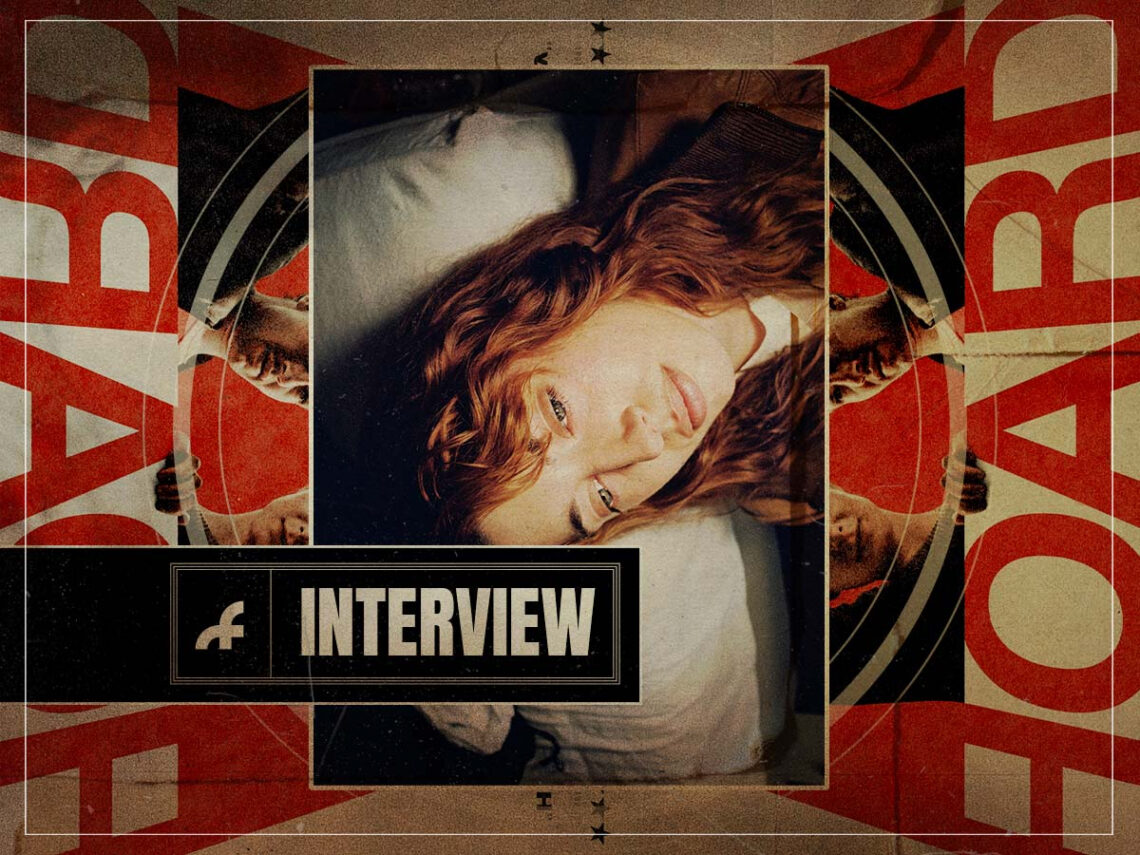
‘Hoard’ director Luna Carmoon discusses Bafta Breakthrough: “I think they’ve made quite a brave choice with me”

Before the release of Luna Carmoon’s debut feature, Hoard, a short teaser clip was posted online that encapsulated the essence of the film: a raw and revealing foray into grief, trauma bonding, and burgeoning sexuality. A teenage girl sits on the toilet with the door open, only to be greeted by a man in his pants. “You piss like a horse,” he tells her before a close-up shot of her face harnessing an intense yet blank stare confronts both him and the viewer, the scene soundtracked by her ferocious piss.
Carmoon’s film doesn’t shy away from making the audience uncomfortable, centering a strange dynamic between Saura Lightfoot Leon’s protagonist Maria, who exists in that awkward period between adolescence and early adulthood, and Joseph Quinn’s binman Michael, just over a decade older. The two are drawn together as Maria’s childhood memories of living with her mother, a hoarder, are reignited.
Hoard is a beautifully constructed film that has already been nominated for several accolades. With the success of Hoard under her belt, Carmoon has now been accepted into the Bafta Breakthrough scheme, supported by Netflix. This scheme gives creatives—ranging from filmmakers and actors to costume designers and casting directors—a chance to prosper in the industry.
Alumni include stars such as Florence Pugh, Paapa Essiedu, Tom Holland, Josh O’Connor, and Letitia Wright. Meanwhile, last year’s scheme featured some of Britain’s most exciting new directors, like Charlotte Regan (Scrapper) and Raine Allen-Miller (Rye Lane).
The Bafta Breakthrough program allows these creatives to be mentored in one-on-one sessions while networking events and opportunities will be on offer to propel them further. Additionally, the scheme allows access to full voting memberships, with career advice also readily available as these individuals look towards the next steps in their careers.
Speaking to Far Out, Carmoon reveals that being accepted onto the scheme has been “quite strange,” explaining that during the post-production of Hoard, “I kind of surrendered to the idea that no one was going to see the film.” Yet, her passion for the film carried it to completion, with Carmoon stating, “It was the film that I wanted to make and that I was really pleased with, and it was something that I would have wanted to probably find online and illegally stream as a teenager.”
Hoard certainly is one of those movies, the kind you find yourself thinking about for months after, morbidly fascinated by the twisted scenes of Maria and Michael’s indefinable relationship, which involves the smothering of shepherd’s pie, the mixing of massive globs of spit, and the licking of wounds. It might not be the kind of film you’d go to see with your parents, but among all of its rubbish piles and stray rats is clear evidence of Carmoon’s creative ethos – to make visible the kinds of characters, themes, and stories that are often seen as taboo, such as those of working-class girls who don’t conform to a preconceived mode of femininity like Maria.

This is exactly why she has been accepted into the Bafta Breakthrough scheme, which aims to champion the most exciting new voices in the creative industries, particularly those from underrepresented backgrounds. “I think it’s important to see real people because that’s how you change things,” Carmoon explains. Art should be about “not shying away from one another, but actually connecting and seeing them parts of ourselves that we don’t always like.” By doing so, we can “eradicate shame and guilt.”
Hoard is a sharp shock for some viewers, with Carmoon exposing the “animal” parts of her characters, yet her fearlessness in crafting such a complex and oftentimes grotesque film makes her presence on the Bafta Breakthrough scheme feel so vital. Still, Carmoon believes “they’ve made quite a brave choice with me,” adding, “I feel like I don’t quite fit the mould of what supposedly you’d imagine Bafta looks like as a writer-director.”
By earning a place on the scheme, Carmoon is excited to be able to solidify connections in the industry since she was never able to take the traditional route into filmmaking, nor did she have a nepotistic way in. She explains, “I couldn’t afford film school, so I was working a lot in between my jobs, and then all of a sudden I’ve got this job, and it’s like radio silence.”
Yet, she believes that “making a film is just about finding people that you work with and connect with, and even at film events – I often don’t feel great going to them – but you never know if you’re going to find that one person who becomes your collaborator, but more so just becomes your friend.”
While Hoard is quite divisive, Carmoon believes that its contrast between being “strange and absurd” and full of “real humanity and groundedness” is its strength. The film feels “fresh” and she hopes that the “people who are meant to find it, find it and connect to it.” Carmoon has made a very special and personal film, and her place on the Bafta Breakthrough scheme will certainly guide her towards even further greatness because, as she concludes, “I’ve definitely got something to say. I’ve always got something to say.”
Bafta Breakthrough is supported by Netflix.
