


A brief history of Pride in the arts and culture

52 years ago, in the early morning hours of June 28th in 1969, a riot broke out in front of the Stonewall Inn in the Greenwich Village area of New York City, beginning in earnest what would later become known as the Pride movement. In truth, this flashpoint incident was the crest of a wave that had been gathering for some time and now continues to grace the shores of society in a wash of egalitarianism every June.
Culture was, and is, such a perfunctory gathering force in the movement that it seems to ratify the famous quote by the beat writer and member of New York’s gay subculture William S. Burroughs, who wrote: “Artists to my mind are the real architects of change and not the political legislators who implement change after the fact.”
In order to understand the way in which the riots came about, we must first understand the history that predated it and the zeitgeist of the times.
In the 1950s and ‘60s, homosexuality in America (and indeed most of the world) was illegal in 49 states, barring Illinois where the criminality was famously repealed in 1961. While the severity of persecutions varied wildly from state to state, threat and hostility were widespread.
However, towards the middle of the 1950s, sexual liberation became a force that challenged the ideologies of sex. The arts in all of its guises were at the forefront of this. Rock ‘n’ roll played such a hand, in fact, that when the snake-hips of Elvis Presley were in full swing in 1956, it led CBS towards the decree that he was only to be filmed from the waist up following his gyrating antics on The Ed Sullivan Show.
Meanwhile, in the literary world, Peyton Place by Grace Metalious became the uber-salacious and provocative best-seller that thrust sexual liberation into the living rooms of the masses. Of course, there had been countless precursors to this, but for the first time the movement seemed to be escaping the clutches of niche subcultures and beginning to seed into society at large and when that happens, invariably the demimonde shifts further into the margins while simultaneously the less daring elements of the movement become accepted and engulfed into the mainstream.
At the forefront of this liberation was Greenwich Village. In the early part of the 1960s, ‘the village’ was the hub of what would later be called the counterculture movement. The streets were awash with folk troubadours with copies of Jack Kerouac’s bible to American disenfranchisement, On The Road, sticking out of the top pockets of gingham shirts as art, culture and forethinking conversation disposed industry as the mainstay of society in a small concentrated pocket of Manhattan.
In short, if you found yourself culturally alienated somewhere within the vast expanse of America, then any dart you threw at a map would forever land in Greenwich Village. This formed a melee of emboldened denizens withholding the progressive end of global politics and chief amongst them were liberal artists like Andy Warhol and Bob Dylan who used their public platforms to propagate a message of fierce political iconoclasm, calling for equality that not only offered hope for the persecuted masses of the world but led a peaceful call to arms for progress, understanding and abating from violence.

Thus, more and more American’s on the fringes of society began to see Greenwich Village as the beacon of hope and a societal custodian of safety. A large LGBTQ community began to flourish and slowly but surely the shackles of torment were beginning to shake loose. Within that subculture, the Stonewall Inn became an anchorage for the movement. It was a daring nightclub owned by the Mafia who would bribe the police to ignore the homosexuality that occurred inside. In exchange, however, the Mafia would extort patrons by all manner of means, making the venue both a haven and a paradigm of the hardships faced for those who attended.
While other movements gained traction around the gay subculture, increasingly protest and action became normalised. Art and culture were frequently at the forefront of each of these movements. While bands eternally sang of peace and love in calls to deescalate violence in Vietnam and writers and musicians like James Baldwin, Sam Cooke and Nina Simone dictated the discourse of the Civil Rights movement, the sexuality movement was still much more marginalised. However, it was still emboldened by progressive thinking in general by proxy. After all, many, if not most, of the members of the community were also vocal figures in the anti-Vietnam and Civil Rights movement.
Thus, at a time when charges for “solicitation of homosexual relations” and “non-gender appropriate clothing” were common, a great chasm of progression was forming as liberation seemed to be leaving the community behind. Tensions were rising both within the community and the assimilated mass of sympathisers alike. On June 28th, this combination of tension and a drive for progress resulted in a riot that sparked a great societal change.
Nine police officers conducted one of their routine raids on the Stonewall Inn. The patrons were fed up, as were the residents and revellers of the neighbourhood who saw what was happening and began to gather outside. The police officers panicked as frictions amassed and locked themselves in the bar. Rioters responded by setting the place on fire. They made a safe escape, however, now the angry mob had grown into thousands.
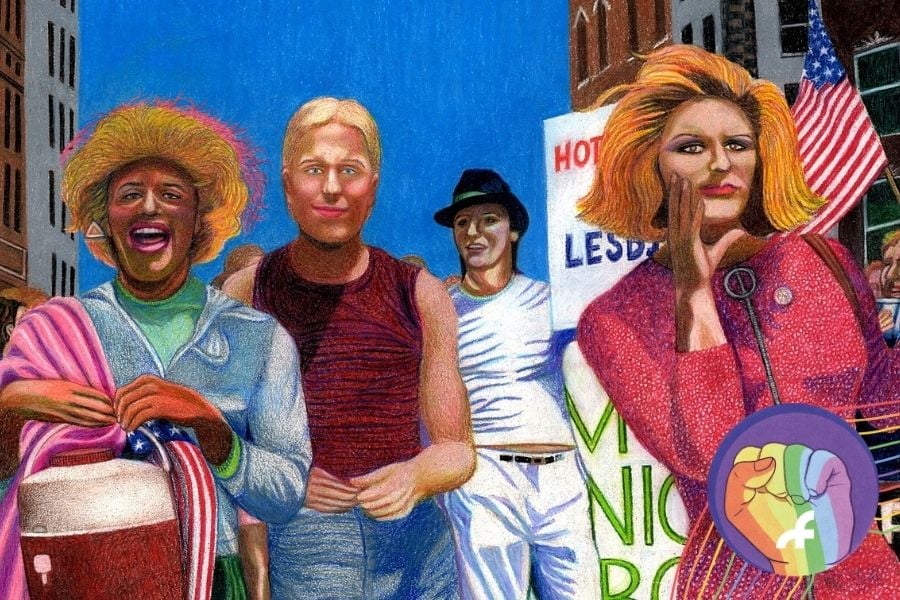
This was the first time that defiance had been propagated on such a large scale and while the violence was condemned, the cause behind it brought attention to the inequality and as the movement gained sympathisers from outside of the community the Gay Liberation Front was formed. This was the first group to publicly advocate for equal gay rights. On the one-year anniversary of the riots, the Gay Liberation Front gathered in the streets once more for what is now considered the first inaugural Pride march.
Along the journey of the movement art and culture has forever been a companion. Whether in the indirect sense of rock ‘n’ roll breaking down boundaries that were previously upheld under the defunct banner of faux-decency and its subtext of discrimination, or the trailblazers within the arts who defiantly touted either their support for the community or otherwise belonged to it, artists were willing to use their platform to preface the virtue of individualism and equality, where power is often unwilling to tread. Soon David Bowie’s androgyny would become iconic and many other artists would notably shape the way forward to make Pride what it is today, and voice the need for equality in society at large.
Over the course of the next month we will be looking some of the most prominent figures in both music, film and art in the past, present and future of Pride and the sexual equality movement.
