


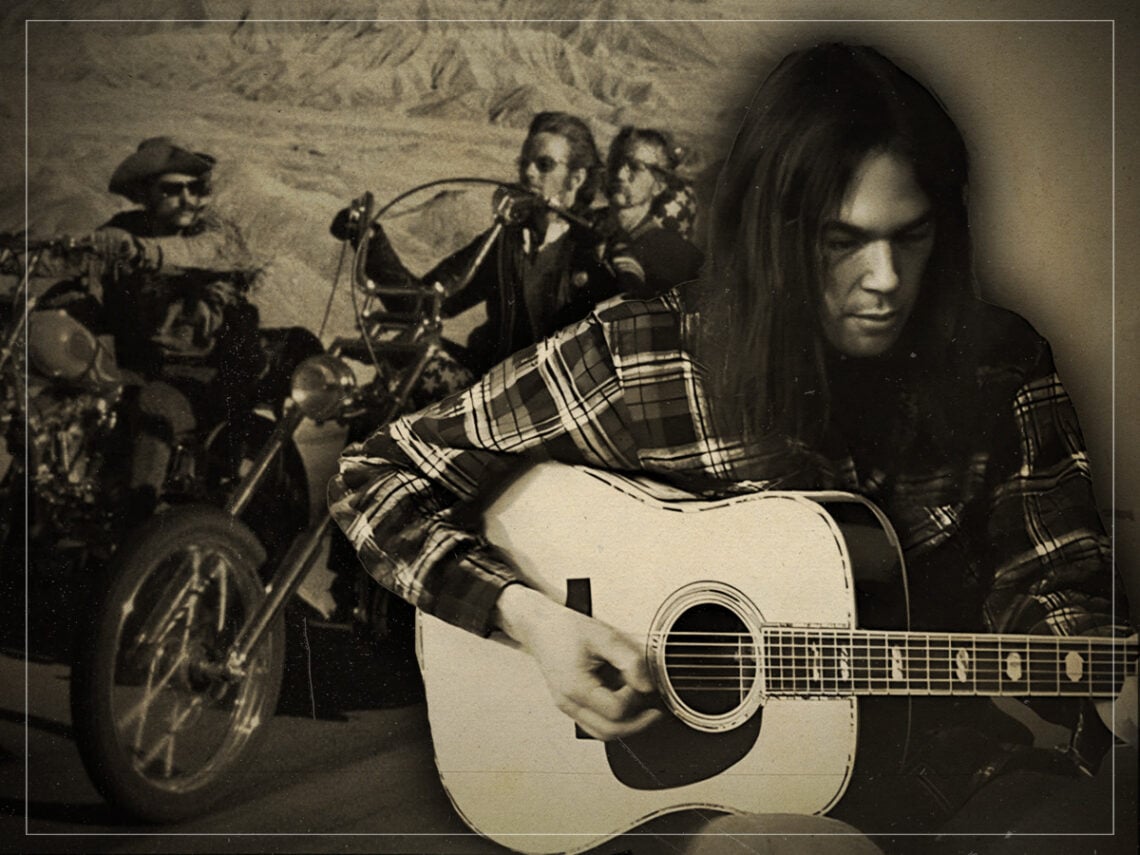
Hippies, the apocalypse, and how 1969’s ‘Easy Rider’ led to an overlooked Neil Young masterpiece

Neil Young is a lot of things, but a man who rushes or forces the creative process isn’t one of them.
Enough time has passed now, and there’s no denying his genius. Anyone who tries to tell you that Neil Young isn’t a good songwriter is ignoring decades’ worth of excellent material. His songs can be grounded, out there, or somewhere in the middle; it doesn’t matter what kind of project you’re after, there’s a Neil Young album for you. However, just because someone is exceptional doesn’t mean that they’re easy to work with.
Young’s career is littered with run-ins with his record label, as they have either been pushing him for ideas or forcing him to change his ideas because they didn’t like the direction he was going in. The 1986 album, Landing on Water, is quite literally Young saying that he hated the direction of the record so much that he likened it to a plane crash.
He was hounded by record labels long before the 1980s, though. In 1970, Young moved to a hippie commune called Topanga Canyon, in the hope of recording a new album. This was just off the back of Crosby, Stills, Nash & Young’s successful Déjà Vu, and Young was struggling to come up with ideas. He was writing a lot, but all of his songs either weren’t good enough or didn’t go anywhere.
With label executives getting increasingly frustrated with his apparent lack of output, the musician began looking for inspiration around the commune. He eventually found it in the form of Dean Stockwell, who was friends with Dennis Hopper, the writer enjoying the success of his film Easy Rider. He told Stockwell that if he were to write a movie, he’d be able to get a production team on board. So he got to work and wound up creating a script called After The Gold Rush (sound familiar?), and keen on getting people’s opinions, he gave a copy to Young.
“Dean Stockwell came by the house with a screenplay called After the Gold Rush. He had cowritten it with Herb Bermann and wanted to know if I could do the music for it,” recalled Young. “I read the screenplay and kept it around for a while. I was writing a lot of songs at the time, and some of them seemed like they would fit right in with this story. The song ‘After the Gold Rush’ was written to go along with the story’s main character as he carried the tree of life through Topanga Canyon to the ocean.”
Young was a huge fan of the story, so much so that the rest of the album, which was inspired by it, seemed to tumble out of him. It wasn’t long before he had a complete LP, much to his record label’s excitement, ready for release. However, while his record label might have been excited about the release of his new album, it seemed production companies didn’t feel the same way about Stockwell’s script.

The album went out without an accompanying movie, much to Young’s disappointment. Maybe his album might not have been as overlooked as it is if the movie had been made. However, even without the accompanying picture, this album still certainly stands up on its own, with tracks like ‘Tell Me Why’, ‘Southern Man’ and ‘Only Love Can Break Your Heart’ speaking for themselves. That doesn’t gloss over the fact, though, that Young believes the world has missed out by not seeing the film.
“It was all about the day of the great earthquake in Topanga Canyon when a great wave of water flooded the place,” he recalled, “It was a pretty off-the-wall concept, they tried to get some money from Universal Pictures. But that fell through because it was too much of an ‘art’ project. I think, had it been made, it would stand as a contemporary to Easy Rider, and it would have had a similar effect. The script itself was full of imagery, ‘change’. It was very unique, actually. I really wish that movie had been made, because it could have really defined an important moment in the culture.”
