


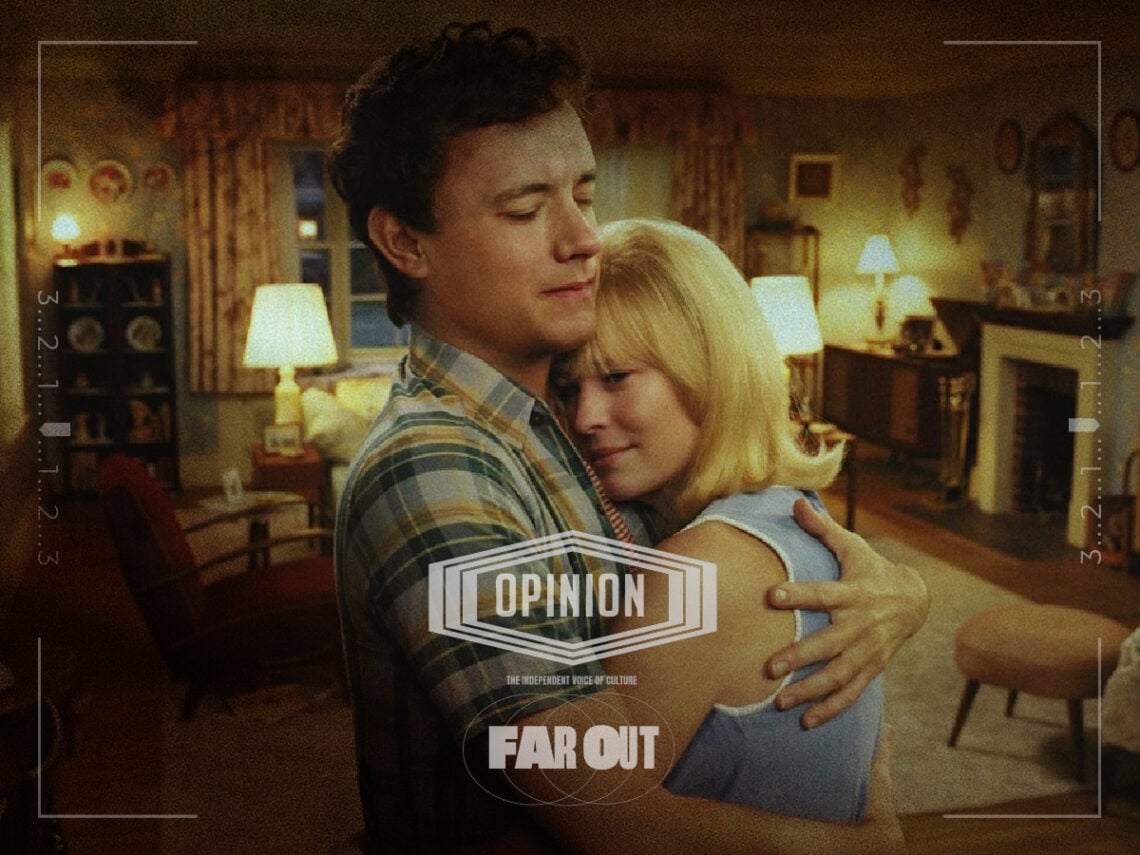
Hear Me Out: ‘Here’ is a late-career masterwork from Robert Zemeckis

Any tribute or summation of the career of Robert Zemeckis will instantly refer to classics like Back to the Future, Who Framed Roger Rabbit, Forrest Gump, and Cast Away, all of which stand the test of time as classics.
That being said, his track record over the course of the last two decades has been disastrous, and between box office bombs, misguided uses of animation, and tonally incoherent projects, he seems to be experiencing a late-stage decline.
Not every director can be like Steven Spielberg or Martin Scorsese, who manage to do just as interesting work today as they did at the beginning of their careers, but the fact that Zemeckis crashed out so hard with misfires like Pinocchio and The Witches doesn’t mean that he has lost his touch entirely. Although it was a massive financial disappointment, his unusual drama Here is far more interesting and subversive than it is credited for.
Based on a popular graphic novel of the same name by Richard McGuire, Here is set entirely within the confines of a single room over the course of thousands of years; although a majority of the film takes place in the 20th and 21st centuries, it also goes into the distant past to explore prehistoric times and early American colonisation, with special effects illuminating the frequent changes in time as the camera remains mounted in the same position for the entire 104 minutes runtime.
Here is told in non-chronological order, which helps make something compelling about an inherently ‘normal’ story. Zemeckis didn’t have the epic goal of exploring the peaks in American history, like he did in Forrest Gump, instead choosing to explore the long-standing relationship between high school sweethearts Tom Hanks’ Richard and Robin Wright’s Margaret. If Forrest Gump was accused of idealising the spirit of “American exceptionalism”, Here offers a sobering, and often cynical assessment of how frustrating it can be to simply survive.
Thanks to the inventive means of cross-cutting, the director is able to intersperse the magic of Richard and Margaret’s early fling with the crushing disappointment of their middle age, in which both characters feel that they have not made any significant achievements, and can’t even take pride in their family. The house in which the entire film takes place begins to feel like a prison that has prevented them from fulfilling their dreams, an idea that is epitomised further when Margaret chooses to leave.
Although the use of digital de-ageing has been somewhat controversial, Zemeckis uses the technique to create a disconcerting effect, such that seeing younger versions of Hanks and Wright has the same unusual impact that a grown person might feel when looking at old photographs of their parents: they can’t fully imagine that the people they’ve always associated with wisdom and experience were once just as unprepared and anxious as they were.
It’s no coincidence that the moments in which the de-ageing begins to decline, where Hanks and Wright’s performances feel more ‘real’, are when the story is modernised to reflect the cold reality of a broken America offset by extremist politics and economic instability, and the final moments of Here, in which Margaret’s optimism is only filtered through her lack of memory, play out like a cruel joke.
Perhaps Zemeckis had been too closely associated with being saccharine for his subversive commentary in Here to be recognised, but the film stands out as a bold experiment from a master of cinema that demands a second life or at least a conscious reevaluation.
