


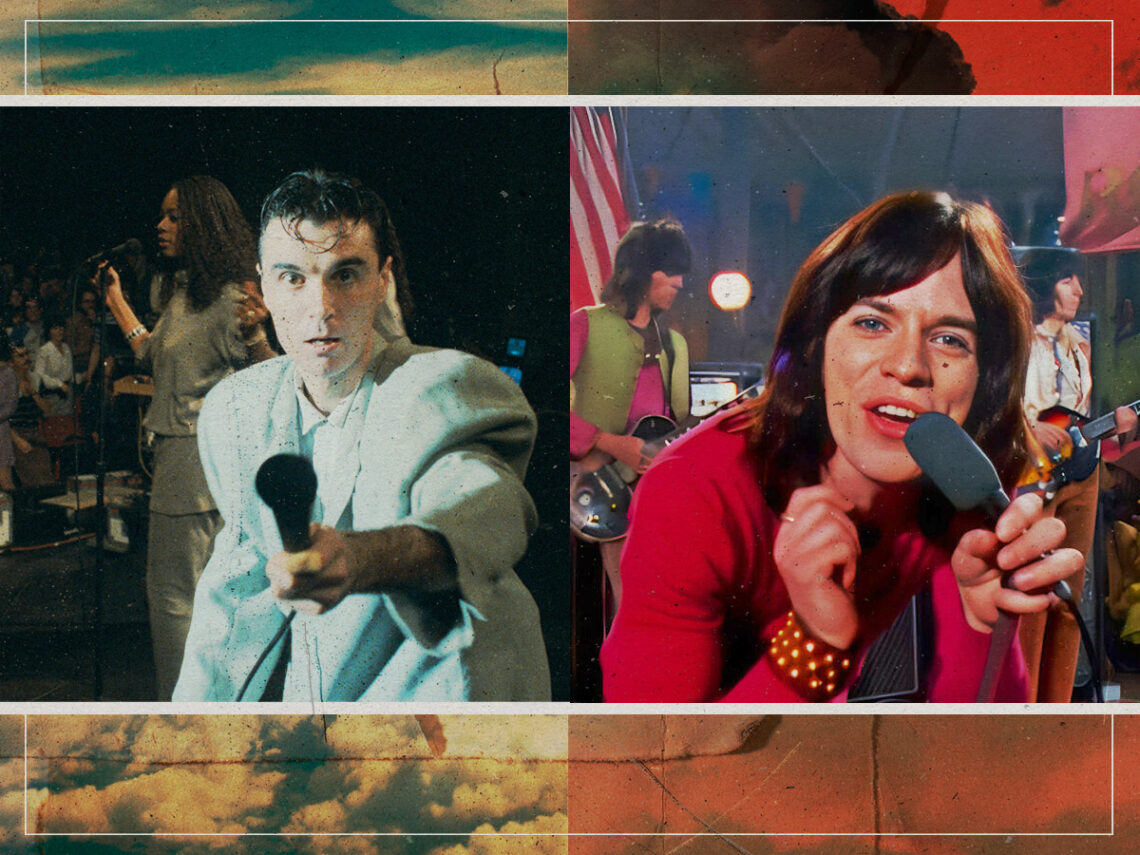
‘Heaven’: how Talking Heads and The Rolling Stones looked at paradise in a different light

The idea of the afterlife, and of heaven more specifically, has been endlessly debated and depicted in song. Bob Dylan confronted mortality by knock, knock, knocking on heaven’s door. Led Zeppelin charted the story of a woman pursuing a stairway to the paradisiacal place. Belinda Carlisle even managed to find it here on Earth. Just as we all have our own ideas of what comes after death, no two artists have tackled the topic in the same way through song. Take Talking Heads and The Rolling Stones, for example.
In 1979, David Byrne and his bandmates provided their own take on eternal Elysium with ‘Heaven’. Textural and eerie, the song is sonically coherent with the rest of the jittering Fear of Music, but its lyrics go beyond the Dadaist nonsense of ‘I Zimbra’ to tackle the complexities of its namesake. Despite the weightiness of Byrne’s topic, his lyrics are fairly simple.
As country twangs and swaying percussion cushion his words, Byrne’s layered vocals liken the perfect place to more earthly experiences. Heaven is a bar where they play his favourite song, heaven is a party where everyone leaves at the same time, and heaven is a kiss that will start again. Ultimately, heaven is a place where “nothing ever happens”, a refrain Byrne keeps returning to throughout the song’s runtime.
At times, his delivery sounds shrugged and distanced. At others, it’s steeped in longing and wondering. As a result, it’s difficult to ascertain exactly what the tone of his words truly is. Is he poking holes in the belief that heaven is an eternal paradise, which would eventually breed boredom, turning into a place where nothing ever happens? Is he finding heaven here on earth, in bars and kisses and music?
The song’s inscrutability is characteristically Talking Heads, a thoughtful yet enigmatic take on heaven accompanied by sparse instrumentation and drawled vocals. It’s a stark contrast to The Stones’ ruminations on the topic. The latter came two years later in 1981 on their iconic Tattoo You, an album which produced enduring tracks like ‘Start Me Up’.
On his take on ‘Heaven’, Mick Jagger replaces distant twangs with sultry strums and shimmering flourishes. True to his reputation as a sex symbol, Jagger seems to find paradise not in the sky, nor in a bar, but in sensuality. “Smell of you, baby,” he sings, “my senses, my senses be praised.” His echoing vocals slur into one another, at odds with Byrne’s nervous wavers.
The track does share a few similarities with the Heads’ take on the topic – Jagger finds heaven in “kissing and running,” but his vocalisations are far more sensual than they are sarcastic. As if subliminally inspired by Byrne’s words, the words “bar” and “nothing” even crop up in his lyrics but in a completely different context to the Talking Heads track.
“No one will harm you, no one will stand in your way,” Jagger declares, “No one will bar you, nothing will stand in your way.” His words swirl around one another with an ease that’s impossible to find in Byrne’s words. Each iteration of ‘Heaven’ seems to distil the differences between the two frontmen, between the agitation and off-kilter artistry of Byrne and the sensuality of Jagger.
Whether you prefer the new wave stylings of the New Yorkers or the sultry rock and roll of Jagger and his bandmates, both tracks are gorgeous takes on the idea of heaven, though markedly dissonant.
