


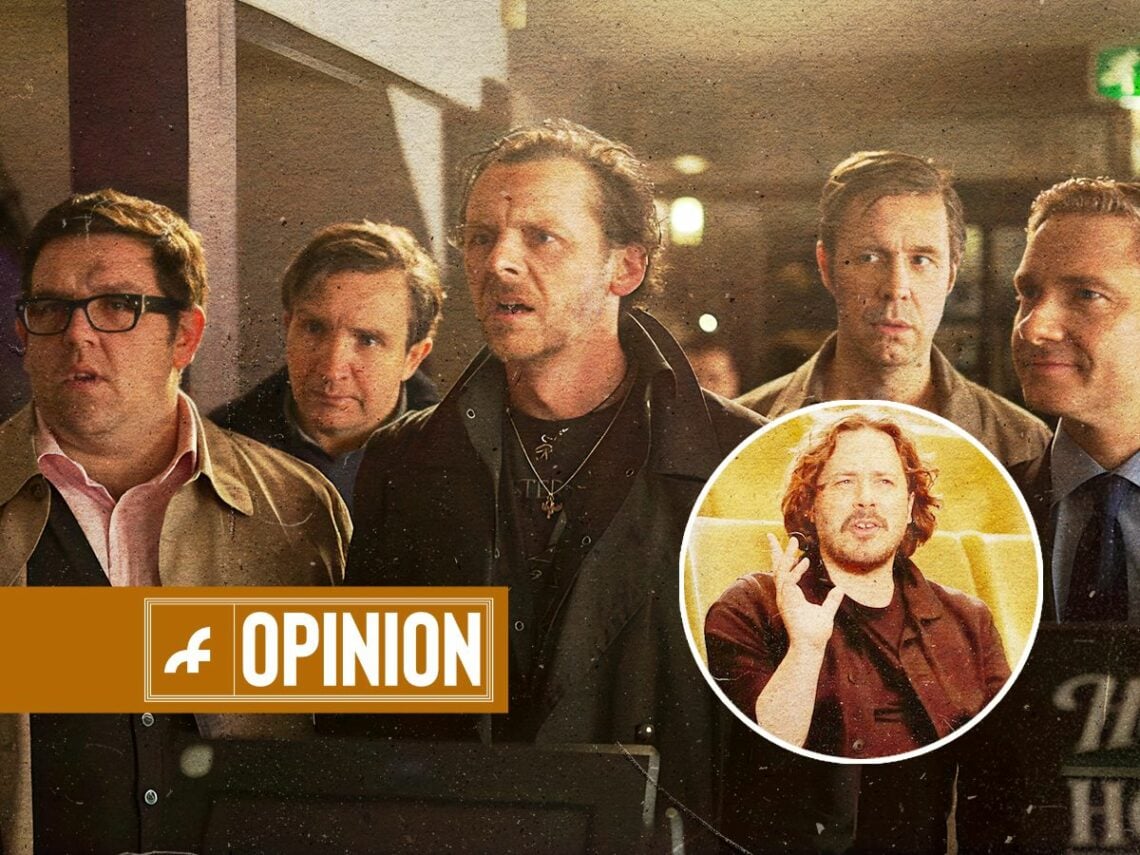
Hear Me Out: ‘The World’s End’ proved Edgar Wright was a one-trick pony

Director Edgar Wright holds a unique place in the narrow landscape of British cinema. Known for his ability to fuse genre tropes with quintessentially British characters and settings, the director has garnered attention and acclaim from audiences and critics alike. His distinctive style, punctuated by kinetic editing and creative visual storytelling, sets him apart from his contemporaries. Most importantly, however, he sent a clear message in the early 2000s: British films can be just as fun as American ones can.
After the success of his genius western parody, 1995’s A Fistful of Fingers, Wright was handed the reins to his own sitcom. The short-lived, two-season Spaced was an instant cult classic and allowed Wright to hone his style and editing sensibilities that would be put on show with his later big-budget features. Building upon what he had established with A Fistful of Fingers, Wright was able to infuse the most mundane British scenario, a flatshare in north London, with fantastical elements and overt pop cinema references. The result was a lasting piece of British entertainment that single-handedly catapulted both Wright and actor Simon Pegg to fame.
Three years after Spaced, the director was granted the opportunity to direct his second film and first fully-financed mainstream feature. His contribution was the timeless rom-com horror Shaun of the Dead. An instant classic, it firmly established Wright’s knack for embedding typically American genre conventions into distinctly British settings. Shaun of the Dead took the American zombie apocalypse trope and set it amidst the mundane landscape of suburban London. While Danny Boyle had stepped into similar territory with 28 Days Later two years earlier, that film was about redefining the genre. In contrast, Wright’s film completely and utterly hinged on appropriating it. The contrast between the catastrophic and the commonplace was striking, lending the film a timelessly unique charm that resonated with audiences both in Britain and abroad – Quentin Tarantino famously cited it as his “favourite British film”.
Building upon this successful model, Hot Fuzz arrived three years later, in 2007, and this time placed a high-octane American-style buddy-cop narrative within a tranquil Gloucestershire village. It cleverly subverted audience expectations, juxtaposing explosive action sequences with the hilarious banalities of rural life. With its increased polish and scale, Hot Fuzz elevated Wright’s style, outdoing its predecessor and cementing Wright’s reputation even further as a British filmmaker well worth his salt. These two films, each unique yet sharing a common thread of blending American genres with British settings, shared one more particular object that ‘linked’ them, like a proto-cinematic universe: the Cornetto ice cream. Undoubtedly thought of as nothing more than a surface-level visual gag, this branded ice cream’s recurrence nevertheless led fans to coin the term “Cornetto Trilogy”, speculating whether Wright would cap it off with a third film. The anticipation was answered in 2013 with The World’s End, the final film in the now-official trilogy.
Why did The World’s End struggle?
The World’s End, rather than innovating on the earlier formula, appeared to rely on it. It aimed to blend the traditional British pub crawl with the grandiose concept of an alien invasion. Yet, despite these disparate elements, the blend felt predictable and uninspired. The novelty of the American genre-British setting mash-up had worn thin and thread-bare, and the film didn’t offer anything new to justify its rehashing of this familiar formula. Shaun of the Dead and Hot Fuzz have countless memorable scenes and instantly recognisable quotes (“You’ve got red on you”), but I would challenge any Wright fan to offer up a line from his sci-fi dud. That’s the problem with the film; it’s not bad, just superbly average. After a decade and many a re-watch of the entire trilogy, it’s abundantly clear that it should have remained the “Cornetto duology”.
Wright’s foray into American cinema, with Scott Pilgrim vs. The World and Baby Driver, suggested a skilful ability to adapt and succeed beyond the British scene. These films showcased his talent for creating visually stunning and entertaining narratives in different cultural settings. He could successfully lean entirely into the strain of cinema he had been cannibalising for ten years prior. However, The World’s End‘s lacklustre legacy prompts a question: as far as his British filmmaking is concerned, was Wright just a one-trick pony, unable to recreate his initial successes?
While I hold Shaun of the Dead and Hot Fuzz as two of my favourite modern films in British cinema, I find it hard to reconcile them with the third entry in the trilogy. It’s a film I tend to ignore when considering Wright’s oeuvre, and the disappointment was only amplified by his soulless return to Britain with Last Night in Soho. With a heavy heart and a sense of trepidation, I now consider the prospect of a future Edgar Wright film set on home turf. Has the director who once brilliantly subverted and remixed American genre tropes into quintessentially British narratives lost his edge? As sad as I am to admit, I think the answer is yes.
