


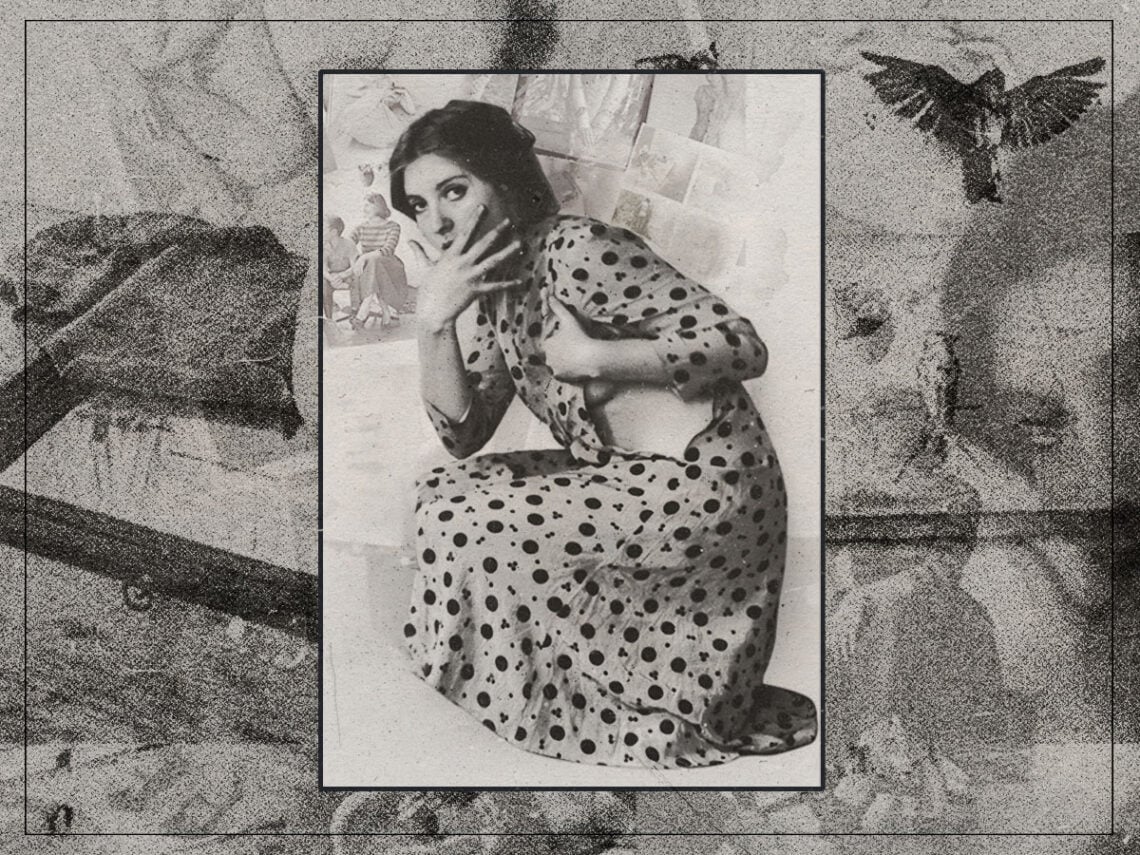
Inside the haunting world of Francesca Woodman

It is a tragedy that many artists end up passing away at a young age. Francesca Woodman, the incredible photographer who jumped out of a window when she was 22, left behind countless beautiful and innovative images. Born in 1958, Woodman began experimenting with photography when she was 13, soon finding herself unable to stay away from her camera, typically placing herself in front of the lens.
Woodman played around with the idea of the self-portrait, often placing herself in unconventional settings, such as behind a broken fireplace or inside a cabinet filled with taxidermy. She becomes one with her surroundings, often literally appearing to melt into the backdrop due to her use of photographic techniques, like slow shutter speed.
Sometimes, Woodman looks directly at the camera, acknowledging our gaze, and other times, she seems oblivious to its presence, making it feel as though we are voyeurs to her nakedness and unusual behaviour. Her choice of settings, often dilapidated buildings with grimy, peeling paint on the walls and stark wooden floors which look like they’d give you lots of splinters, are deliberate, of course. There isn’t anything remotely glamorous about these settings. Instead, she immerses herself in these crumbling worlds, becoming equal with these images of destruction, death, ruin and decay.
Inspired by gothic literature and a fascination with the way our bodies relate to our surroundings, Woodman expertly merges herself with both the artificial and natural world, and by situating herself, a woman, directly at the centre, it is impossible not to read her work as a commentary on the role of women in relation to the wider world.
Some of her photos appear to show her experiencing visceral sensations, such as her legs tightly bound with tape, pegs attached to her stomach and breasts or her hands bound with rope. These images seem to reflect the female struggle for independence and autonomy, with her black-and-white images confronting us with such ideas head-on. Woodman’s photos are honest and often shocking, forcing us to really consider the story she is actively telling through her position in the photograph and her use of props.
Time becomes an illusion within her work, and it feels as though there is no distinction between dreams, waking life and death. Woodman created such an astounding collection of photographs, with some of her greatest works being made when she was just a teenager. Completely unhinging herself from the male gaze, using nudity often without a trace of eroticism, Woodman’s work is a profound example of pure talent.
The only book of her work released in her lifetime (just days before her death) was Some Disordered Interior Geometries, a very small collection of photographs. She also had a small number of exhibitions for her work, but her lack of overall success as an artist, struggling to find the funding she needed to continue, was part of the reason she inevitably took her own life in 1981.
These days, many books compiling her work can be purchased, such as On Being An Angel, revealing haunting photographs of Woodman that are truly one of a kind.
