


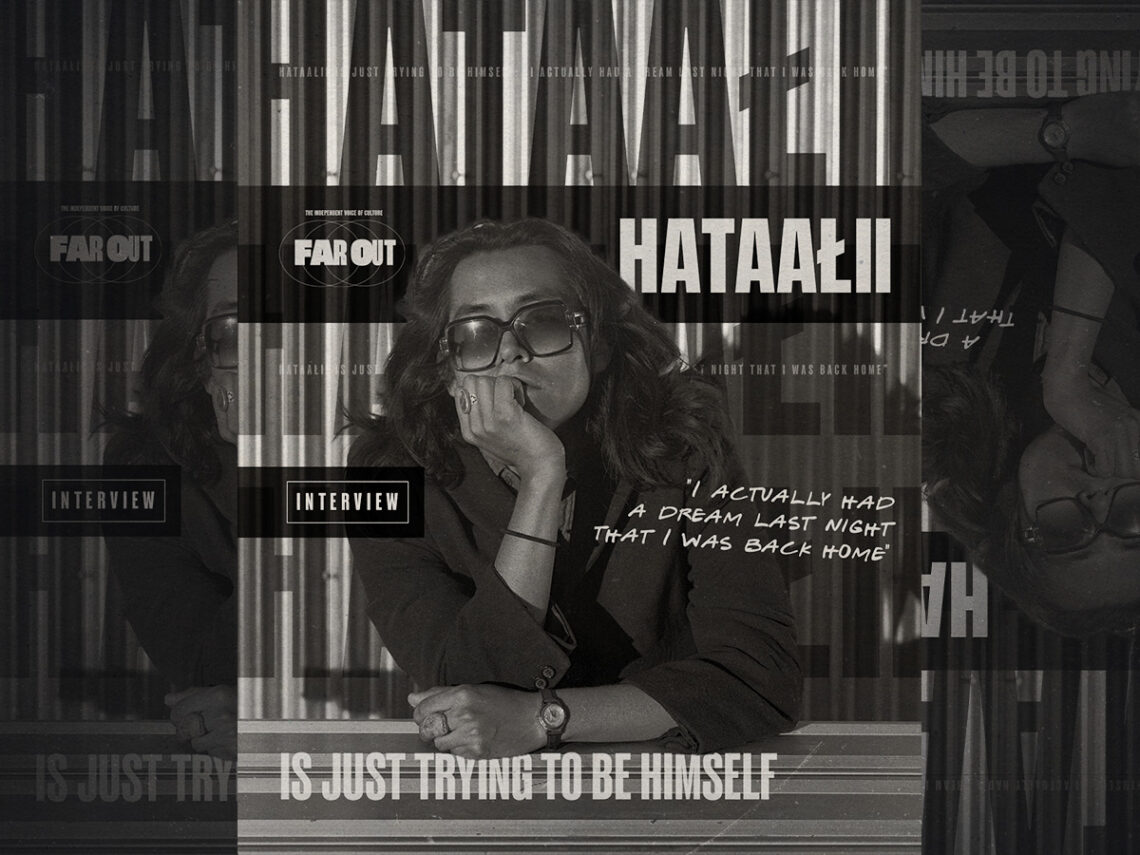
Hataałii is just trying to be himself: “I actually had a dream last night that I was back home”

Amid the hush of an orangey New Mexico suburb, the distant sun pauses its descent to perch on top of a shed like a waterlogged football that’s been kicked up there and forgotten about. Some place not far off, a blaring TV set spills bleak news through an open window into the wild. Hataałii doesn’t pay it any mind. As the sun sets on a broken America, he’s busy bustling around inside the crooked shed, trying to mend his own broken heart with his latest collection of lo-fi indie.
Like the beating sun and the blaring news, there is a weight bearing down on I’ll Be Around, Hataałii’s latest record—his first on Panther Mountain. It causes the country sounds of the album to creak, but it all remains an ominous background, present but unmentioned. Hataałi was just busy in his shed. He had more personal problems to contend with this time around. In many ways, this is how he has encapsulated America indirectly on each of his albums—by just trying to get through it.
“I think that can be viewed as like an indigenous American’s perspective on America,” the Navajo Nation native explains. “I feel like a lot of natives don’t even feel a part of the United States.” Somehow woven into the sound of everything Hataałii has done in his young yet prolific career, has had a sense that he is perched on his porch, watching the world go by. “On this album, the songs aren’t really about anything that topical. They’re pretty simple. But the sound is definitely drawing from…”
He trails off—understandably so. It’s a vast and haunted sound that he summons on I’ll Be Around, loaded with more multitudes than an interview could ever hope to conjure the right words for. He manages to mutter, “It was trying to be country music or something”. There’s a sense that it’s country music in many different ways.
While there are tinges of Hank Williams and other stars of the cowboy-hatted ilk, there are equal amounts of Nirvana, Twin Peaks and Terry Callier—in that sense it is country music by virtue of being an eclectic sound of a nation. All of that is woven together with the Southern saudade soul of Cormac McCarthy, put forth as weerily as you might expect from an author two years dead, and beautifully performed in Hataałii’s unique tones.

It wasn’t just originality and individualism driving the distinctive timbre of the record this time out either. Stationed in a shed that had been transformed into a makeshift recording studio in his friend’s garden, Hataałii began experimenting. “The writing was kind of the same as ever, but I just had a new arsenal of instruments now, because I started playing the cello and lap steel,” he explains. “So, whatever you’re hearing on the album is essentially me learning how to play those instruments.”
“If anything, I’m trying to reach for a sound that hasn’t really happened yet.”
Hataałii
Aside from that, he says he was “listening to a lot of Neil Young at the time. So I just, I was just trying to sort of emulate what my idea of what country music was, because I grew up with country music, so I felt like it was about time that this needed to happen.” It was a very casual intent, even the lap steel and cello came his way inadvertently as gifts from friends, but somehow, it all struck at the core of Hataałi as a person.
Speaking of his upbringing, before finding himself holed up in a shed in Alburqurque, Hataałii was raised in Window Rock. “There’s a lot of poor infrastructure there,” he says, “but the the reservation is big enough to sustain its own culture, and so it’s kind of like being in another country in terms of the people. But country music is very popular there, but that’s not all I listened to.”
He adds, “My dad gave me a good music sense, I think, and I actually had a dream last night that I was back home and some old childhood friends of mine, like, rented a bus and we went camping. That was kind of cool, nice.” It’s a strange impromptu segue appropo of nothing, but in it sown strange way, such an aside typifies his music.
The arboreal forestry of Arizona is in some strange and far off way, present in his sound. “I think that’s the case,” Hataałi says. “But I don’t try to aim for that, you know? Yeah, I think it just naturally comes out that way, because that’s where I’m from. If anything, I’m trying to reach for a sound that hasn’t really happened yet, but as of right now, that’s just the way it’s sounding.” in truth, he does strike upon something new—it’s also something old, something borrowed, and something blue.
“I’ve always made music as a response,” he says, and skirting declaring anything too personal in his own laidback way, this was a response to “life happening”. Titles of tracks like ‘She Ain’t Coming Back’, ‘Somebody Else Has My Baby’ and ‘I Tried’ should give you a flavour of the sort of “life happening” that he is talking about. Yet, no matter how earnest and honest his music, it always comes from an unfamiliar place for many of the masses by virtue of Hataałii’s culture.
“How I feel about who I am and where I’m from is always changing, but I’ll always be proud,” explains. “I guess my art has constantly just sort of been figuring that out—figuring out what that is in the world.” The inclusivity of the art world might be changing, but while a white middle class artist from a major city will simply be seen as an artist, those from a minority are seen as artists with an eternal prefix attached to their name and all the flag-bearing pressures that go along with that.
Hataałii feels those pressures. “Native Americans have been put in the spotlight in recent years. So, I don’t want to speak for anybody. But as far as representing, you know, I hope I’m doing a good job. But I think I will just always be trying to be myself, because there are a lot of natives who are taking advantage of that – not in a bad way – but for good. They’re really a community, helping their own communities, and they’ve got big hearts. I think I just have a weak heart. I’ve never really tried to speak for anybody else. I’m just trying to make art about who I am.”
That’s all you can do, and this time around, he was a heartbroken man in a shed in the midst of listening to a lot of “Neil Young, Richard Hawley, Julia Holter, Paul Westerberg, and Bob Dylan’s country albums—the ones that everybody else says are his worst.” The result is another masterpiece from one of America’s accidental preeminent artists of its dilapidated age. He’s done all that be being his own laidback self, bustling through the present barage of mayhem trying to find peace.
There’s so much of him in I’ll Be Around in all respects that you could drop an anvil into the dainty, doleful tracks and never live to hear it hit the bottom.
