


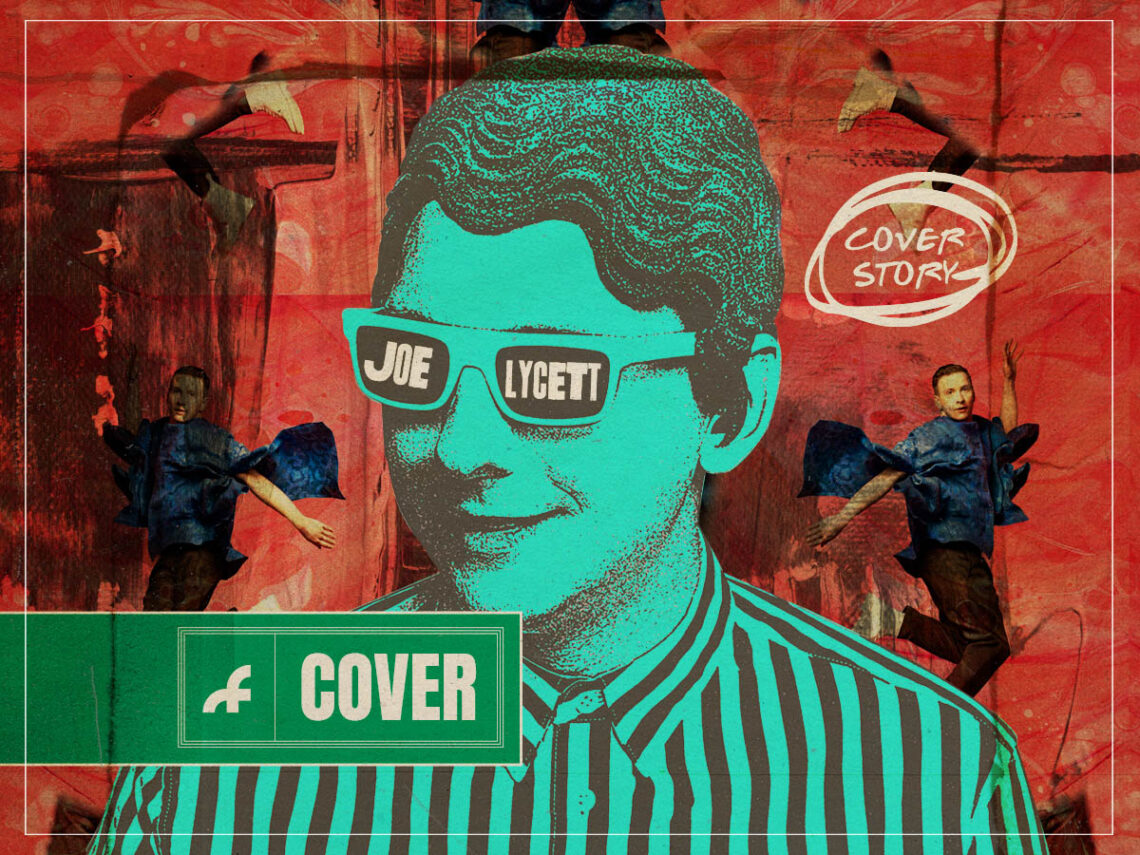
Joe Lycett is an absolute Art Hole: talking about the importance of culture with Britain’s most important comic

I pause the Olympics, where an Algerian boxer has not only triumphed over her Chinese opponent but also defied rampant misogyny to claim gold in the ring. I set aside the newspaper with its grim headline story about fascist rioters attempting to set fire to a hotel full of asylum seekers in Rotherham. And I pick up Joe Lycett’s new art book, Art Hole.
Perhaps it was the backdrop that preceded it, but as I leaf through the pages, finding Harry Styles depicted as a dandily dressed boiled egg seems like the very height of triviality. But in due course – after reading about the New Statesman crowning him a faux-intellectual, self-serving prankster and a lengthy discussion about art with the man himself – suddenly, this singing art brut egg takes on its own vital gravitas.
In fact, it seems like simply the latest flex from the most important comedian of recent times. Or, as he puts it, “the greatest artist of the 21st century”. A bold comedian who, a couple of enlightened centuries ago, may well have been skewering the horrors of the recent riots in the Olympics and claiming gold for broken Britannia in the men’s watercolourist final.
Comedy, in those Ancient Greek days, served as a tool for social commentary. It was revered as a vital cog in the workings of society, so important that art had its place in the Olympics of the day. However, all of that has since changed. The good and the bad of the transition that has followed can easily be seen in Art Hole. I’m not sure the Ancient Greek judges would score the raisin-like depiction of Lycett’s “nemesis”, Sir Alan Sugar, quite as highly as Plato’s latest philosophical paper—but it certainly has an importance of its own.

Pranking the press
After all, Plato said himself, “Rhetoric is the art of ruling the minds of men”, and Lycett has certainly done his fair share of silliness to help shape modern rhetoric—not to rule, but to push for progressive change. He has made this comedy’s duty. “Laughter is the key thing. If you’ve lost that, you’ve lost life, essentially.” This is something that was, indeed, lost on the po-faced press when they fell for the ludicrous fake stories he recently seeded into published reality. Stories about a statue of H from Steps and a bruise in the shape of Prince Phillip, among other satirical absurdities.
Like the naïve artistry and accompanying essays in Art Hole, these fake stories might have seemed trivial on the surface, but what they say about modern media is anything but. As a member of said media – albeit a very separate, entirely independent branch – I worry I may be his next victim. Will he slip a false story into our discourse? “You never know, Tom,” he says wryly, “But unfortunately, I don’t have anything planned. I was thinking it’d be fun to just refer to the publication as Far Right Magazine all the way through. Very timely. That’s my plan. It’s lovely to speak to Far Right Magazine.”
There is a lot of mainstream media out there where such a name would be fitting. Lycett, in his own comic way, has held these publications and figures to account. For instance, he threatened to shred £10,000 in protest of David Beckham’s sanitised ambassadorial role for former World Cup hosts Qatar, where it is illegal to be gay—a fact that seemingly mattered not when £10million was involved.
“People talk about them as pranks,” he says of such incidents, “But I describe them as stunts—though I don’t know what the difference is really. Pranks feels not very thought-out and aimless in its target. I don’t do pranks for the sake of doing pranks. I do them with a purpose. They’re high concept. I wouldn’t just run up and pull someone’s trousers down. I think that’s naff and cruel.”
He continues: “I watch that sort of League of Their Own style joshing, and I don’t want anything to do with it. They’ve asked me to be on that show and I just think, ‘I’ll leave you guys to it. I’d much rather speak to the Far Right Magazine’. I’m not pranky without purpose.”
This purpose not only probes at the pitfalls of society but also highlights the power of art. For instance, take corporate media’s angry response after falling for his ‘stunt’. “Somebody on Twitter said, ‘The problem is, these people are working in a really difficult industry. Difficult hours, under real stress, and it’s a really horrible environment’. And somebody replied, ‘Surprise, surprise, bad working conditions at the racism factory’. That’s the point I’m making,” he explains.
That’s a hell of a statement on the purpose of art at a time when the same powers behind corporatised media are trying to gerrymander culture towards another mere engine of capitalism—governed by an algorithm of their own making.

The purpose of modern art, according to Joe Lycett
Art is no longer in the Olympics—far from it. Music gets £0.0028 per stream rather than gold medals. But Lycett likes the idea of bringing it back for Los Angeles 2028. “I think it’s a brilliant idea,” he proclaims. “It’d be interesting to see who, if they did an Olympics for comedy, we’d put up?” A beat later, he concludes, “It’d be Ricky Gervais, obviously. I don’t even know why I asked.”
Quips aside, it would at least restore the once lofty status of art and comedy in the stakes of societal importance. Whether it’s Art Hole or his stand-up, Lycett is always aware of this pertinence in his work. “I’m a big advocate for art having a purpose and doing something for people,” he says. “I know that sounds wishy-washy, but it’s not: art fulfils a valuable role. One of those roles is to take you out of yourself.”
“Awe and being amazed by the world around you happens randomly. You might get a beautiful sunset, but you can’t plan for that,” he continues. “Art provides that service on tap. Basically, you can look at an amazing artwork and be in awe of it. That’s invaluable. If you want to feel sad, you can listen to some Alanis Morissette. It’s a valuable thing that it’s giving you there.”
That feels even more palpable when it comes to his own craft in these trying times. “I think comedy is something that is unique to our species. Laughter is a unique way of approaching the hard things in life and tragedy and things that are wrong and injustice; having access to that through art is a really useful part of society. It’s a really important way of expressing opinions and your feelings about life.”

Why art matters to everyone
That expression has often been undermined as unimportant in the modern age. This is tackled in the very style of Art Hole. There is an easy accessibility to Lycett’s work by design. “What I’d like people to take away from the things that I do is a sense that they can do it. Nobody’s looking at my artwork going, ‘Wow, the technical skill of this’. It’s naive, and it’s childlike, and it’s massively imperfect, but that’s fine, and that’s still valid.”
It’s more than just valid; it’s an encouraging call to arms. As he explains: “One of the things I absolutely hate is when people say, ‘Oh, I can’t make art, I can’t do anything. I’m not creative’. If you’ve bought a sofa, you’re creative because you’ve made a decision. The phrase ‘I can’t’ actually stops people from getting the joy out of art that they could because everyone should be doing it. It’s really good for you. They’ve done studies that prove it adds years to your life. It’s an integral part of a holistic way of looking at people’s wellbeing.”
They’ve also done studies that show why so many people stop partaking in art from a young age. In a psychological experiment, a classroom of kids were allowed to do what they wanted for a few hours without comment. Those who wanted to paint simply painted. Those who wanted to play football simply played football. They did things they wanted to do for the cathartic joy of doing them. A few weeks further down the line, the adults suddenly stopped quietly observing and offered rewards for what would be deemed traditionally ‘good’ work. Suddenly, the kids began doing what they were ‘good’ at rather than following the needs of their natural inclinations.
In recent years, Michael Gove, in essence, formalised this practice by de-incentivising the arts. “We now live in a world where arts hasn’t literally been rewarded from an education level up,” Lycett posits. That’s a big problem. Because art can hold people like Gove accountable, as Lycett has proven to be very chagrined.
Comedy is no mere laughing matter
It’s Lycett’s view that the ruling elites have also tried to diminish comedy while they’re at it. Even his latest comic turns that have poked wholesale holes in the flawed fabric of modern media have still, by and large, been regarded as jokes unworthy of reverence and primed for castigation. “I think people that don’t work in comedy think it’s easy,” Lycett says of his craft’s frequently overlooked standing. “I actually think it’s easier to make people cry than it is to make them laugh because there’s just a load of buttons you can press, and suddenly you’ve got a good thing that’s happened.”
He drily continues: “I always just think, ‘Yeah, well done, you’ve made ‘em cry. What now?’” But that’s often applauded, sweeping up Oscars, being cast in bronze statues, and adorned with the ‘genius’ tag. “Whereas I think that comedy’s just seen as a bit tacky like it’s a bit naff to make ‘em laugh. Often, the sorts of people at the top-end of arts organisations, the sort who vote on the Oscars or own the galleries, are quite humourless people.”

How did we get here?
The advent of the printing press altered culture’s role in the world, democratising its production and consumption. This was, in theory, a good thing. Liberty being the benefactor of progress was even more true in the case of the internet. With these two giant leaps, art – in its broadest sense – was no longer exclusive to the elites and power was wrestled away from its gatekeepers.
A great cultural shift was set in motion. Yet, in modern times, this democratisation has been co-opted by extreme capitalism, whereby subtle, omnipotent control shapes creative expression. You have to provide something in line with what the people want, and what the people want is prescribed by the powers that be. This story, for instance, will be deemed much too long, by their bloody capricious algorithm, to be read by any degree of the masses in the 21st century—is that my problem for not adhering to digitised cultural modernity, or is that a casualty of digitised modernity’s control over culture?
Art, once a revolutionary force, has been commodified into mere content—something to be programmed and consumed rather than an unrestricted transformative tool revered within society. But Lycett is trying to pull down the pants of the powerful by exposing pitfalls and turning the ways of the “silly“ world into punchlines.
Joe Lycett’s work reminds us that art, once considered and Olympic feat, can still provoke change and discussion. This has made him a much-needed radical artist. He might be making his point in a fuzzy hoodie and have an inability to exceed ten sentences without mentioning his mum, but it’s only the restrictive mechanism of the ruling elite that would make you believe that renders those points less revolutionary.
In works like Art Hole, Lycett not only critiques the commodification of art towards an algorithmically overruled content machine but also encourages everyone to embrace their own creativity, even if it does ”look a bit off”. He navigates the complex relationship between art, media, and power in this celeb-crazed, content-obsessed world, reminding us that laughter has revolutionary potential. Whether he is illustrating the issues in the modern practices of modern media’s racism factory or offering a boiled egg rendition of Harry Styles, Lycett’s work underscores the importance of art, where the trivial can be really quite profound.

Never Miss A Beat
The Far Out New Music Newsletter
All the latest New Music from the independent voice of culture.
Straight to your inbox.