


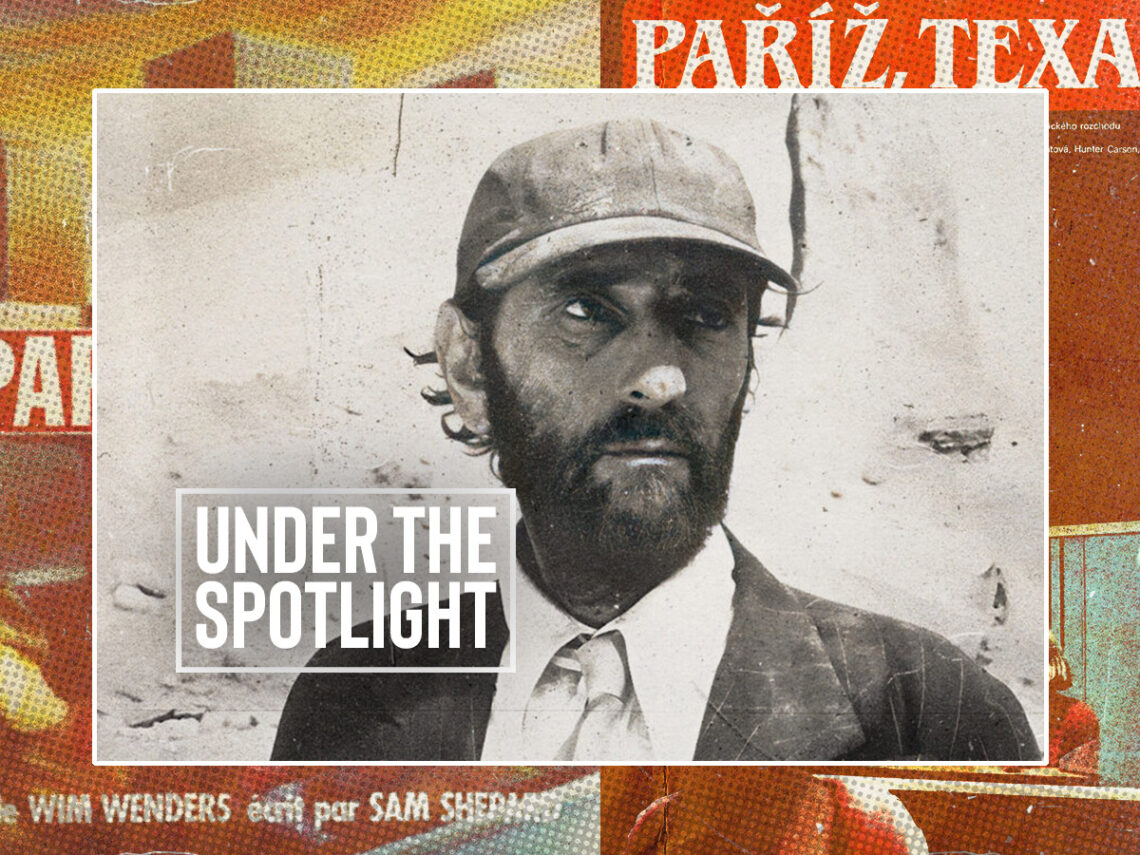
Under the Spotlight: Harry Dean Stanton’s spectacular performance in ‘Paris, Texas’

Wim Wenders’ Paris, Texas opens with expansive shots of a dry, sun-beaten desert, with the camera tracking across the screen in search of something. Eventually, it finds what it’s looking for: Harry Dean Stanton’s lonesome character, Travis, wandering aimlessly. A long shot identifies the mysterious man wearing a suit and red baseball cap before a close-up shot focuses on his weathered face.
Up until this point, Stanton’s career had consisted predominantly of supporting parts in high-profile movies like The Godfather Part II and Alien. However, under the direction of Wenders, Stanton was given his first leading role. No doubt an emotional feat for Stanton, who was 58 at the time, the actor gave a career-defining performance worth the decades-long wait.
When introduced to Travis at the beginning of Paris, Texas, we meet a man at odds with the world around him. The desert rocks tower over his slender frame, as does an eagle, the quintessential symbol of freedom, creating a looming presence. Soon, he walks away from the camera into the distance, leaving us to question the whys and wheres of Travis’ situation. Momentarily, he is rescued from his drifting by his brother, Walt, played magnificently by Dean Stockwell. We discover that Travis disappeared several years prior, leaving behind a young son, Hunter, and his wife, Jane, who is now missing, too.
Paris, Texas is a delicate film that explores the complicated nature of familial relationships against the trials and tribulations of the American dream. It’s hard to fault any aspect of Stanton’s performance as Travis – a man who carries the weight of guilt, fear and uncertainty on his shoulders. Underneath his timid, quiet exterior, Travis possesses a heavy backstory, which manifests in idiosyncratic ways, such as shining shoes or refusing to speak.
In fact, Travis doesn’t talk for the beginning of the movie, much to the frustration of Walt. To some, this could quickly become tedious to watch, with Travis never giving in to Walt’s insistence that he just say something. Yet, Stanton plays the part with genuine empathy for his character and a side of subtle humour. You cannot help but side with Travis, who embodies a modern-day Bartleby, “preferring not to” in the face of constant questioning from the outside world.
Stanton brings greater depth to Travis’ character through his interactions with Hunter. While the pair don’t get off to the smoothest start, they bond throughout the movie, with the boundary between parent and child blurring as Travis slowly assimilates back into normal society.
In one heartbreaking scene, Travis goes to pick Hunter up from school, only to be ignored by his son. Yet, when he tries again, this time in a smart suit with a comical oversized hat, Hunter begins to warm to his father. As they walk on opposite sides of the street, Hunter mirrors Travis’ humorous actions. Their initial tension unravels as Travis loosens up, trying his best to connect with his son. Stanton imbues an incredible amount of bittersweetness into the scene, taking inspiration from silent-era slapstick to entertain his character’s young son. There are many moments in Paris, Texas which could be considered defining, and this tender, hopeful sequence is one of the movie’s most important, mainly down to Stanton’s simple yet affecting performance.
Of course, any discussion of Paris, Texas cannot ignore Stanton’s monologue at the peep show, where he reunites with Jane and retells their story. She cannot see him but allows him to speak at length, soon realising that the man concealed on the other side of the screen is Travis. It’s a terrific scene, both thanks to Nastassja Kinski and Stanton’s performance, exercising nuanced restraint, subsequently giving the scene more emotional effect. Stanton never overindulges despite the intensity of the subject matter. There’s no dramatic outburst. Instead, Stanton gives a subdued, thoughtful performance awash with reflection and guilt, processing the incident that caused their separation as he delivers his words with a touch of awkwardness.
Stanton’s portrayal of Travis is nothing short of perfect, suiting the movie’s mellow tones and Ry Cooder’s contemplative slide guitar score. Travis’ journey ends on a note of uncertainty as he drives away from the hotel after reuniting Jane with Hunter. A breathtaking shot of Travis, his face wet with a tear, ends the film. He knows he cannot join Jane and Hunter because the cycle would repeat again, so he lets them go, driving off like a lonesome cowboy. Reckoning with the hefty weight of his emotions, Travis continues onwards – that’s all he can do. Stanton’s tender portrayal of such an emotionally complex man anchors the film, arguably giving one of the finest performances in cinematic history.
