


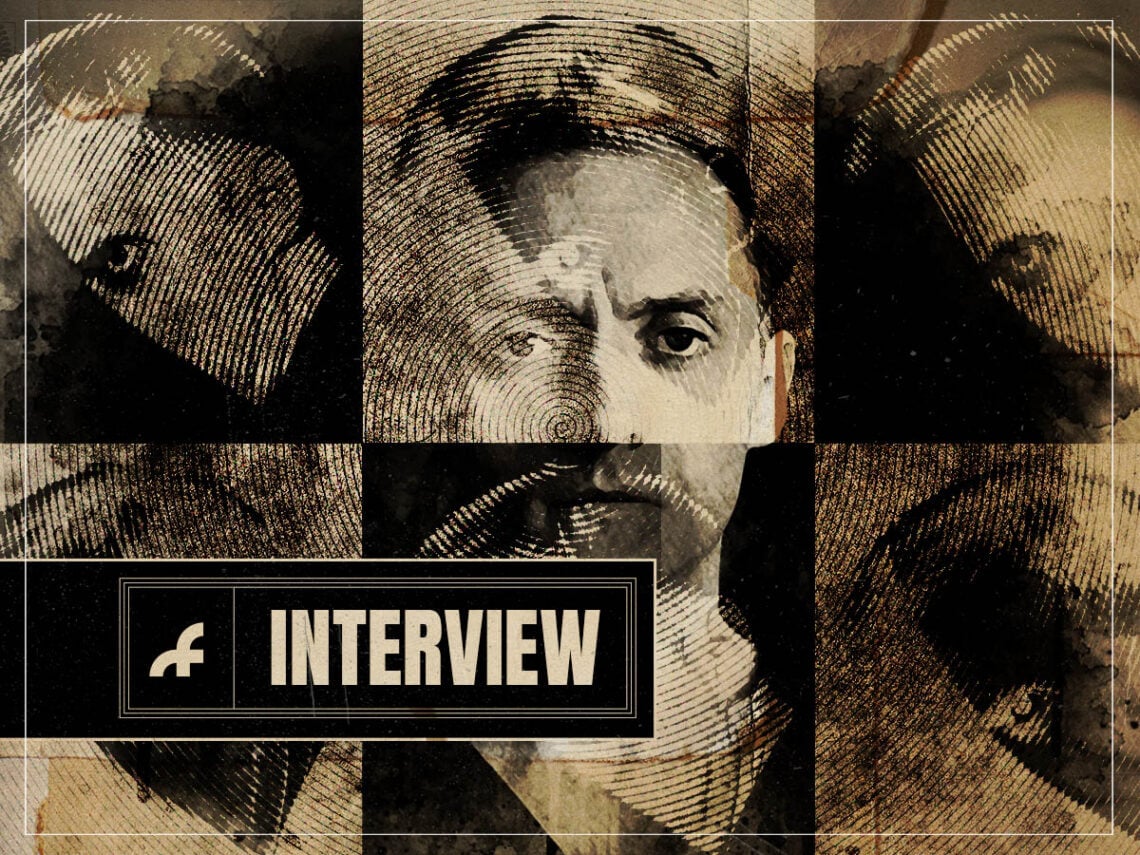
Hamish Hawk’s secret journey to a sordid ‘Firmer Hand’: “Am I going to get myself in hot water?”

“When I was a teenager, I went to lots and lots of gigs,” Hamish Hawk explains. “That was what I spent my pocket money on.” With the indie scene abuzz in his native Edinburgh in the early 2000s, the slight would-be songwriter hauled his skinny jeans and scuffed Converse from Studio 24 to The Hive in search of be-fringed MTV2 heroes rattling off ‘banging tunes’. Hamish and his friends would even doctor the dates on photocopies of their passports, using them as falsified IDs like wee spooks infiltrating grand indie fraternities.
Therein, Hawk squeezed into the squishiest rows, reserved for the keenness of youth, and found himself “enamoured with the frontman or frontwoman mystique”. He’d stare on agog, his 12-year-old eyes entranced by the “kind of distant lead at the front of the stage,” he said. “I was so enthralled with that, and I didn’t know that I was taking things from them at the time, but I was definitely being inspired”.
Two decades on from his spellbound early phase, that inspiration has resulted in A Firmer Hand, Hamish Hawk’s third album—or fifth if you count releases as Hamish James Hawk in 2014 and then as Hamish Hawk and the New Outfit in 2018. After years of maturation, evolving from the sticky carpets of his skull T-shirt-ed youth, the Dunediner has now arrived at a place where he’s so assured in having found his own voice that he’s now characterfully playing around with it. In the process, he delivers another triumph, affirming himself as one of the finest songwriters of the era.
However, while his lyricism might be a decidedly contemporary critique of the flaws of modern man, there is something undeniably anthemic about his musicality that holds true to the hallmarks of the good old indie he was raised on at its best. “It was the great and the good and the terrible of UK indie music of the early naughties,” he says of his earliest inspirations.
“It was bands like the Arctic Monkeys and The Futureheads and…” he trails off, cautious not to cite one of the dreaded ‘terrible’ acts. “But my big band at the time was The White Stripes,” he says, having focused a little. “I absolutely loved them and to this day, The White Stripes are one of my favourite bands in the world. I absolutely idolise Jack White and everything he touches. I’ll follow every bit of work that he’s done.” Amid the multitudes of A Firmer Hand, there is a touch of the gritty power that White upholds and a definite mystic shadow honouring the clandestine spirit of the blues.

Alas, there is only a touch; the journey to this record did not begin and end with The White Stripes or the inspirations at hand in the fervour of youth. In fact, of those bands, it was the evolution of Arctic Monkeys that helped to drag his sensibilities into new realms. “It’s really self-evident why a band like the Arctic Monkeys became as popular as they are,” Hawk says. “Because they really did take something from the indie movement, but consistently, in my mind, do it better than all of their contemporaries. They evolve.”
So, noticing this, young Hamish became determined to evolve from a punter to a performer himself. “I was in a band at the end of school with two of my friends, one of which, Alex Duffy, became the bassist that I play with regularly to this day, and another close friend of mine, Ewan Douglas. We didn’t have a drummer, so yeah, we were pretty niche. Should I tell you the name?” he comically ponders. “They were called Little Egypt. That was our name. I think that might be an exclusive for Far Out Magazine.”
Like everything Hamish Hawk still does to this day, there was also romanticism and due consideration to that name choice. “There’s obviously the Elvis connection,” he begins. “But where we went to high school – this is very niche – on one side of the road, apparently, there was a sort of colony in the 19th century, and it was called Little Egypt, and it had big gates. It was a traveller community, as far as I understand it, but it was quite a large one for northern and western Europe. There aren’t very many traces of it in Edinburgh, but some of the streets have names that are at odds with others in the area.” In its way, this name choice feels like a fitting prognostication: being at odds with the status quo is something that has given great ponderance to Hamish Hawk over the years and continues to do so on A Firmer Hand.
Throughout the album, there is a torturous uncertainty about his place, a tug-of-war between fitting in and comfortable conformity and standing out and dangerous individualism. This feels deeply resonant for many people of a certain age in the 21st century. As Hamish Hawk rummages through the depths of his closet on the record, he often finds pettiness in the skeletons he encounters. Or at least there would be if they were uncovered in the cold light of day. But under the flicker of candlelight, their pettiness makes them loom no less large, like spirits expounded by a trick of the light in the darkness of the fevered psyche they’re kept locked away in.
With this in mind, we return to the journey that led us to this exploration of closeted cruxes. In musing about the whys and wherefores of his own constitution, Hamish Hawk has always been boldly autobiographical in his songwriter, even if a character serves as a conduit. This is not only informed by his own disposition, but his days as a musician after Little Egypt’s three-gig reign came to an end and he developed into an acoustic solo artist in his university days. In this guise, he happened upon his first little masterpiece, ‘Catherine Opens a Window’, a song that contains the crushing lyric, “I remember when cancer was just a constellation, a starry-eyed crustacean with nothing to say of whether you or I live or die”.

“As you can imagine, I’m quite protective of what songs really mean or refer to autobiographically, just because I do concern myself with how other people relate to them, but yeah, that one is absolutely 100% autobiographical,” he tells me. “That is one of my most personal songs. It concerns itself with a very particular period of my childhood. And every lyric in it is absolutely true to life,” he says. “It’s rare for me to have zero embellishment, or zero symbolism, of nothing heightened. As much as I would say, I am quite autobiographical, diaristic in my writing.”
“I will use the truth and then kind of knock it off other things and see how it interacts or contrasts with other ideas. But with ‘Catherine Opens a Window’, it’s absolutely all real. My family and friends that I grew up with, if they heard the lyrics, and they have, obviously, they know exactly what I’m talking about,” he says. “It’s a really meaningful song for me.” This inspired plunge into the depths of his own backwaters is a gauntlet run that has become even more daring on A Firmer Hand.
There is an openness that is positively Dylanesque in its honesty, with Hawk happy to cast himself as the villain, revelling in revealing the more wanton, flagitious side of our thoughts. No matter how minor, trifling and untroubled they might be in truth – hidden competitiveness, streaks of capricious loathing, ego trips, and schadenfreude fantasies – we usually cling to them subtly like a nervous flying nun to a crucifix, but A Firmer Hand is an open book, complex, too ambiguous, and playfully character to be a diary, but there is a sense that even the unreliable narrator orating the show is weaving a few of the harshest truths of Hawk’s career into the web of lies.
This style of writing has taken a level of maturity for Hawk to release he can dabble in the vices of the big leagues. “Something like ‘Idiot Wind’ was vital,” he says, self-effacingly distancing himself from Dylan in the process, “Because I couldn’t tell the entire story that was necessary for A Firmer Hand, without scrutinising myself. It wasn’t going to be viable. It couldn’t be told without the warts and all approach, without putting myself under the magnifying glass and exposing some uncomfortable truths.” Without, as Dylan has done many times before, daring to be the antagonist in his own script – we often are.
From the fucklessness of the indie dance floors of his youth to getting into Dylan, romanticising old street names, taking to the stage alone, careening into bins of his past, reaching this stage has been a journey, a march to finally confront something that has been a motivating factor throughout the artistry that has led to now. It was, as A Firmer Hand is, in many ways, an uncomfortable move. As he explains: “It had me worrying about, ‘what happens if I release the song and the people I’m talking about hear it? Am I going to get myself in hot water because of this?'”
“I had the sense that it’s important for me, probably, just to push ahead with it and not sort of polish it up for consumption. The second song that was written for the record was ‘Machiavelli’s Room’, which is the symbolic cornerstone of the record. It is its own thing. And the lyrics of that song really confronted me in a way that I’d never been confronted by my own writing before. I was suddenly thinking, ‘OK, right? That’s what I’m talking about? It’s dark and lusty. It has desire and deeply personal admissions. It’s a warts and all sorts of songs. But I think it’s effective in that approach, and because of that approach,” he explains.
“I think about the album as a collection of great unsaids. It’s not only the subject matter, but it’s the tone. It’s how I tried to work in plainer language to shed away layers of artifice. And I think every singer, necessarily, sort of works with a degree of artifice because performing sort of brings that out of you. It’s not only the subject matter, which is dealing with sort of masculinity and my relationships with men of all of all types. But it’s also about learning to speak in a particular way and not sort of make too many apologies or be too coy, ashamed, embarrassed or trepidatious. It’s an exercise in assertiveness and confidence and honesty. It was A Firmer Hand, as the title suggests.”
It is Hamish Hawk dragging all the skeletons he’s kept in the dark out into the performative spotlight that he stared at agog two decades ago. Embracing the fullness of that glow, he realises gallows loom larger for the man not yet sentenced than they do for the already condemned, liberated by this truth that what is revealed no longer has to be locked away, he happily shares his most sordid secrets and brings his full journey to the stage of indie delights.
