


John Carpenter – ‘Halloween’

The horror genre was at its peak during the late 1970s and 1980s, with some of the most iconic and pioneering movies and franchises emerging from the period. Most importantly, the ’70s gave rise to slashers, a subgenre of horror focused on ruthless killings, typically by a masked stalker, using a sharp tool rather than a gun. The victims were usually a group of young people, especially teenagers, with a ‘final girl’ often emerging at the end of the movie.
These tropes are familiar to cinema audiences now, having been played out numerous times and even satirised in movies such as Scream and subsequently parodied in the Scary Movie franchise. The slasher subgenre is deeply embedded in movie culture, yet it wouldn’t be as coveted if not for John Carpenter’s 1978 movie, Halloween.
Although Halloween was not the first slasher in history, given that movies such as Black Christmas and The Texas Chainsaw Massacre came a few years before, it remains one of the most influential early entries to the canon. The film has a simple premise: a masked killer stalks a group of teenagers on Halloween night, killing almost everyone apart from the protagonist, Laurie Strode. However, its brilliance relies on the fear and tension it instils despite being created on such a low budget. Thus, simple yet innovative techniques, such as POV shots from the killer’s perspective (heavy breathing and footstep sounds included), are employed to keep the viewer engaged.
The movie begins with a haunting POV shot, filmed in one continuous take, starting outside Michael Myers’ house and ending with him murdering his sister, Judith, captured from the inside of his mask. It’s an extraordinary opening, immediately placing the viewer on the same level as the killer. The tension builds slowly as the yet-unknown killer spies through the window as his sister engages in promiscuous activity. Then, he goes inside, grabs a knife, waits for her male companion to leave, and climbs the stairs to make his murderous move. When the killer emerges outside, we shockingly discover that the ruthless knife-wielder is actually a cute, small child wearing a clown costume.
Fifteen years later, Michael escapes the sanitarium, ready to return to his evil ways. He begins to stalk Laurie after witnessing her on the street, excited to relive the events of the night he killed his sister. For the rest of the film, we see Michael attempt, and largely succeed, at killing several teenagers, most of whom are depicted as careless and sexually active. In contrast, Laurie is the virginal good girl archetype who is unafraid to fight back. She challenges Michael, who cannot seem to destroy her despite his desperate efforts.
Carpenter’s movie is over in 90 minutes, yet he creates a distinctive atmosphere that lingers long after watching. It’s moody and shadowed, with a constant feeling of impending doom lurking around every corner. With every POV shot and gruesome kill, Michael feels like a real threat to the audience, further emphasised by his eventual unmasking, which reveals him to be a normal guy in appearance – a far cry from the stereotypical depiction of a serial killer.
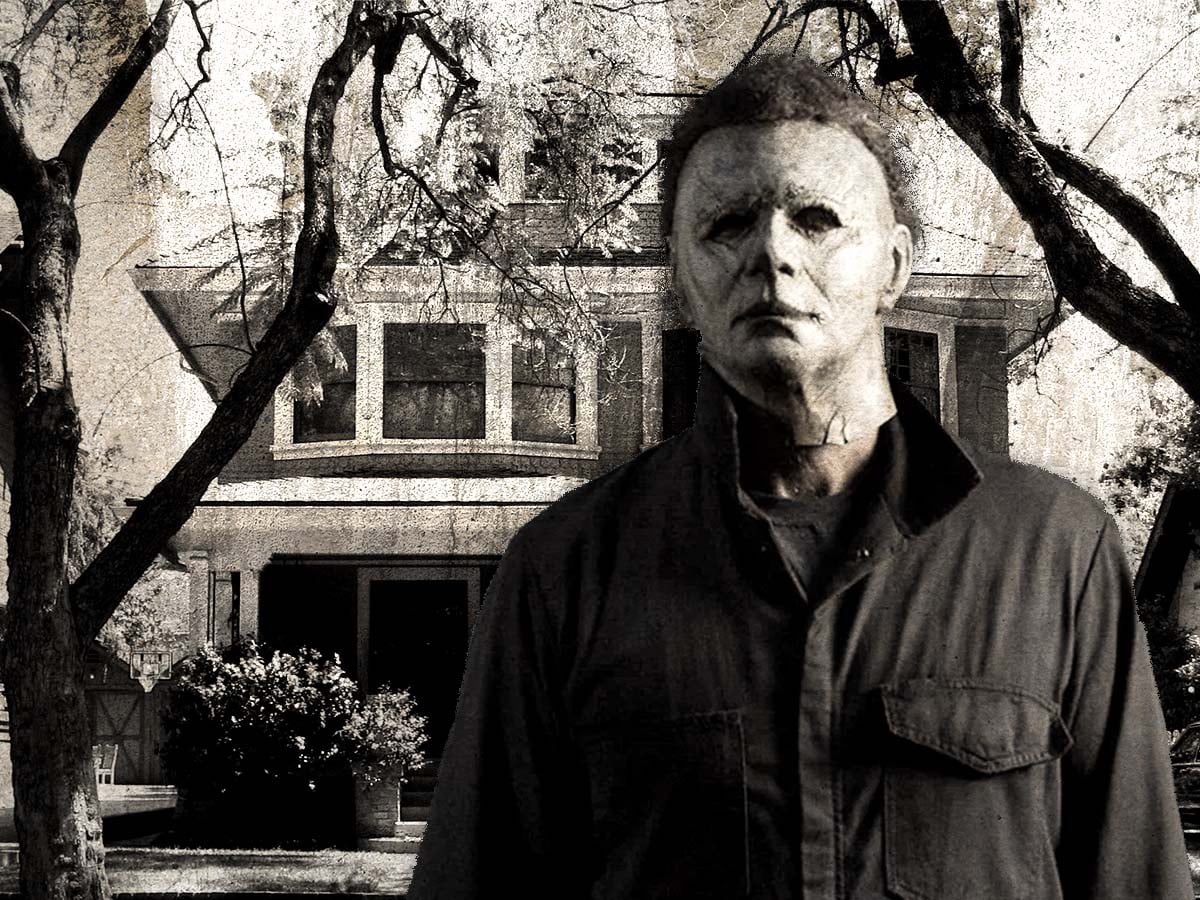
The film’s suburban setting aids this unsettling atmosphere, instilling real fear into the viewer, with Carpenter suggesting that evil can lurk anywhere. People might settle in quiet, white-picket-fenced neighbourhoods, believing these areas to be a safer alternative to crime-laden cities, but the director reminds us that this isn’t always the case. Michael has been evil since he was a kid, raised in a quiet suburb – he is living proof that evil has no bounds.
Carpenter’s soundtrack is also an unforgettable part of the film, his repetitive piano melody creating yet another layer of unease for the viewer. The sound becomes synonymous with danger, heightening our attention as the killer comes into view, signalling that another brutal kill is about to occur. Michael’s kills are intense, whether he’s pinning Bob to the wall with a knife and letting his feet dangle or strangling Lynda with a phone cord while she calls Laurie. Carpenter’s film never slides into complacency; instead, we are constantly left wondering whether Laurie will end up dead or alive.
Laurie’s defiant nature is another excellent aspect of Halloween. She is never depicted as a helpless victim, as many female horror targets were at this time. Rather, she fights back, injuring Michael in the process, almost killing him. Although some critics have pointed out that Laurie is saved by a man, Dr Loomis, who shoots Michael, ultimately, Loomis’ efforts are equally as unsuccessful as Laurie’s because the killer eventually escapes from them both. Against the stronger, unrelenting Michael, Laurie does an excellent job of defending herself, even leaving him with permanent eye damage.
This is not to say that Halloween is a flawless film. There are multiple scenes of exploitative female nudity that feel unnecessarily catered towards the male gaze, as best evidenced in the opening sequence, when Judith is killed naked, letting out borderline pornographic yelps as she dies. The acting is unashamedly amateur, which is certainly a dealbreaker for some viewers, although some might argue that this gives the film a greater sense of verisimilitude.
In spite of this, Halloween is a quintessential example of stellar independent filmmaking, and the movie’s rough-around-the-edges quality only adds to its cult appeal. It has none of the clinical nature a big-budget studio production offers, making it considerably scarier. By forcing the audience to consider the potential for evil to infiltrate safe, suburban lives, Halloween shakes us from the comfort of our homes, leaving us perpetually on edge for its entire runtime.
